Artwork
Mercury and Argus
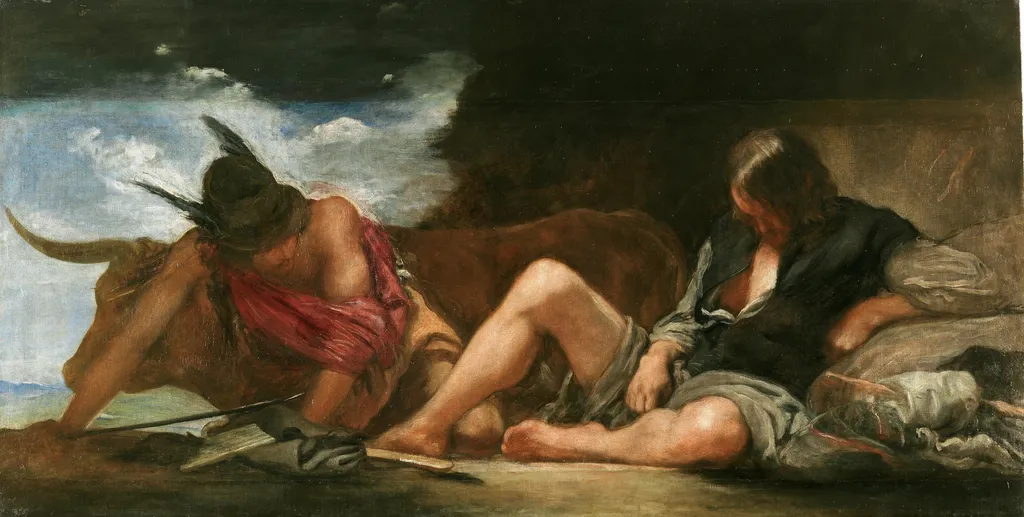
Mercury and Argus is an oil painting by the Baroque artist Diego Velázquez. It dates from 1659 and is held in the collection of the Museo del Prado.
About this work
Subject & Meaning
While the myth describes Argus as having eyes that never all close simultaneously, the painting depicts him as a mortal with only two eyes, deeply slumbering.
Velázquez illustrates a specific moment from Ovid's Metamorphoses where Mercury, sent by Jupiter to rescue Io, uses music to lull the hundred-eyed giant Argus to sleep. While the myth describes Argus as having eyes that never all close simultaneously, the painting depicts him as a mortal with only two eyes, deeply slumbering. This humanization extends to Mercury, who is portrayed not as a heroic warrior brandishing a sword, but as a cunning assassin creeping cautiously through shadows to strike.
The work emphasizes a meditation on vision and its absence, culminating in the giant's blindness before his death. Velázquez retains classical attributes to ensure narrative clarity, such as Mercury's winged hat and the pan flute laid aside in favor of a blade. By reducing the landscape to a minimal twilight opening between rocks, the artist focuses attention on the quiet, unheroic tension of the impending murder rather than dramatic action.
Technique & Style
The painting is executed in oil on canvas, a medium typical of Baroque easel painting. Velázquez rendered Mercury and Argus with a restrained palette and subtle chiaroscuro that emphasizes the figures' physicality and the narrative tension; Mercury is depicted as a cunning assassin cloaked in shadow, while Argus appears as a weary, half‑sleeping giant, his multiple eyes suggested only by faint anatomical cues. The composition is landscape format, with the figures stretched horizontally across the canvas, a format that required a less heroic treatment than Rubens' more dynamic rendering.
Formal qualities include a muted background of rocks and twilight sky, delicate handling of drapery, and an emphasis on tactile surfaces such as the red cloak and the simple pan‑flute held by Mercury. The work retains traces of later expansions, particularly a 25.5 cm band added to the upper edge, reflecting its history of alteration after the fire of the Buen Retiro palace.
History & Provenance
Painted by Diego Velázquez in 1659, Mercury and Argus was created as one of the artist's final works for the Hall of Mirrors in the Alcázar of Madrid. Commissioned during Velázquez's role as superintendent of royal works, the canvas formed part of a series of mythological landscapes decorating the spaces between the windows, intended to please King Philip IV. The painting survived the 1734 fire that destroyed the Alcázar and was subsequently transferred to the Buen Retiro Palace, later moving to the New Palace.
An inventory from 1772 documents that the original canvas was enlarged by the addition of two strips, with a 25.5 cm band added to the top being particularly visible. The work entered the collection of the Museo del Prado in 1819 upon the museum's founding.
Diego Velázquez's Mercury and Argus is held in the Museo del Prado in Madrid, where it has resided since 1819. The work was originally created around 1659 for the Hall of Mirrors in the Alcázar of Madrid. It survived the 1734 fire that destroyed the palace, subsequently moving to the Buen Retiro Palace and later the New Palace.
An inventory from 1772 recorded the painting's transfer to the royal collection and noted that the canvas had been expanded by adding two strips, with a 25.5 cm addition at the top being particularly visible. The painting was one of four mythological works by Velázquez listed in the 1686 inventory of the Alcázar, which also mentioned three other canvases lost in the fire. In 1999, the work was exhibited alongside a version by Rubens in the exhibition Velázquez, Rubens and Van Dyck at the Museo del Prado.
Context
The painting Mercury and Argus was created by Diego Velázquez in 1659 as part of his decorative program for the Hall of Mirrors at the Alcázar of Madrid, a project tied to his role as court architect and interior designer beginning in 1643. It is one of four mythological works painted for the space, documented in the 1686 inventory of the royal collection and later relocated to the Museo del Prado after surviving the 1734 fire at the Palacio del Buen Retiro. The work depicts a moment from Ovid’s Metamorphoses in which Mercury lulls the hundred-eyed giant Argos to sleep to rescue the transformed Io, a scene Velázquez rendered with subdued heroism and naturalistic figures, contrasting with Rubens’ more dramatic interpretation.
Art historical analysis notes Velázquez’s use of classical models, such as Hellenistic sculptures like the Ludovisi Gaul and Michelangelo’s prophet Ezekias, to inform the poses of Mercury and Argos, reflecting broader Baroque engagements with antiquity. The composition’s landscape format and restrained spatial treatment underscore a contemplative rather than theatrical approach, aligning with scholarly observations of Velázquez’s late mythological paintings as meditations on vision and perception.
Legacy
Velázquez’s Mercury and Argus has been repeatedly cited in scholarship as a pivotal late work that reinterprets classical myth through a markedly un-heroic lens. Early comparative studies juxtaposing it with Rubens’s version, such as Julián Gállego’s 1990 analysis and Jonathan Brown’s 1999 survey in the Prado’s exhibition Velázquez, Rubens y Van Dyck, highlight how Velázquez strips the scene of grand rhetoric, presenting Mercury as a stealthy assassin rather than a heroic figure and reducing the landscape to a minimal backdrop. The painting’s survival of the 1734 Alcázar fire and its later transfer to the Prado in 1819 ensured its continued visibility, anchoring its legacy within the museum’s holdings.
Its deliberate deviation from Ovidian literalism and classical prototypes has framed it as a key example of Velázquez’s demystifying approach to mythological narrative.
Overview
Diego Velázquez’s oil on canvas, dated 1659, portrays a scene drawn from classical mythology. The work is part of the collection of the Museo del Prado in Madrid. It presents a compact, outdoor setting where two male figures occupy the foreground, framed by a partially visible bull’s head and a sky heavy with clouds.
Artist & collection
Artist
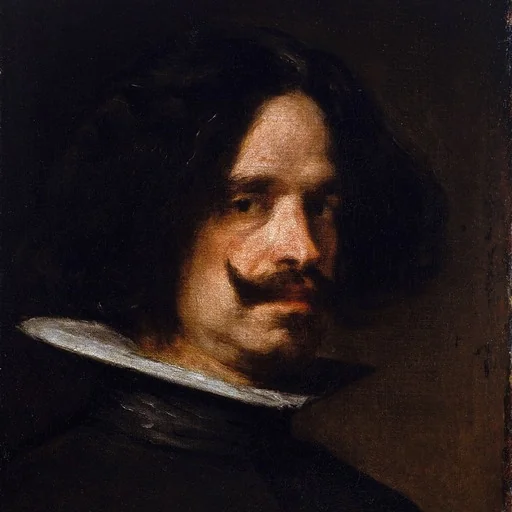
Diego Rodríguez de Silva y Velázquez was a Spanish Baroque painter, the leading artist in the court of King Philip IV of Spain and Portugal, and of the Spanish Golden Age.