Artwork
Saint John the Baptist in the Wilderness
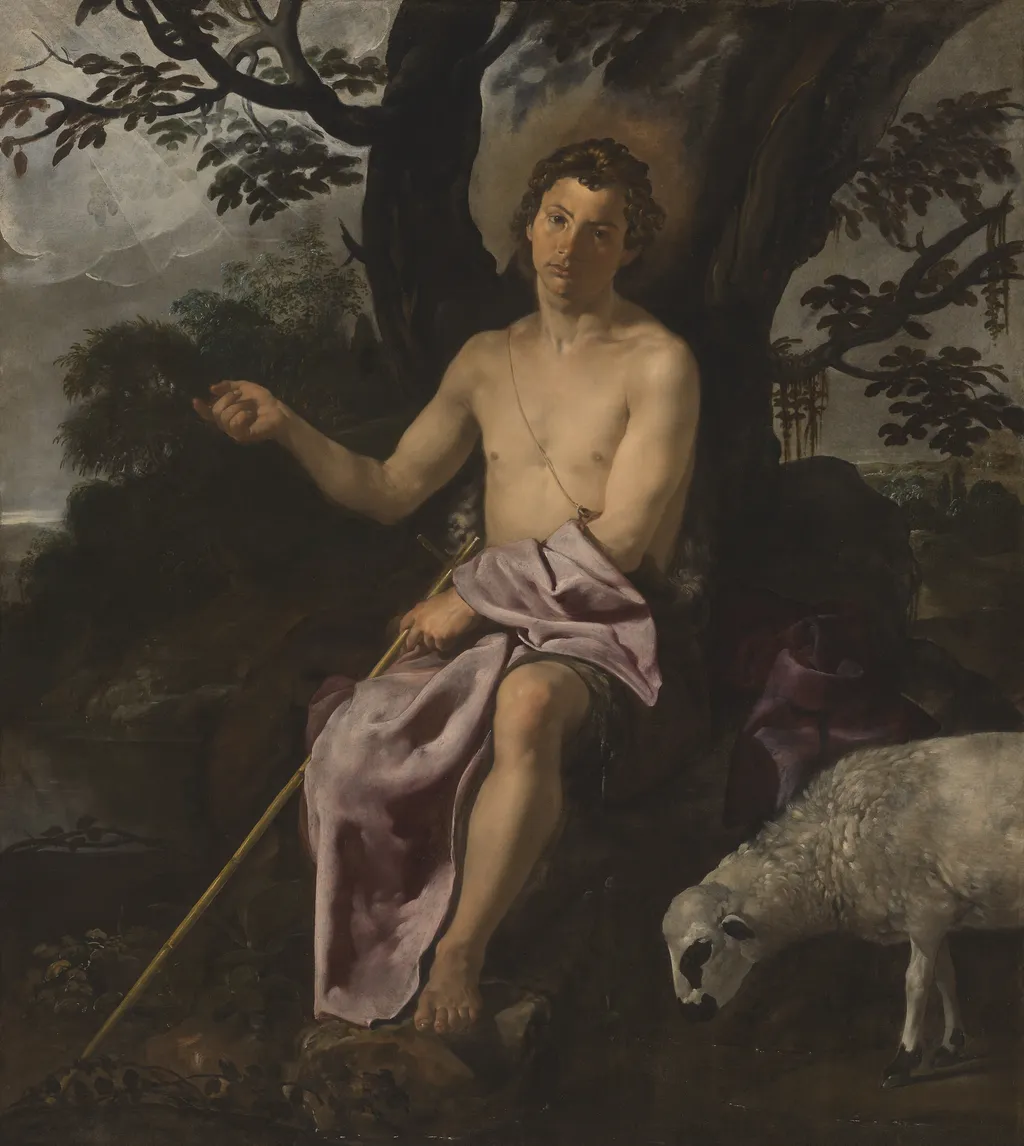
Saint John the Baptist in the Wilderness is an oil painting by the Spanish Baroque Tenebrist artist Diego Velázquez. It dates from 1618 and is held in the collection of the Art Institute of Chicago.
About this work
Overview
The work depicts the youthful saint seated in a wooded landscape, nearly nude save for a mauve-pink drapery across his lap, with a sheep grazing nearby.
Saint John the Baptist in the Wilderness is an oil painting attributed to Diego Velázquez, dated to 1618, and held at the Art Institute of Chicago. The work depicts the youthful saint seated in a wooded landscape, nearly nude save for a mauve-pink drapery across his lap, with a sheep grazing nearby. Despite its traditional attribution to Velázquez, the painting's authorship has been contested since 1960, and it has been excluded from scholarly monographs and catalogues raisonnés since 1965. Its contested status, combined with its technical affinities to Velázquez's Seville-period works, makes it a significant and unresolved case study in Spanish Baroque painting.
Subject & Meaning
The painting represents John the Baptist in the wilderness, a standard subject in Christian art depicting the saint's retreat into nature before his public ministry. The figure wears a thin cord or chain across his chest, likely alluding to his ascetic life or possibly a reference to his future martyrdom. His right hand is raised with partially curled fingers, perhaps in a gesture of preaching or blessing, while his left hand holds a slender staff or reed that extends toward the lower left corner. The sheep grazing to his right carries dual significance: it refers to John's proclamation of Christ as the Lamb of God, and it reinforces the pastoral setting of his wilderness sojourn. A faint halo behind the figure's head confirms his sanctity. The direct gaze of the figure establishes a confrontational relationship with the viewer, characteristic of Counter-Reformation devotional imagery that sought to engage the faithful personally.
Technique & Style
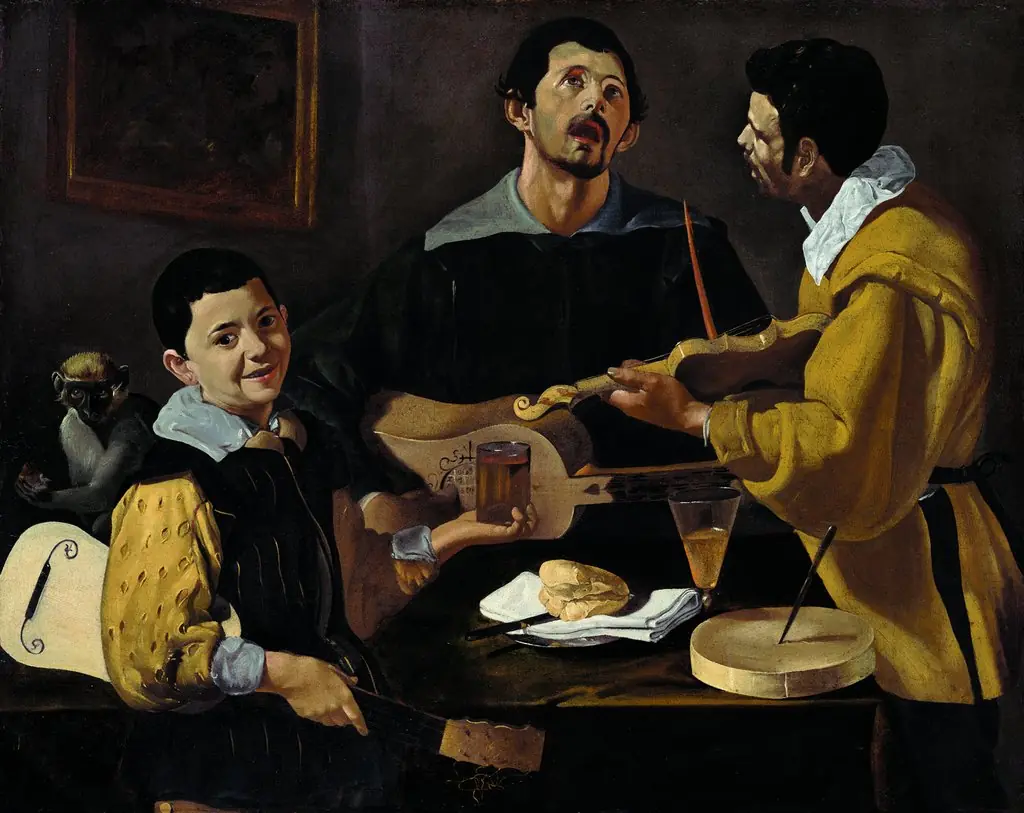
The painting is executed in oil on canvas. The surface exhibits smooth brushwork in the flesh tones, contrasting with more textured handling in the foliage and the sheep's wool. Strong directional light falls from the upper left, creating pronounced shadows against the dark background and modeling the figure's pale skin against deep browns and greens. The composition is organized around a large tree trunk that divides the pictorial space, with dense dark foliage above and to the sides, while misty gray-green trees and distant hills recede under a pale sky. The palette relies on the contrast between the figure's pale flesh, the mauve-pink drapery, and the surrounding darkness. Technical analyses conducted at the Art Institute of Chicago have yielded results similar to those of Velázquez's Seville-period works, though scholars have noted both significant differences and meaningful affinities with authenticated paintings such as The Adoration of the Magi and The Drinkers.
History & Provenance
The painting was donated to the Art Institute of Chicago in 1957 by the American collector Barbara Deering Danielson. Until 1961, it was catalogued as an authentic work by Velázquez. However, beginning in 1960, its attribution was questioned, and from 1965 onward it was excluded from monographs and catalogues raisonnés on Velázquez, including those by Jonathan Brown and José López-Rey. From 1990, it was attributed instead to an unknown Seville master. In 2007, the painting was exhibited at the Museo del Prado in Madrid as part of the exhibition Fábulas de Velázquez, where Javier Portús Pérez, curator of Spanish painting at the Prado and a specialist in Velázquez's work, studied it in situ. Portús has defended the attribution to Velázquez, rejecting the alternative theory that the Andalusian painter Alonso Cano was partially responsible, and arguing that technical analyses support Velázquez's authorship.
Context
The contested attribution of Saint John the Baptist in the Wilderness reflects broader challenges in the study of Velázquez's early Seville period, when the young artist was establishing his workshop and developing his mature style. The exclusion of the painting from standard reference works since 1965 illustrates the conservative tendencies of Velázquez scholarship, which has often prioritized secure attributions over contested works. Javier Portús Pérez's intervention represents a significant counter-current, one that relies on technical analysis and close visual comparison rather than inherited scholarly consensus. Portús's comparison of the painting to The Adoration of the Magies and his suggestion that its relationship to The Drinkers may prove illuminating point toward the interconnected nature of Velázquez's early religious and genre compositions. The painting's presence in the Art Institute of Chicago, rather than in a Spanish collection, also speaks to the international dispersal of Spanish Baroque painting in the twentieth century.
Legacy
Saint John the Baptist in the Wilderness occupies an ambiguous position in Velázquez's legacy: excluded from the canonical corpus for over half a century, yet periodically revisited by scholars who find its technical and stylistic qualities difficult to dismiss. The 2007 Prado exhibition Fábulas de Velázquez provided a significant platform for reconsideration, with Portús's in situ study offering the most sustained defense of its authenticity since its deattribution. The painting's unresolved status makes it a touchstone for debates about attribution methodology, the role of technical analysis in connoisseurship, and the boundaries of an artist's oeuvre. For the Art Institute of Chicago, it remains a work of substantial art historical interest, embodying the complexities of Spanish Golden Age painting even as its authorship remains, in nuanced terms, complex and for the time being unsolvable.
Own this work as a print
Artist & collection
Artist
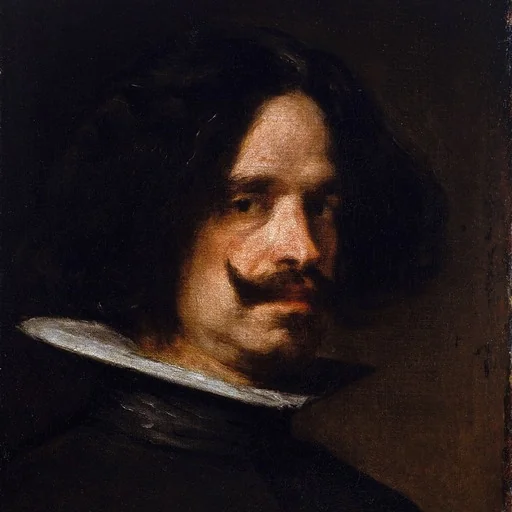
Diego Rodríguez de Silva y Velázquez was a Spanish Baroque painter, the leading artist in the court of King Philip IV of Spain and Portugal, and of the Spanish Golden Age.