Artwork
Old Woman Cooking Eggs
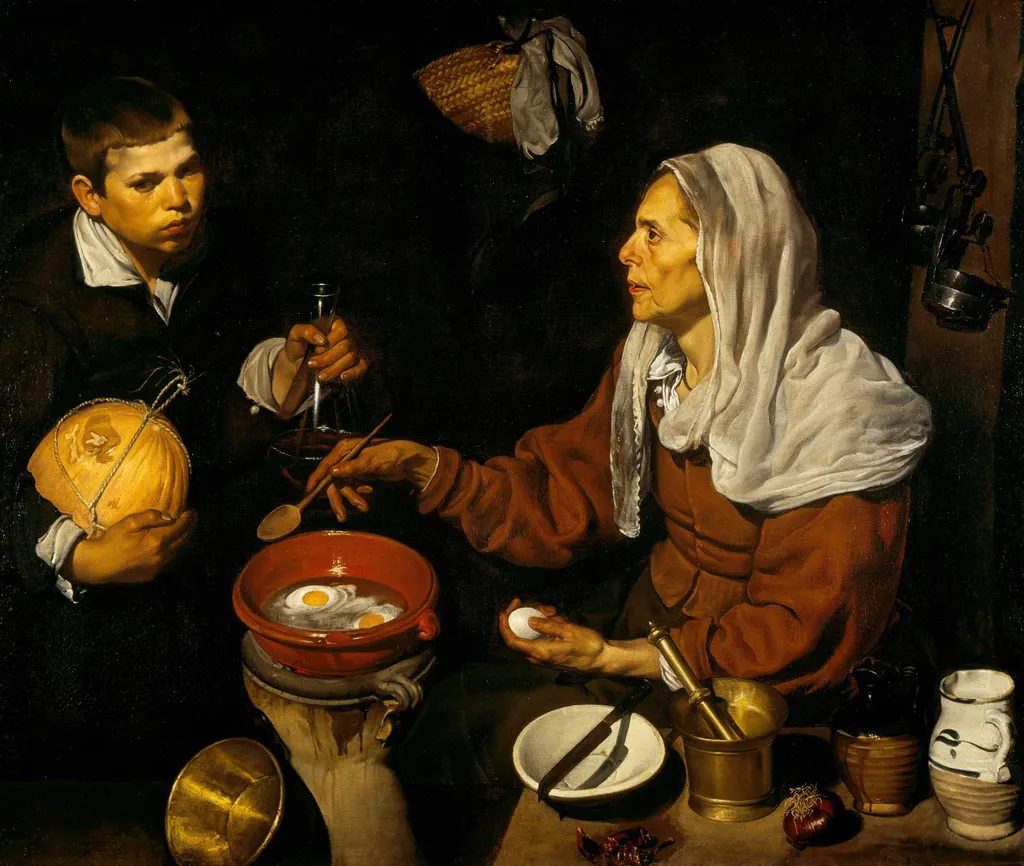
Old Woman Cooking Eggs is an oil painting by the Early Baroque Italian artist Diego Velázquez. It dates from 1618 and is held in the collection of the National Galleries Scotland.
About this work
Subject & Meaning
The painting’s meaning lies in its dignified portrayal of everyday labor, capturing both the physical act and the quiet mystery of the subjects’ gazes.
The painting depicts an elderly woman engaged in the act of cooking eggs, a humble domestic activity that Velázquez elevates through careful observation and composition. The scene is rendered with strong chiaroscuro, using a single light source from the left to illuminate the woman, her utensils, and the eggs, while the background recedes into shadow. Subtle hues of ochre and brown dominate the palette, and the composition forms an oval, drawing the viewer into the near plane where the figures and objects reside. The work reflects Velázquez's early interest in genre scenes and still lifes, often employing working‑class subjects and family members as models. Objects such as a wooden spoon, a ceramic jar, and a bronze pot are rendered with meticulous attention to texture and light, emphasizing the transient moment of cooking. The painting’s meaning lies in its dignified portrayal of everyday labor, capturing both the physical act and the quiet mystery of the subjects’ gazes.
Technique & Style
Executed in oil on canvas in 1618, this work measures 100.5 by 119.5 cm. The painting is characterized by an intense chiaroscuro, with a strong light source entering from the left to illuminate the foreground figures and utensils against a deeply shadowed background. Velázquez employs a palette dominated by ochres and browns, utilizing subtle hues to render diverse textures, from the opacity of cooking egg whites to the reflective surfaces of bronze and ceramic vessels.
The composition is organized as an oval, drawing the viewer into the immediate plane through an elevated viewpoint. While the individual objects are rendered with remarkable singularity, the work exhibits minor perspective inconsistencies and shadow incongruities. Despite these technical anomalies, the handling of light creates a sense of stillness, treating the working-class subjects with a severe dignity rather than as caricatures.
History & Provenance
Painted in 1618 during Diego Velázquez's Seville period, *Old Woman Cooking Eggs* dates to the year following the artist's examination as a painter. The work was first documented in 1698 within the inventory of Nicolás de Omazur, a Flemish merchant in Seville, who described a canvas depicting an old woman frying eggs and a boy holding a melon. By the early 19th century, the painting had reached England, entering the collection of John Woollett before being auctioned at Christie's in London on May 8, 1813. Although Charles B. Curtis formally attributed the piece to Velázquez in 1883, the date of 1618 was only revealed in the lower right corner during a cleaning in 1957. The painting entered the Scottish National Gallery in 1955, having been acquired from the heirs of Sir Francis Cook for £57,000 with assistance from the Art Fund and a Treasury Grant. The painting is held by the Scottish National Gallery in Edinburgh, part of the National Galleries of Scotland. Its accession number is NG 2180. The work was purchased in 1955, with assistance from the Art Fund and a Treasury Grant, having been acquired from the heirs of Sir Francis Cook for £57,000. The painting's documented provenance begins with a 1698 inventory of the Flemish merchant Nicolás de Omazur in Seville. By the early nineteenth century it had reached England, appearing in the collection of John Woollett, which was auctioned at Christie's, London, on 8 May 1813. After passing through several British collections, it was first attributed to Velázquez by Charles B. Curtis in 1883. During cleaning at the Scottish National Gallery in 1957, the date 1618 became visible in the lower right corner. The painting's recorded exhibition history includes the Rembrandt, Velázquez exhibition.
Context
Old Woman Cooking Eggs is regarded as one of the strongest works from Velázquez's early Seville period, painted in 1618 shortly after he qualified as a master painter. The painting is frequently cited as a touchstone of the Spanish bodegón tradition as defined by his father-in-law Francisco Pacheco, who praised such kitchen scenes as estimable when handled by Velázquez. Its intense chiaroscuro has prompted comparisons with Caravaggio, though critics such as Julián Gállego have stressed the painting's disquieting stillness, finding parallels instead in the French painters Louis Le Nain and Georges de La Tour. The reappearance of the old woman as a model in Christ in the House of Martha and Mary (1618) has reinforced the work's importance within Velázquez's early oeuvre. Jonathan Brown has argued that Velázquez treats his figures with the same detached objectivity as his still-life objects, while the painting's optical subtlety, particularly in capturing the transition of egg whites from transparency to opacity, has been read as evidence of his interest in fleeting, transient effects. The work was included in the Rembrandt, Velázquez exhibition.
Own this work as a print
Artist & collection
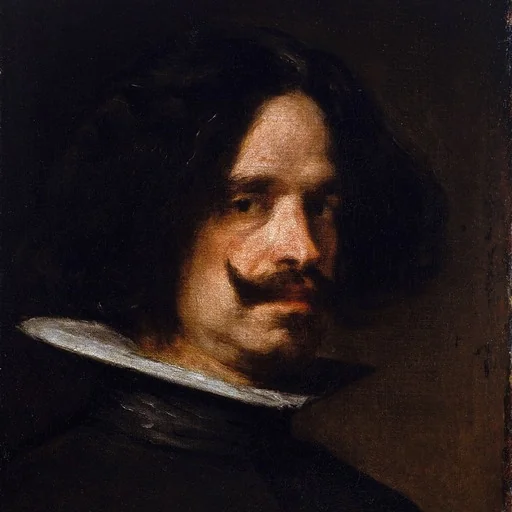
Artist
Diego Rodríguez de Silva y Velázquez was a Spanish Baroque painter, the leading artist in the court of King Philip IV of Spain and Portugal, and of the Spanish Golden Age.