Artwork
Saint John the Baptist and Saint John the Evangelist
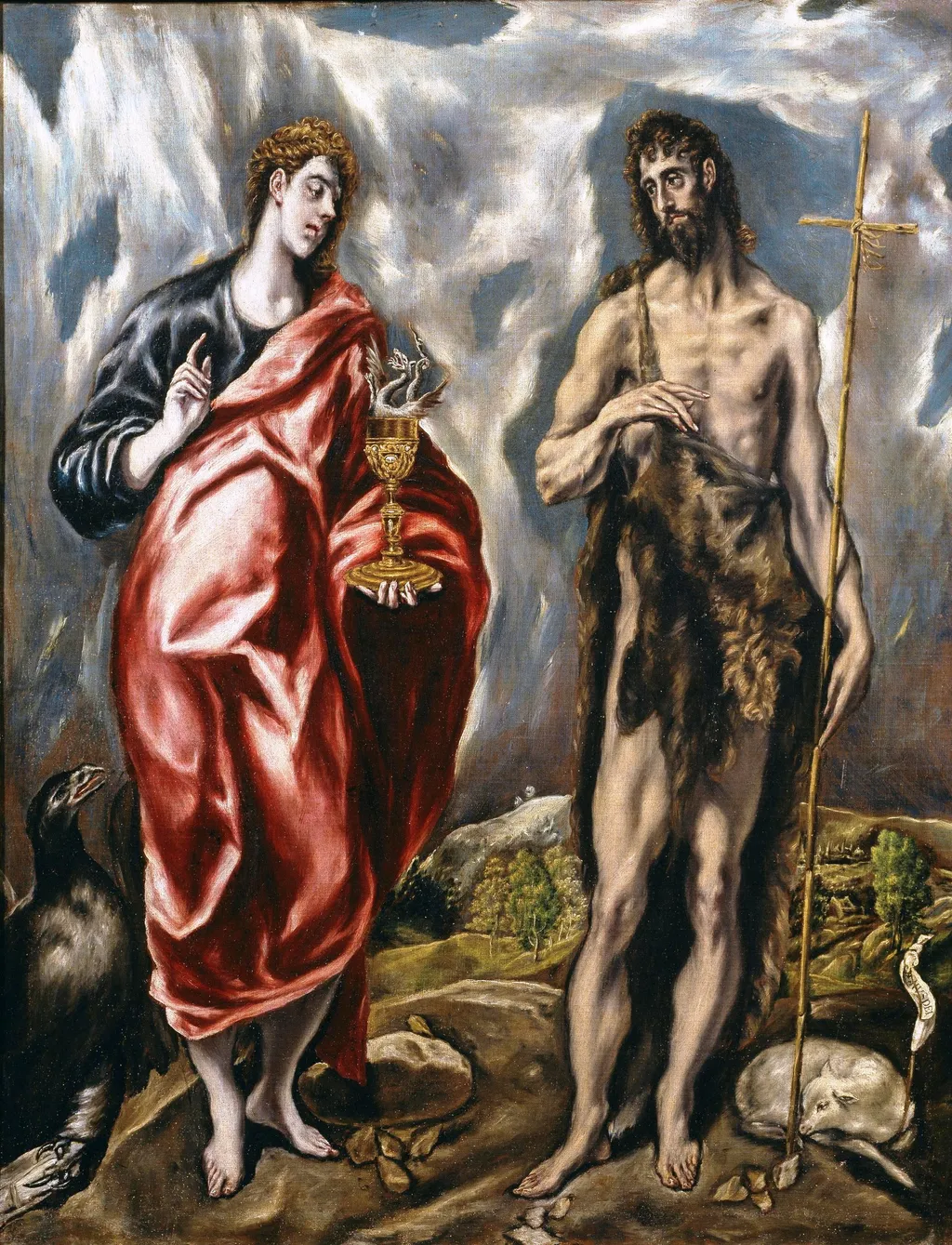
Saint John the Baptist and Saint John the Evangelist is an oil painting by the Mannerist artist El Greco. It dates from 1600 and is held in the collection of the Museo del Prado.
About this work
Subject & Meaning
The rocky landscape and stormy sky frame the figures, their heads wreathed in nimbus-like light, reinforcing their sanctity.
The pairing of Saint John the Baptist and Saint John the Evangelist departs from narrative or doctrinal necessity and instead reflects a private commission, as was sometimes practiced during the Counter-Reformation without ecclesiastical objection. The Baptist is shown with the camel-skin garment and a thin staff topped by a cross, while his right hand points to a lamb, the Agnus Dei, identified by the inscribed scroll he holds; this iconography underscores his role as the herald of Christ. The Evangelist appears as a youth in a rose mantle over a blue tunic, holding a chalice from which a dragon emerges, a visual reference to the legend of an attempted poisoning recounted in the Golden Legend.
Above him an eagle signifies the authorship of his Gospel. The rocky landscape and stormy sky frame the figures, their heads wreathed in nimbus-like light, reinforcing their sanctity. The composition emphasizes spiritual dialogue rather than historical episode, aligning with the period's preference for emblematic rather than strictly narrative presentation.
Technique & Style
The painting is executed in oil on canvas, measuring 110 × 86 cm. The figures are rendered with the elongated, attenuated proportions typical of El Greco's late style, their forms sharply defined against a stormy, blue-grey sky that functions almost as a nimbus around their heads. Behind them a rugged, hilly landscape culminates in a mountain, with a sketch-like building at the right evoking the Escorial. The dramatic lighting and restless, flame-like drapery underscore El Greco's late manner, aligning the work with his contemporaneous paintings such as the Saint John the Baptist at Malagón.
History & Provenance
Painted by El Greco around 1600, during his final Toledan period, this oil on canvas is the only known painting by the artist depicting these two saints together; the pairing lacks a direct New Testament narrative link and likely reflects a patron's specific commission. The painting hung in the Church of San Ildefonso in Toledo until 1956, was then deposited in the Museo de San Vicente (1956–1961) and subsequently the Museo de Santa Cruz (from 1961). The Spanish State acquired it for the Museo del Prado in 1998, where it is catalogued under number P007724 while remaining on deposit at the Museo de Santa Cruz in Toledo.
The inventory of the artist's son, Jorge Manuel Theotocópuli, records a larger canvas of the same subject, previously held in the palace of the Marqués de Villena.
Context
Painted around 1600 during El Greco's final Toledan period, Saint John the Baptist and Saint John the Evangelist belongs to a recurring format in his output: the "paired saints" ("santos aparejados") composition. According to Spanish-language scholarship, certain pairings, such as his versions of Saints Peter and Paul, illustrate a New Testament episode or doctrinal point, while others, including this canvas, unite two saints arbitrarily, likely at the request of a patron, an arrangement tolerated by Counter-Reformation authorities. The painting is catalogued as no. 252 in Harold Wethey's catalogue of El Greco's oeuvre and as no. 150 in Tiziana Frati's monograph, and is discussed in José Gudiol's monograph and in José Álvarez Lopera's 2014 study of the artist.
The composition closely reworks the figure of the Baptist and the rocky landscape from El Greco's Saint John the Baptist at Malagón, differing chiefly in the placement of the Lamb.
Overview
This oil painting by El Greco, created around 1600, depicts two prominent figures from Christian theology: Saint John the Baptist and Saint John the Evangelist. The work showcases the artist's distinctive style through its portrayal of these saints in a dramatic outdoor setting. Currently, the painting is part of the collection at the Museo del Prado.
Own this work as a print
Artist & collection
Artist
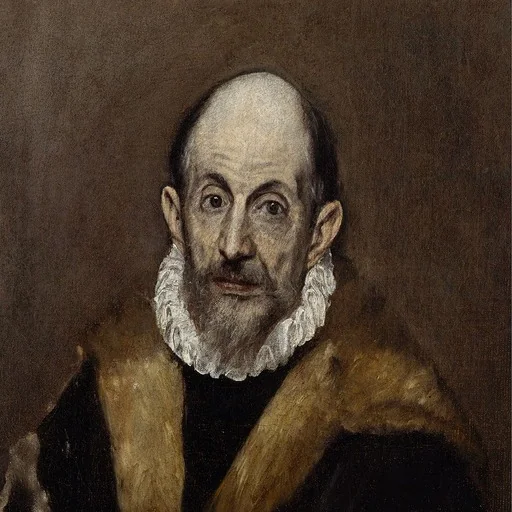
Doménikos Theotokópoulos was born in 1541 in Candia (modern Heraklion), the capital of Venetian-ruled Crete, where he was trained in the post-Byzantine tradition of icon painting.

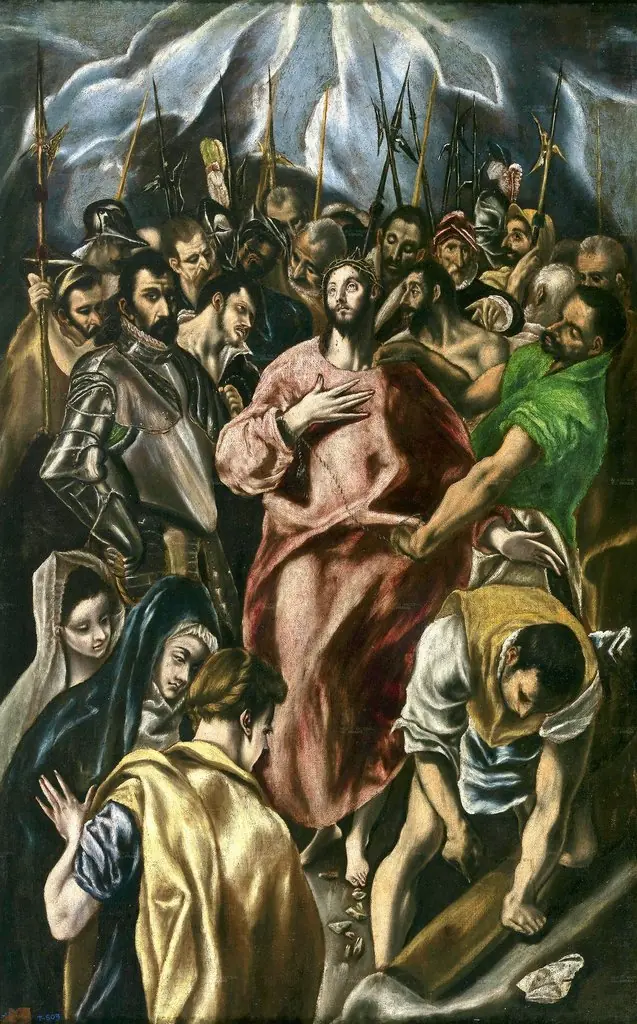 Disrobing of Christ (by J.M.Theotocópuli)
 Saint John the Baptist
 Saint John the Baptist
 Saint John the Baptist
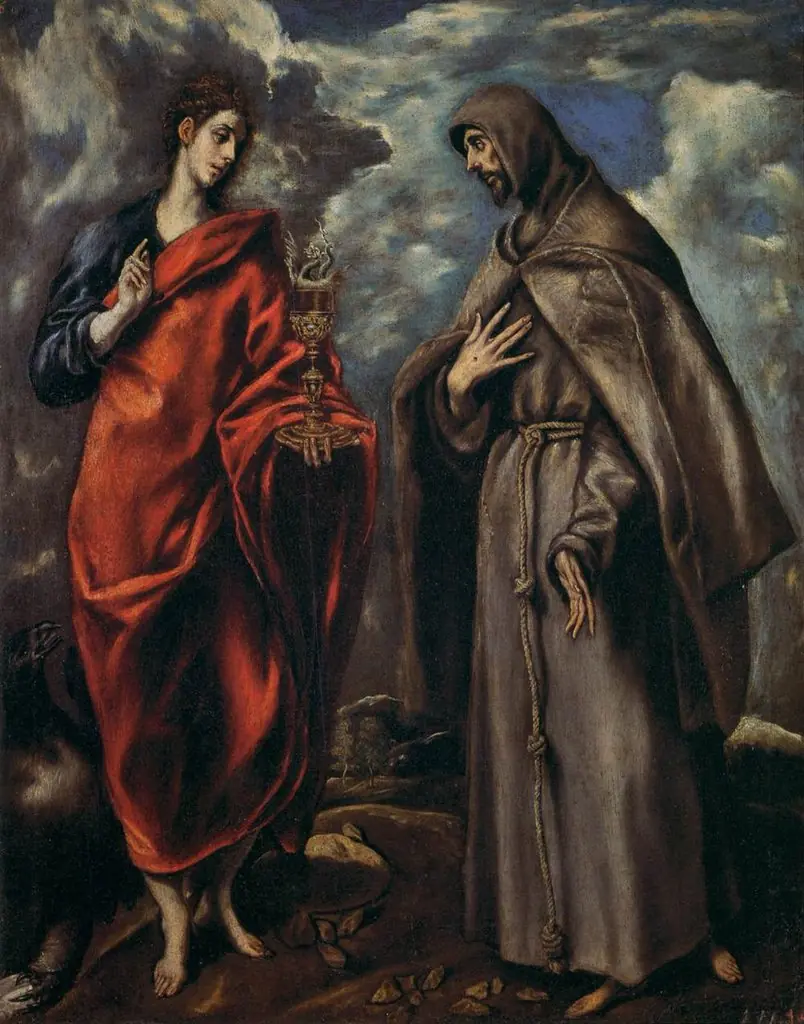
 Saint John the Evangelist and Saint Francis of Assisi
 Saint John the Baptist and Saint Francis of Assisi
 Christ Holding the Cross
 Saint John the Baptist in the Wilderness
 St John the Evangelist
 The Baptism of Christ
 Baptism of Christ
- Saint John the Evangelist and Saint Francis