Artwork
The Holy Family with Mary Magdalen
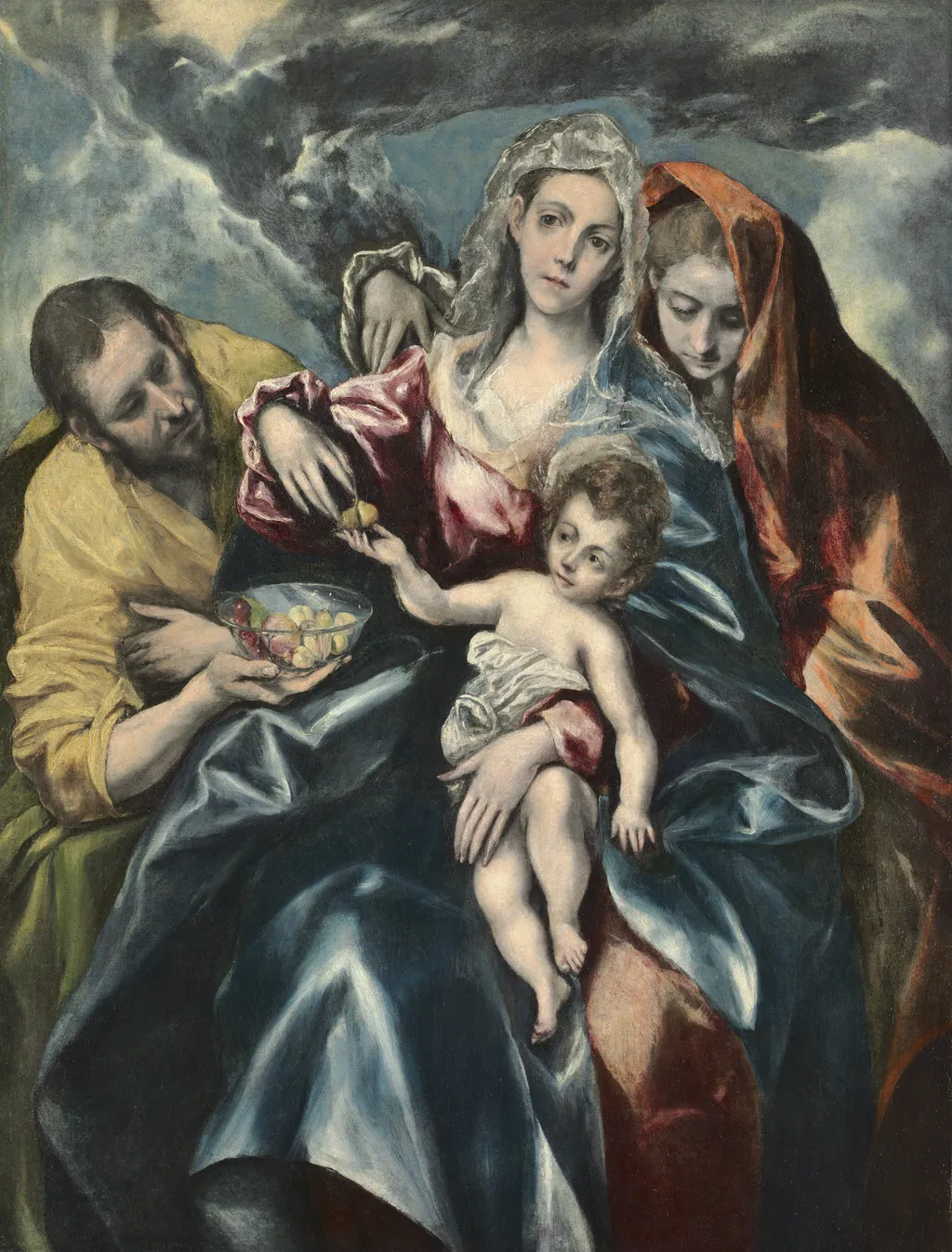
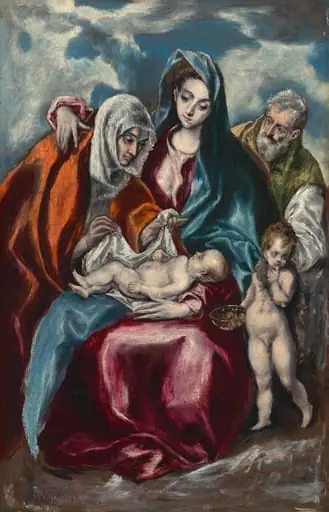
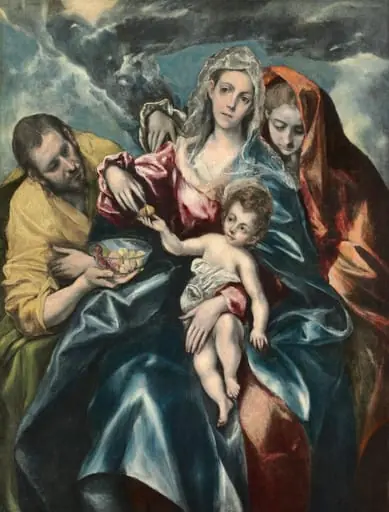
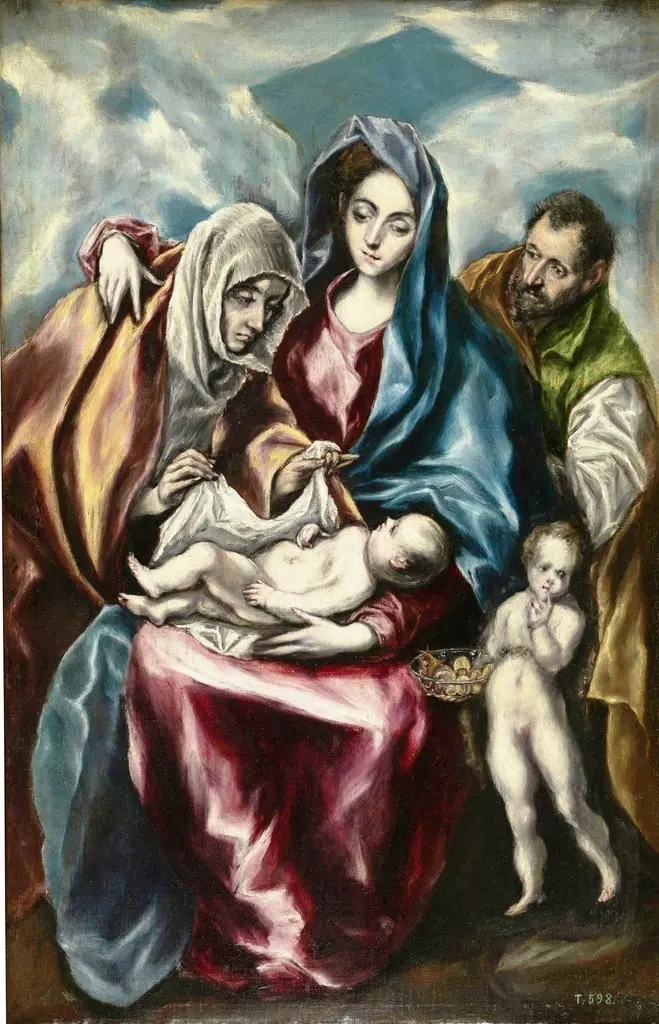
The Holy Family with Mary Magdalen is an oil painting by the Mannerist artist El Greco. It dates from 1596 and is held in the collection of the Cleveland Museum of Art.
About this work
Subject & Meaning
The Holy Family with Mary Magdalen depicts the Virgin Mary, the Christ Child, Saint Joseph, and Mary Magdalene grouped together in an intimate devotional scene.
The Holy Family with Mary Magdalen depicts the Virgin Mary, the Christ Child, Saint Joseph, and Mary Magdalene grouped together in an intimate devotional scene. The episode does not appear in the canonical Gospels but was devised to engage popular sentiment in a manner consistent with Counter-Reformation sensibilities. The composition derives from El Greco's earlier Holy Family compositions, but Saint Anne has been removed from the left side, replaced by Saint Joseph, while Mary Magdalene occupies the right side where Joseph previously stood.
The Christ Child is shown as a playful, laughing infant accepting fruit offered by his foster father. The Virgin's stylized face carries a melancholy that prefigures the Passion, while Mary Magdalene's graceful posture and complex expression contrast with the Virgin's serenity. Symbolism is concentrated in the glass bowl of fruit held by Joseph: the apple signifies the Fall of Adam, cherries the blood of Christ, peaches salvation, and pears the sweetness of Christ's virtues.
The brilliant color contrasts, sky-blue mantle of the Virgin, scarlet mantle of the Magdalene, and luminous yellow tunic of Joseph, reinforce the spiritual harmony of the group against a cloud-filled sky.
Technique & Style
Executed in oil on canvas, this work measures approximately 130 by 100 centimeters. The composition eliminates environmental details, restricting the background to a cloudy sky. Stylistically, the painting features bright, harmonious colors, notably contrasting the Virgin's blue mantle with Mary Magdalene's red garment and Saint Joseph's luminous yellow tunic.
Figures display distinct characteristics: the Virgin is highly stylized with a melancholic expression, while the Christ Child appears playful and laughing rather than naturalistic. Mary Magdalene is depicted with graceful posture and complex psychology, her scarlet cloak partially revealing chestnut hair. Although the canvas has undergone multiple restorations, its current condition is described as poor, particularly regarding the preservation of the figures' clothing.
History & Provenance
El Greco painted The Holy Family with Mary Magdalen circa 1590–1595 in Spain, an oil on canvas work measuring 132 × 100 cm. The painting was first recorded in the convent of Esquivias, Torrejón de Velasco, then passed to Juan Gutiérrez and later to the family of Torrejón de Velasco. It entered the collection of Vargas Machuca in Madrid before being sold to Stanislas O'Rossen in Paris in 1908. The work was subsequently owned by Marcell Nemes in Budapest (1913), then by Gentile di Giusepe in Paris, and was acquired by the Cleveland Museum of Art in 1926.
No documentary evidence identifies a specific patron or commissioning request. The dating rests on stylistic analysis and catalogues raisonnés placing it in the early 1590s.
The Holy Family with Mary Magdalen is held by the Cleveland Museum of Art, which acquired the painting in 1926. Its inventory number is 1926.247. The work is catalogued as number 86 in Harold Wethey's raisonné of El Greco, with reference 91-a in Tiziana Frati's catalogue.
Its documented provenance begins at the Convent of Esquivias in Torrejón de Velasco, passing through Juan Gutiérrez, then to Vargas Machuca in Madrid, before reaching Stanislas O'Rossen in Paris by 1908 and Marcell Nemes in Budapest by 1913, and subsequently Federico Gentili Di Giuseppe in Paris. The painting was exhibited publicly in Paris at the Grand Palais exhibition devoted to El Greco, running from 16 October 2019 to 10 February 2020.
Context
The Holy Family with Mary Magdalen (c. 1590–1595; Cleveland Museum of Art) is recognized as the third and final type in El Greco’s evolving treatment of the Holy Family, catalogued by Harold Wethey as no. 86. Its iconography, absent from canonical scripture, was cultivated during the Counter-Reformation to appeal to popular piety through heightened emotion and devotional clarity. Wethey’s catalogue identifies six studio copies, including a notable version at the Museo Soumaya, Mexico City, underscoring the composition’s influence within El Greco’s late Toledan circle.
The work entered European collections by 1908 and was acquired by the Cleveland Museum of Art in 1926, later appearing in the Grand Palais, Paris exhibition on El Greco (2019–2020). Scholars such as José Álvarez Lopera and José Gudiol situate the painting within El Greco’s mature Mannerist phase, emphasizing its stylized figures, luminous palette, and psychological nuance, particularly the Virgin’s melancholy prefiguring the Passion and Mary Magdalene’s complex, contrasting presence.
Legacy
Recognized as the prototype for Type III of El Greco's Holy Family series, the work holds a specific place in the artist's catalog raisonné as number 86 in Harold Wethey's classification. Its legacy includes the existence of six known workshop copies, with the version held by the Museo Soumaya in Mexico distinguished as particularly significant among them. The painting's reputation was reinforced by its inclusion in the major El Greco exhibition at the Grand Palais in Paris during 2020.
Art historical analysis highlights its unique iconography, which departs from canonical gospels to reflect Counter-Reformation sensibilities, a characteristic that has sustained scholarly interest. Despite noted conservation issues regarding the garments, the work remains a key reference for understanding the evolution of El Greco's treatment of the Holy Family theme, influencing the categorization of his subsequent variations on the subject.
Overview
The Holy Family with Mary Magdalen is an oil painting created by El Greco in 1596. This religious work, characteristic of the Mannerist movement, is currently housed at The Cleveland Museum of Art. It presents a gathering of sacred figures, rendered with the artist's distinctive approach to form and color, offering a contemplative scene to the viewer.
Own this work as a print
Artist & collection
Artist
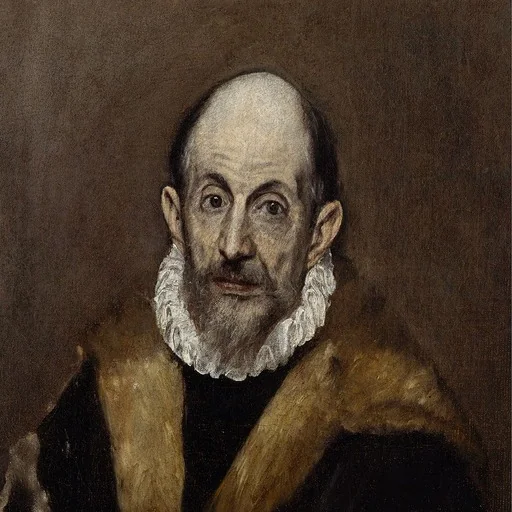
Doménikos Theotokópoulos was born in 1541 in Candia (modern Heraklion), the capital of Venetian-ruled Crete, where he was trained in the post-Byzantine tradition of icon painting.