Artwork
Valentine of Milan Mourning her Husband, the Duke of Orléans
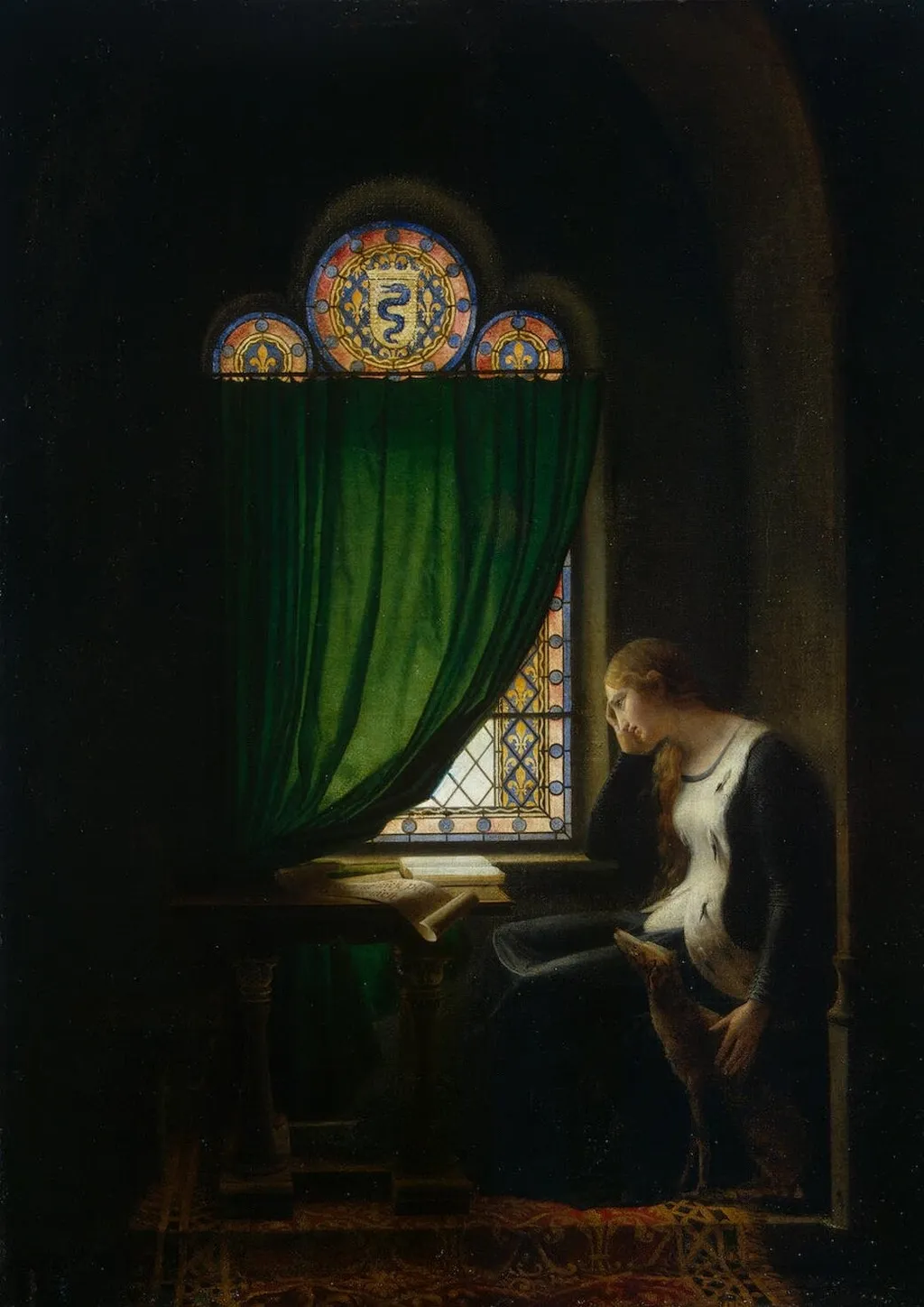
Valentine of Milan Mourning her Husband, the Duke of Orléans is an oil painting by the Neoclassicist artist François Fleury-Richard. It dates from 1802 and is held in the collection of the Hermitage Museum. Fleury François Richard’s 1802 oil painting portrays Valentina Visconti, Duchess of Orléans, in a moment of private grief.
About this work
Overview
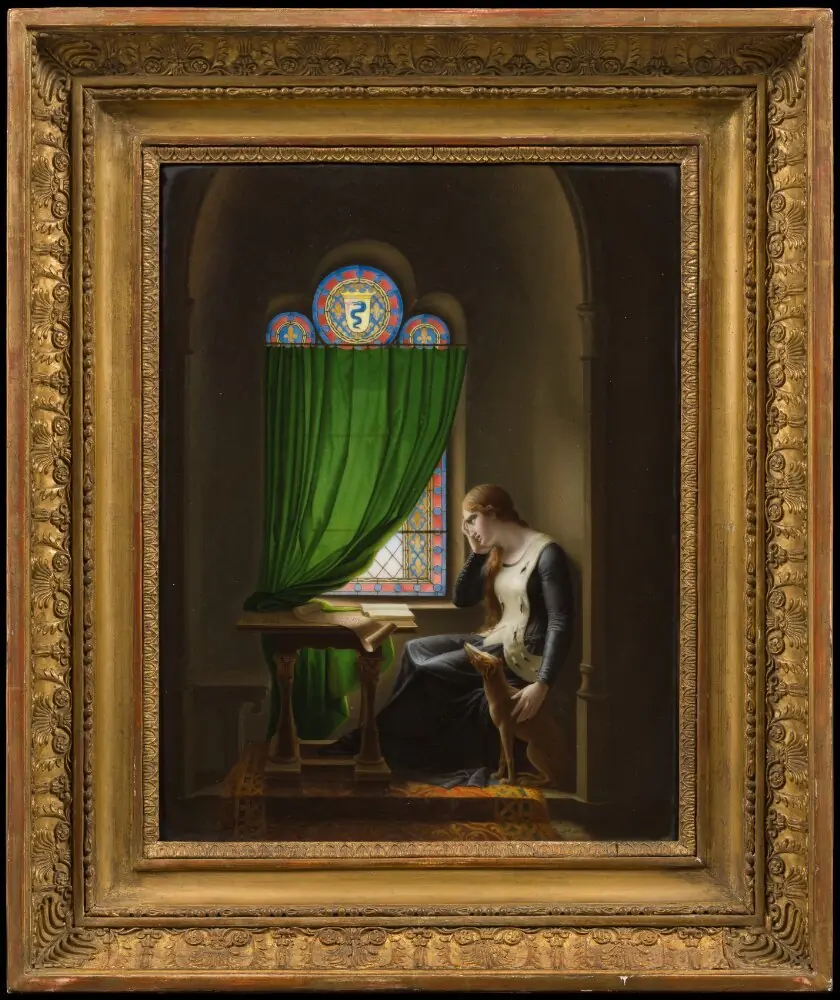
Valentine of Milan Mourning her Husband, the Duke of Orléans is an 1802 oil painting by French artist François Fleury-Richard, now held in the Hermitage Museum in Saint Petersburg. Measuring 55.1 by 43.2 centimetres, the work is widely regarded as one of the earliest examples of the Troubadour style, a genre of Romantic painting that flourished in early nineteenth-century France and looked back to the medieval past with nostalgic precision. Exhibited at the Salon of 1802 in Paris, the painting marked a decisive break from academic convention and established the direction of Richard's subsequent career.
Subject & Meaning
The sitter rests her head on her right hand while her left hand touches a small dog standing on its hind legs at her lap, a traditional symbol of fidelity.
The painting depicts Valentina Visconti, Duchess of Orléans, in mourning for her husband Louis I, Duke of Orléans, who was assassinated in 1407 during a power struggle at the French court. Richard drew inspiration from the tomb effigy of Valentine of Milan at the Musée des monuments français, and particularly from her motto: Rien ne m'est plus; Plus ne m'est rien (Nothing is more to me; Nothing is anything to me). Rather than adopting a demonstrative pose, Richard chose a melancholic, introspective presentation. The sitter rests her head on her right hand while her left hand touches a small dog standing on its hind legs at her lap, a traditional symbol of fidelity. She wears a white undergarment with a dark overdress. A green curtain hangs beside a tall window with stained glass in geometric and circular patterns of red, blue, and yellow. Light enters from the window, illuminating her face, hands, the dog, and open books on a carved wooden table, while the surrounding space remains deeply shadowed. A patterned carpet covers the floor. The green curtain serves a dual purpose: it contributes to the melancholic atmosphere and filters the light to create a particular transparency.
Technique & Style
The painting is executed in oil on canvas. Richard employed a smooth paint surface with fine detail in the glass and fabrics, contrasted with broader handling in the dark background. The composition is vertical, with the figure placed right of center, creating asymmetrical balance with the window's luminous colour on the left. For this work, Richard deliberately attenuated the light using a green veil, achieving a particular transparency through the use of Scheele's green. This technique was part of his broader exploration of pictorial methods to give accessories qualities that would contribute to the melancholy of the subject. The handling of light and colour, especially the green curtain, was noted by Jacques-Louis David, who praised the complete illusion it created. This approach represented a departure from academic conventions and helped define the emerging Troubadour aesthetic.
History & Provenance
The painting was exhibited at the Salon of 1802 in Paris, where it made a strong impression and enjoyed enormous public success. It may have been acquired by Armand Jean-Baptiste Maurin, director general of supplies for the seventeenth military division, as it appeared in the sale following his death in January 1805 in Paris. There, Empress Joséphine purchased it for 2,605 francs. It was inventoried in 1814 as number 1128 at the Château de Malmaison. After Joséphine's death, the painting's trajectory becomes uncertain. Two hypotheses exist: either it was sold to Tsar Alexander I in 1815, or it was given to Eugène de Beauharnais and sent to Munich in 1816. A Valentine de Milan was recorded at the Galerie Leuchtenberg in 1825, though whether this was the original or a copy remains unknown. The painting then disappeared for many years before reappearing in Russia in 1997. It was placed temporarily at the Pushkin Museum in Moscow in 1998, then purchased by the Hermitage Museum in 2000. Labels on the canvas confirm it is the same work exhibited at the Galerie Leuchtenberg in 1825, though it remains impossible to determine whether the present canvas is the original or an autograph replica commissioned by Eugène de Beauharnais. Richard also produced an unfinished copy, now preserved at the Château de Malmaison.
Context
The painting emerged during a period of personal difficulty for Richard, who later wrote that his sad and sorrowful state of mind influenced his choice of first subject. The work's creation also involved a pivotal encounter with Jacques-Louis David. Visiting Richard's studio, David offered only lukewarm praise for a work on Bonaparte, saying Ce n'est pas mal, but upon seeing the Valentine of Milan, he ex spluttered enthusiastic approval, declaring it resembled no one, was as new in effect as in colour, with a charming and expressive figure, and that the green curtain before the window made a complete illusion. David urged Richard to finish this work and pursue this genre. This endorsement marked Richard's break with academic style and the beginning of the Troubadour genre. The painting also addressed a completely novel subject, privileging melancholic introspection over dramatic display. Numerous sketches and preparatory studies survive in Richard's notebooks.
Legacy
As one of the earliest Troubadour paintings, Valentine of Milan Mourning her Husband, the Duke of Orléans occupies a foundational position in the history of Romantic art. The style would flourish throughout the early nineteenth century, feeding a broader European fascination with medieval history and nostalgic nationalism. The painting's success at the Salon of 1802 established Richard's reputation and helped validate the Troubadour approach. Under the Restoration, it was reproduced in large-scale engraving by Auguste Fauchery, extending its reach. The work has been featured in significant exhibitions, including as the opening painting of L'invention du passé. Histoires de cœur et d'épée en Europe, 1802-1850 in 2014, where it was contextualised through preparatory sketches. Other exhibitions include France in Russia: empress Josephine's Malmaison collection at Somerset House, London, in 2007, and L'Impératrice et ses peintres at the Musée national du château de Malmaison et Bois-Préau in 2003-2004.
Artist & collection
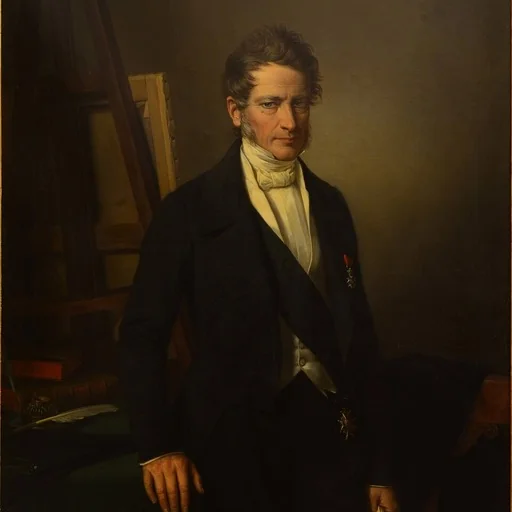
Artist
Fleury François Richard (25 February 1777, Lyon – 14 March 1852, Écully), sometimes called Fleury-Richard, was a French painter of the Lyon School.