Artwork
Agnus Dei
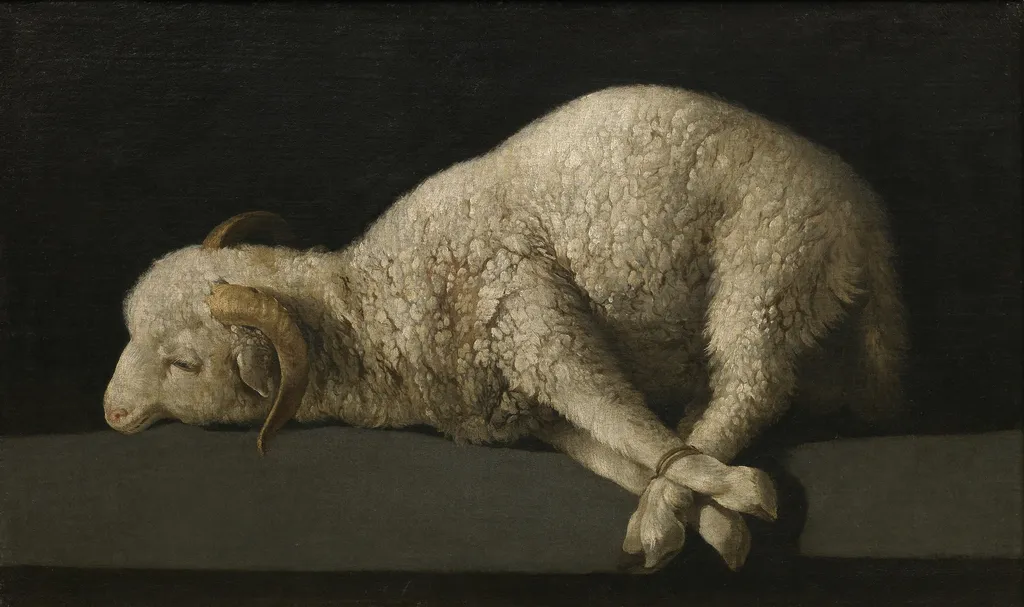
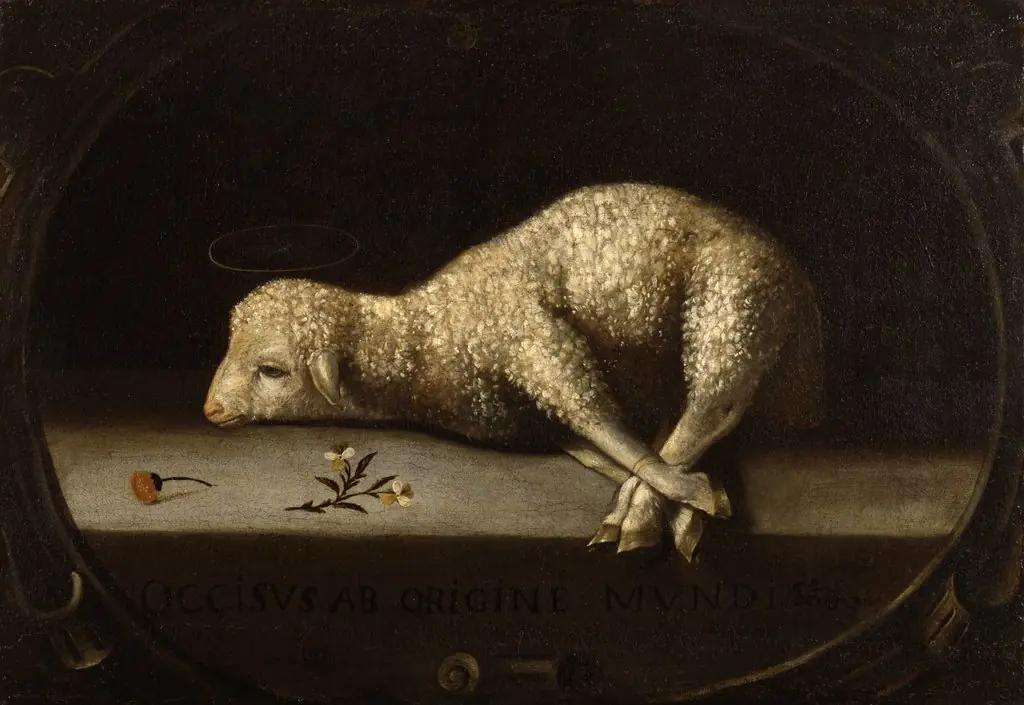
Agnus Dei is an oil painting by the Early Baroque Italian artist Francisco de Zurbarán. It dates from 1635 and is held in the collection of the Museo del Prado.
About this work
Agnus Dei is a painting by Francisco de Zurbarán. It's an oil painting completed between 1635 and 1640.
The title Agnus Dei refers to the Lamb of God, a title for Jesus from John's Gospel. This painting is housed in the Museo del Prado in Madrid, Spain.
To learn more about the style and techniques used in Agnus Dei, look up the technique of chiaroscuro.
Subject & Meaning
The subject depicted is a lamb with its legs bound, rendered with naturalistic precision.
The subject depicted is a lamb with its legs bound, rendered with naturalistic precision. In most versions the animal is shown without explicit religious attributes, relying instead on the long-standing liturgical identification of Christ as the Lamb of God (Agnus Dei), a title drawn from the Gospel of John (John 1:29).
Two variants include overt symbolism: the San Diego version shows a nimbus on the ram’s head and the inscription “TANQUAM AGNVS,” while the San Fernando version adds “IN OCCISIONE (M)” and depicts a shorn lamb ready for slaughter. A third, the Prado version, omits these markers yet remains legible within the tradition that a seventeenth-century Spanish viewer would have recognized the lamb as a direct reference to Christ’s sacrificial role.
Technique & Style
Francisco de Zurbarán executed the Agnus Dei in oil on canvas, a medium chosen for its capacity to render the work's highly naturalistic treatment. The Prado Museum version, widely considered the most accomplished, measures 38 cm in height by 62 cm in width. Zurbarán applied the paint with virtuoso brushstrokes that highlight the quality and simplicity of the lamb's corkscrew curls, creating an elegant and substantive composition characteristic of the Spanish Baroque.
The formal style emphasizes a stark, still-life arrangement where the tied legs of the animal are clearly depicted. While some versions include a nimbus or inscriptions to clarify the religious subject, the Prado iteration relies on the sheer technical mastery of the depiction and the symbolic association of the sacrificial lamb. Restoration efforts on related versions have previously revealed the work's true qualities after suffering from abrasive cleaning and oxidized varnishes.
History & Provenance
Francisco de Zurbarán created at least seven versions of the Agnus Dei subject between 1631 and 1640. The earliest dated example, signed in 1631, resides in a Swiss foundation, while a 1632 version signed by the artist is held in the Salvadó Plandiura collection in Barcelona. The most renowned iteration, located at the Museo del Prado in Madrid, lacks a signature but is dated by experts to the period between 1635 and 1640.
This specific canvas was acquired by the museum in 1986 and was previously owned by King Ferdinand VII, evidenced by a wax seal on its reverse. Other versions from this mid-1630s period include works in private Madrid collections and the San Diego Museum of Art, the latter of which was bequeathed by Anne R. and Amy Putnam. A further version, signed "F.Z. 1639," was purchased by the Real Academia de Bellas Artes de San Fernando in 1999 from a New York auction house.
The most celebrated version of Agnus Dei, dated between 1635 and 1640, is held in the permanent collection of the Museo del Prado in Madrid. Acquired by the museum in 1986 and assigned catalog number 105, the work bears a wax seal on its reverse indicating former ownership by Ferdinand VII. This specific painting was featured in the Rembrandt-Velázquez exhibition.
Other autograph versions reside in different institutions. A 1632 iteration, known as the Plandiura version, was exhibited as a guest work at the Bilbao Fine Arts Museum in 2004 and is held in the Salvadó Plandiura collection in Barcelona. Another variant, distinguished by a halo and the inscription "TANQUAM AGNUS," was bequeathed to The San Diego Museum of Art by Anne R. and Amy Putnam.
Additionally, a version signed and dated 1639 was acquired by the Real Academia de Bellas Artes de San Fernando from Sotheby's New York in 1999.
Context
Scholarly debate surrounds the classification of Zurbarán's multiple versions of this subject, with historian Odile Delenda arguing that works depicting horned rams without halos should be termed "rams with tied legs" rather than "Agnus Dei." Conversely, experts at the Museo del Prado maintain that the image's religious connotation as a symbol of Christ's sacrifice would have been inescapable to a seventeenth-century Spanish viewer, regardless of explicit iconography. The Prado version, acquired in 1986 and formerly owned by Ferdinand VII, is widely regarded as the most accomplished iteration, exemplifying the elegance and technical virtuosity of the Spanish Baroque.
The subject's enduring significance is evidenced by its inclusion in major exhibitions such as "Rembrandt-Velázquez" and its continued resonance in modern media.
Legacy
The Prado’s Agnus Dei has become emblematic of Zurbarán’s restrained naturalism and is repeatedly cited as the most successful iteration of his lamb-with-bound-legs motif. Its exhibition in the Prado’s permanent galleries since 1986 has anchored the work’s status as a touchstone of Spanish Baroque painting, and in 2004 the Plandiura version was highlighted as a guest loan at the Bilbao Fine Arts Museum after restoration, underscoring the motif’s continued resonance.
Modern adaptations extend the image’s reach: the Prado panel supplied the lamb’s trussed symbolism in Sarah Phelps’s BBC adaptations of Agatha Christie, appeared on the 2021 Dutch Bible’s cover, and inspired a whiter, hornless lamb in Ottessa Moshfegh’s 2022 novel Lapvona. The motif also migrated into game design, notably informing the ram on the card Sacrifice in the board game Dominion.
Overview
Francisco de Zurbarán’s oil painting titled Agnus Dei was executed in the mid‑1630s, most likely between 1635 and 1640. The work is part of the collection of the Museo del Prado in Madrid, where it remains on display as a representative example of Spanish Baroque religious art.
Artist & collection
Artist
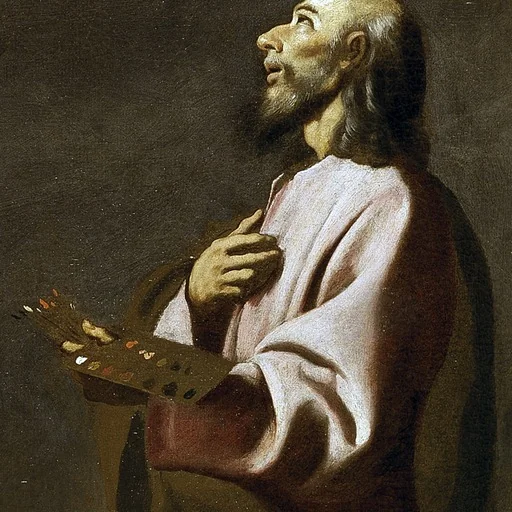
Francisco de Zurbarán was a Spanish Baroque painter. He is known primarily for his religious paintings depicting monks, nuns, and martyrs, and for his still-lifes. Zurbarán gained the nickname "Spanish Caravaggio",…