Artwork
Militia Company of District XI under the Command of Captain Reynier Reael
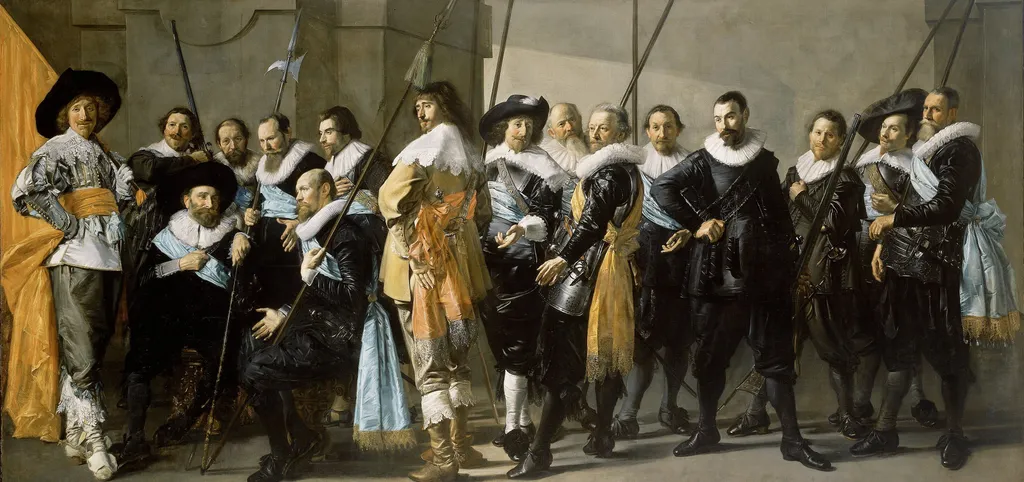
Militia Company of District XI under the Command of Captain Reynier Reael is an oil painting by the Dutch Golden Age artist Frans Hals. It dates from 1633 and is held in the collection of the Rijksmuseum.
About this work
Subject & Meaning
The work later acquired the nickname "The Meagre Company" because the men appear thinner and leaner than those in later Amsterdam militia portraits.
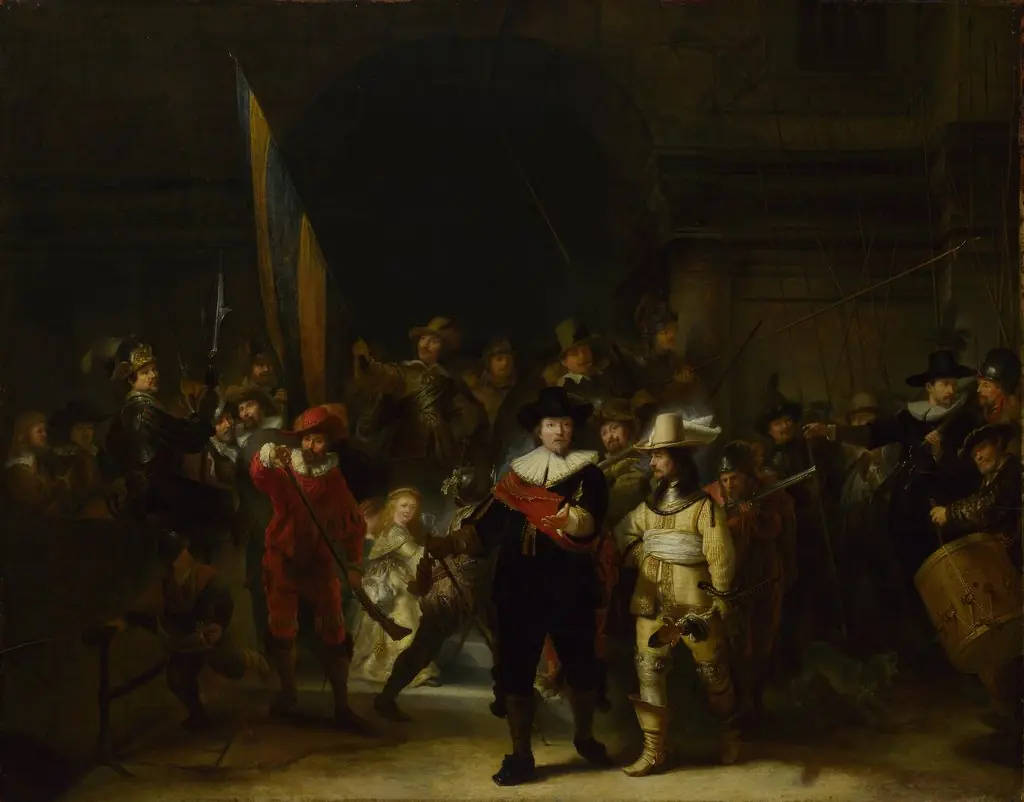
The painting is a schutterstuk, a Dutch militia group portrait, depicting the civic guards of District XI. It features approximately sixteen armed militiamen shown in full length, adhering to the Amsterdam portrait convention rather than the three-quarter length Haarlem style. The composition is illuminated from the left, where the most prominent figures are situated.
On the far left stands the flag bearer, Nicolaes van Bambeeck, dressed flamboyantly and holding a flag matching his sash. Seated beside him are Captain Reinier Reael, identified by his hat and commander's staff, and the balding Lieutenant Cornelis Michielsz Blaeuw, holding a spontoon. The remaining officers carry halberds and lances, though most of their names are now unknown.
The work later acquired the nickname "The Meagre Company" because the men appear thinner and leaner than those in later Amsterdam militia portraits. Symbolically, the flag bearer's attire incorporates orange, white, and blue, reflecting the national colors of the period.
History & Provenance
The painting commonly known as The Meagre Company was commissioned in 1633 by the militia company of District XI, led by Captain Reynier Reael and Lieutenant Cornelis Michielsz Blaeuw, for display in their meeting hall, the Voetboogdoelen on the Singel in Amsterdam. Frans Hals began work that year after the success of his earlier schutterstuk for the Amsterdam militia, but he was unable to complete the painting on schedule due to his reluctance to travel frequently to Amsterdam. By 1636 the work remained unfinished, prompting the sitters to hire Pieter Codde to finish it; Codde painted the seven figures on the right side while Hals retained authorship of the left portion.
The work, executed in oil on canvas and measuring 209 by 429 centimeters, was completed between 1633 and 1637 and has been part of the Amsterdam Museum collection since the 18th century, on long‑term loan to the Rijksmuseum since 1885.
The provenance traces a continuous ownership chain from its original commission and display in the Voetboogdoelen, through removal to the Amsterdam Museum after the hall’s demolition in the 19th century, and its subsequent placement on permanent loan to the Rijksmuseum. The painting’s dating is anchored by contemporary records indicating an inception between 1633 and 1637, with Hals originally engaged in 1633 and Codde completing the work by 1637. Its creation history reflects Hals’s initial intention to replicate his Haarlem‑style group portrait, his subsequent dissatisfaction with the Amsterdam commission, and the collaborative resolution involving Codde’s contribution.
The painting originally hung in the archers' meeting hall known as the Voetboogdoelen on the Singel in Amsterdam. It was relocated to the city hall in 1758. Today, the work is part of the collection of the Amsterdam Museum but has been on permanent loan to the Rijksmuseum since 1885, where it is displayed in the Gallery of Honour.
It was exhibited in the Rijksmuseum during the exhibition Dutch Portraits: The Age of Rembrandt and Frans Hals.
Context
The painting known as De magere compagnie (The Meagre Company) is regarded as a pivotal work in the development of Amsterdam schutterstukken, or militia group portraits, marking a stylistic transition from the more compact Haarlem 'kniestuk' format to the full-length, narrative-driven compositions characteristic of 17th-century Amsterdam civic art. Unlike Hals' earlier Haarlem militia portraits such as The Officers of the St Adrian Militia Company (1633), which featured figures cropped at the knees and emphasized uniformity, this work adopts the Amsterdam convention of full-length depictions and complex spatial arrangement. Its innovative use of light, color, and individualization, particularly the flamboyant rendering of the leftmost flag bearer, Nicolaes van Bambeeck, served to demonstrate Hals' ability to adapt his Haarlem style to the expectations of Amsterdam patrons, even as logistical and artistic conflicts delayed completion.
The collaboration and eventual substitution by Pieter Codde, while disrupting Hals' authorship, ultimately highlighted the distinct painterly approaches of the two artists: Hals' vigorous, visible brushwork and lifelike spontaneity contrasted with Codde's smoother, more restrained technique, which, despite technical shortcomings, preserved the overall composition and allowed Hals' original vision to dominate the finished piece.
Legacy
The painting acquired the enduring nickname "Meagre Company" after the Amsterdam painter and historian Jan van Dijk wrote in 1758 that the figures were so thin and lean that the work deserved to be called the "meagre company," and that epithet has remained attached to it ever since. Its display history also shaped its reputation: after hanging for generations in the Voetboogdoelen meeting hall on the Singel, it was transferred to the city hall in 1758 and has been on view in the Rijksmuseum since 1885, where it is considered one of the principal attractions of the Honor Gallery.
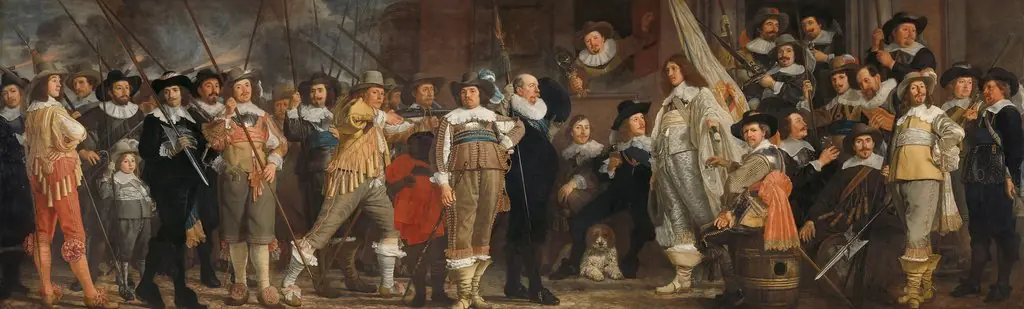
A landmark moment in its legacy came in October 1885, when Vincent van Gogh visited the newly opened Rijksmuseum and wrote an enthusiastic letter to his brother Theo praising the work, singling out the pearl-grey standard-bearer in the left corner as "a divinely beautiful figure" whose handling of orange, white, and blue he believed Delacroix would have adored. The painting now hangs across from its successor, Bartholomeus van der Helst's militia group portrait of Captain Roelof Bicker, allowing direct comparison of the two Amsterdam schutterstukken.
Overview
Frans Hals painted a militia portrait for Amsterdam’s District XI, depicting Captain Reynier Reael and his officers. The oil on canvas, now held by the Amsterdam Museum and displayed at the Rijksmuseum, is the sole example of Hals’s schutterstuk work outside his native Haarlem. The composition presents the civic guard members in formal 17th‑century attire, arranged within an interior space with a stone wall backdrop.
Technique & Style
Hals applied his characteristic lighting from the left, illuminating the principal figures and creating a subtle contrast across the group. The brushwork combines loose, lively strokes for the faces with finer detail in the lace and weaponry, reflecting his typical balance of spontaneity and precision in group portraiture. The composition follows a left‑to‑right progression, a method often used to prioritize the most important sitters.
Artist & collection
Artist
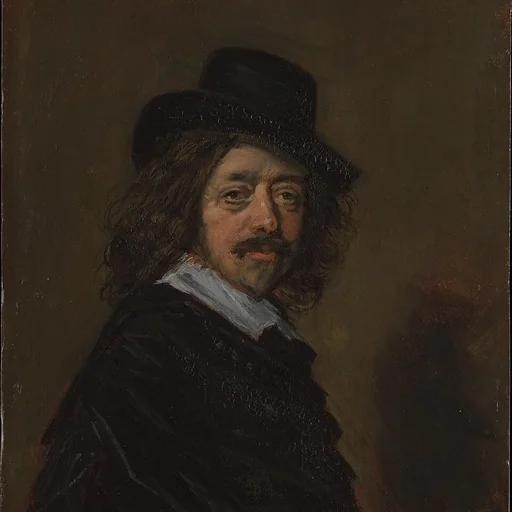
Frans Hals the Elder (UK: US:; Dutch:; c. 1582 – 26 August 1666) was a Dutch Golden Age painter. He lived and worked in Haarlem, a city in which the local authority of the day frowned on religious painting in places of…

- Militia Company of District VIII under the Command of Captain Roelof Bicker
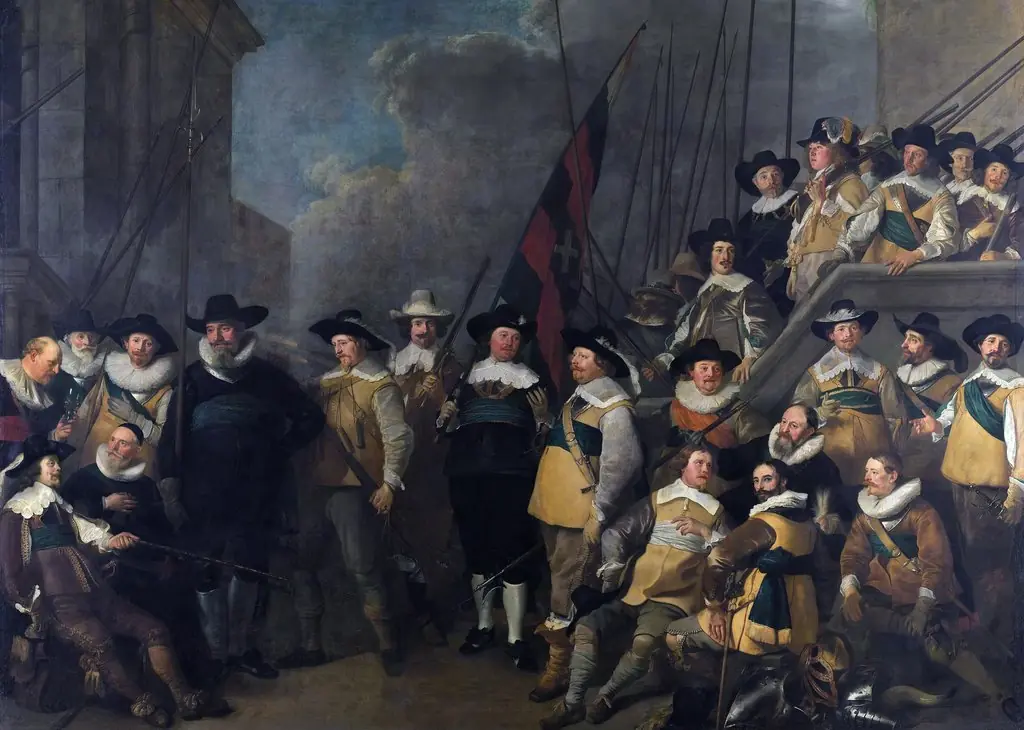 Officers and other Civic Guardsmen of the V District in Amsterdam under the command of Captain Cornelis de Graeff and Lieutenant Hendrick Lauwrensz
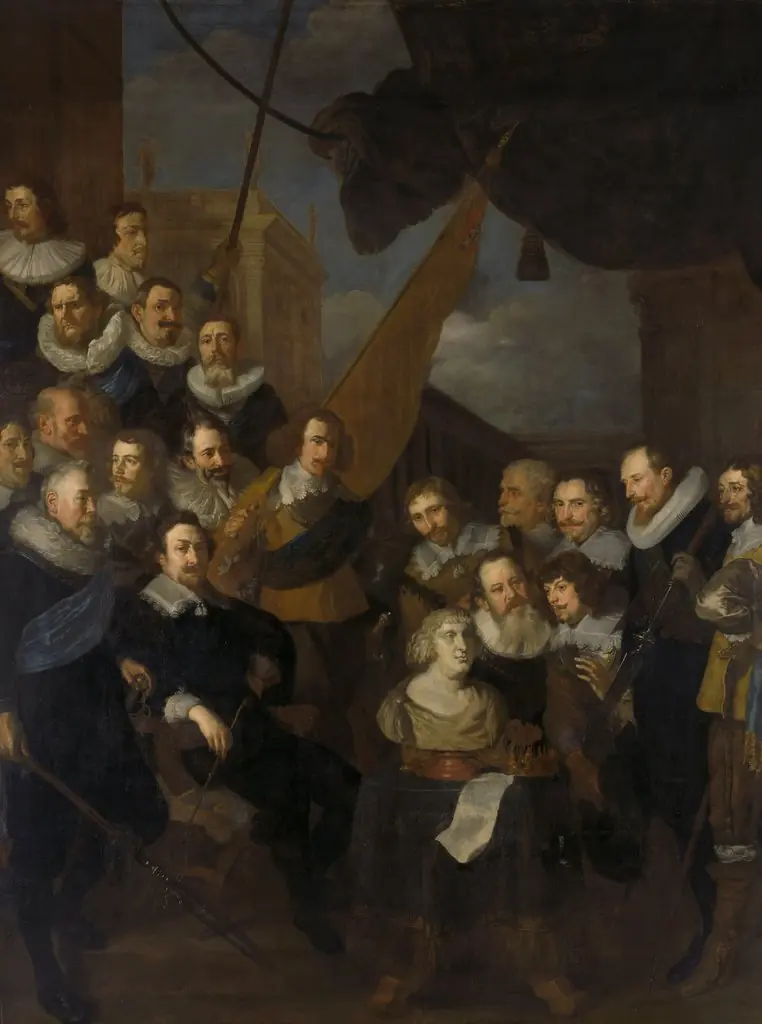 Officers of the militia of departmetn XIX in Amsterdam under the command of Cornelis Bicker and Frederick van Banchem, ready to receive Maria de' Medici in 1638
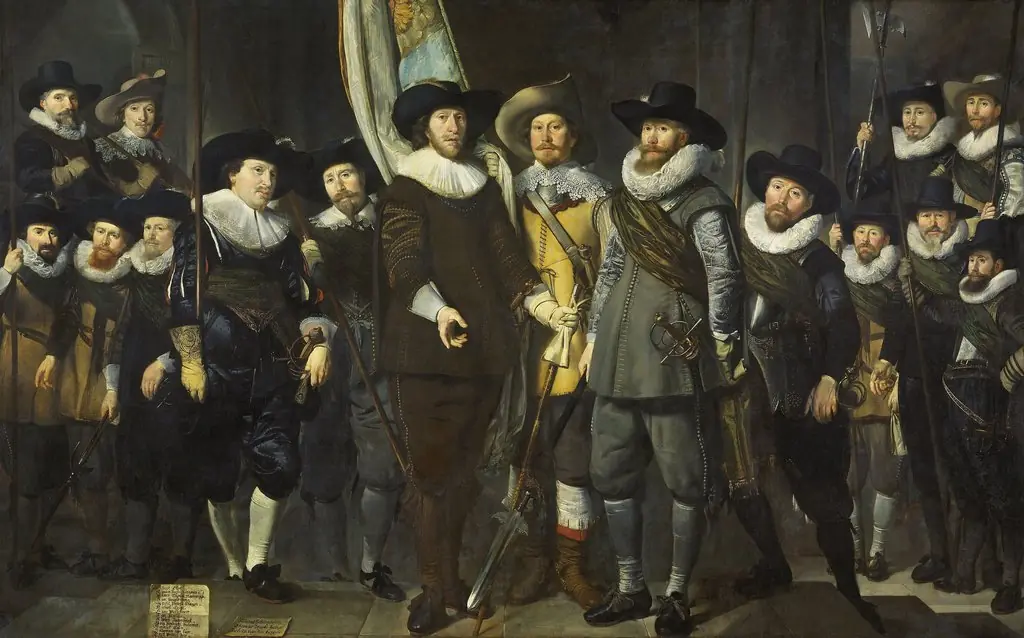 Officers and other civic guardsmen of the IIIrd District of Amsterdam, under the command of Captain Allaert Cloeck and Lieutenant Lucas Jacobsz Rotgans
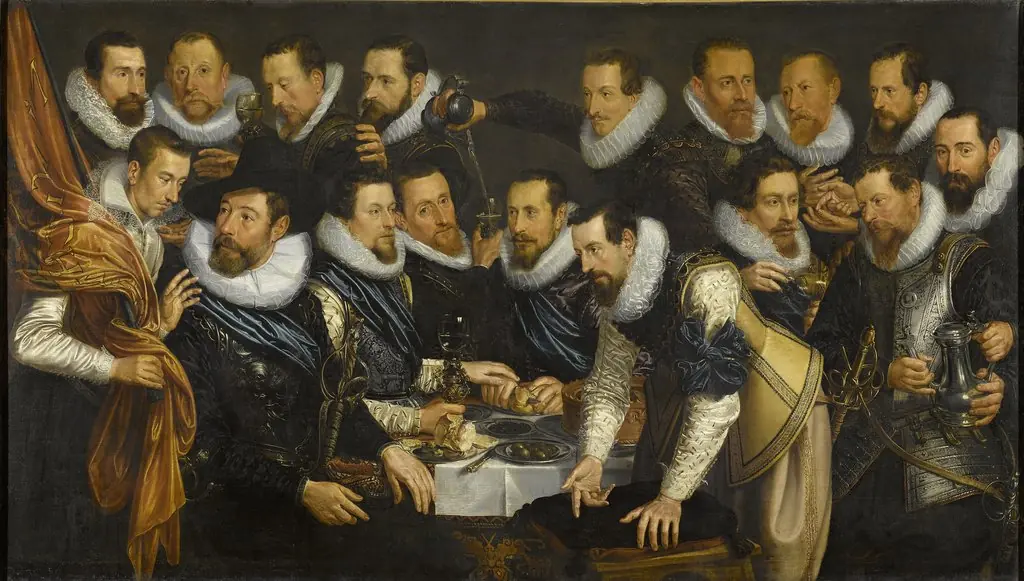 Officers and other civic guardsmen of the XIth District of Amsterdam, under the command of Captain Geurt Dircksz van Beuningen and Lieutenant Pieter Martensz Hoeffijser
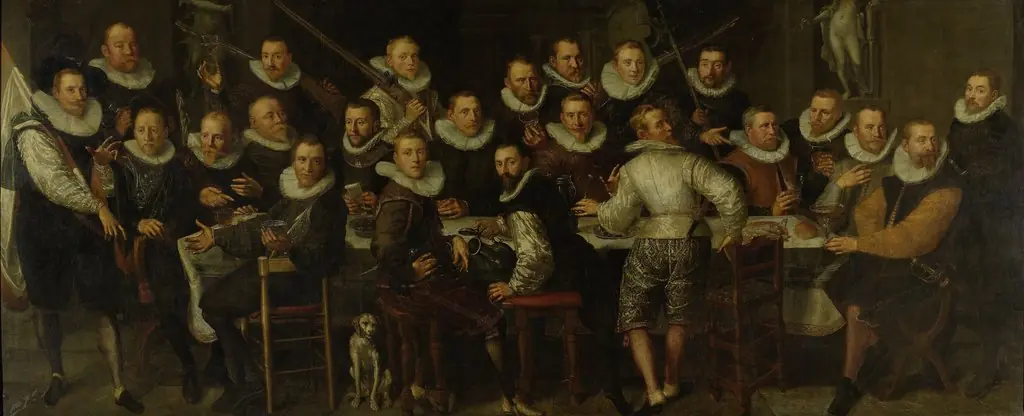 The Company of Captain Gillis Jansz Valckenier and Lieutenant Pieter Jacobsz Bas, Amsterdam, 1599
 The Company of Captain Banning Cocq