Artwork
Twilight in the Wilderness
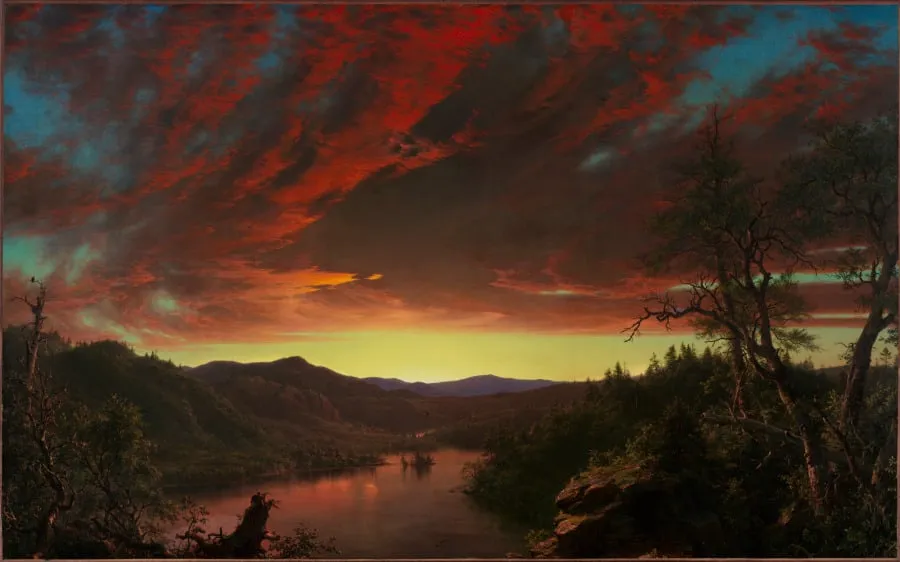
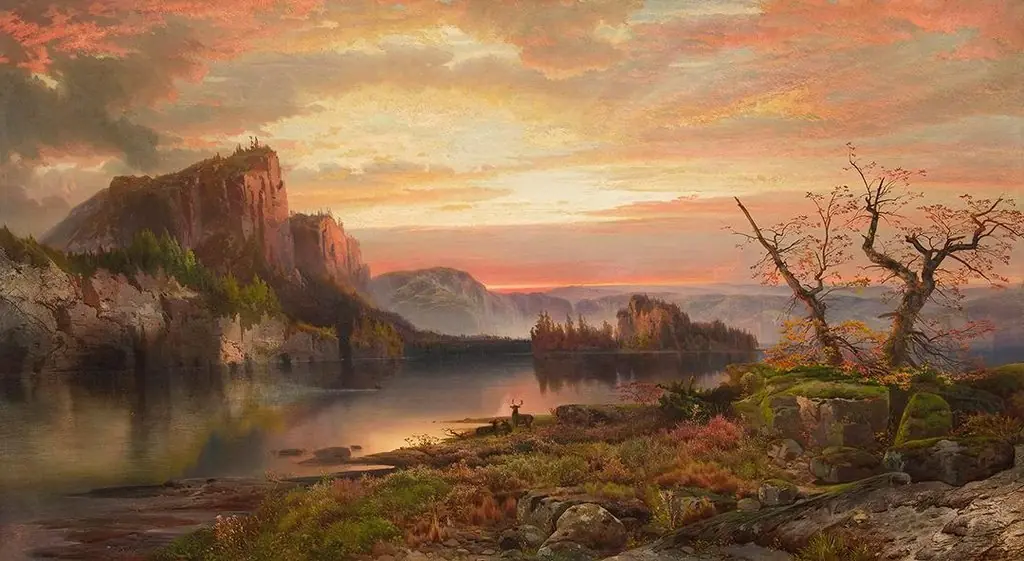
Twilight in the Wilderness is an unspecified painting by the Hudson River School artist Frederic Edwin Church. It dates from 1860 and is held in the collection of the Cleveland Museum of Art. Created in 1860, this oil painting captures a rugged, rocky terrain illuminated by a vivid sunset.
- Accession no.
- 1965.233
- Credit line
- Mr. and Mrs. William H. Marlatt Fund
About this work
The colors and mood remind me of another American painter who loved landscapes.
This painting shows a wild, rocky landscape glowing under a fiery sunset. Bright reds and oranges fill the sky, while dark green pines frame the scene. The light feels almost too bright, like the world is on fire.
Church painted this in 1860, right before the Civil War. Some think the burning sky hints at the storm to come. The details are sharp, you can almost feel the cool air and smell the pine.
The colors and mood remind me of another American painter who loved landscapes. Look up Albert Bierstadt next.
Overview
Created in 1860, this oil painting captures a rugged, rocky terrain illuminated by a vivid sunset. The sky burns with reds and oranges, while dark green pines border the foreground, giving the scene a dramatic contrast between fire and foliage. The composition conveys a sense of expansive wilderness near Mount Katahdin in Maine, rendered with precise detail that invites the viewer into the cool, pine‑scented air.
Subject & Meaning
While the work depicts a natural landscape, its timing on the eve of the Civil War invites a symbolic reading. The intense, almost incendiary sky can be seen as an allusion to the looming national conflict, suggesting a nation poised on the brink of upheaval. The painting thus operates on two levels: a celebration of American scenery and a subtle commentary on contemporary tensions.
Technique & Style
The artist employed meticulous brushwork to achieve sharp delineation of rock formations and foliage, while using a luminous palette to render the glowing horizon. Contrasting warm hues of the sunset with the cool, deep greens of the pines creates a heightened visual drama. The overall effect reflects the Hudson River School’s emphasis on detailed naturalism combined with a romanticized, almost theatrical presentation of light.
History & Provenance
The scene was based on sketches made during a visit to the Katahdin region nearly two years before its completion. Rather than presenting the piece in a group exhibition, the artist displayed it alone at a prominent New York gallery, where extensive publicity and favorable reviews attracted several hundred visitors during its seven‑week showing. This singular exhibition strategy contributed to the work’s early acclaim.
Legacy
The painting’s striking use of color and its evocative mood have influenced subsequent American landscape painters, reinforcing the tradition of portraying wilderness with both scientific accuracy and emotional intensity. Its dual function as a landscape and a subtle historical allegory continues to be a point of discussion among scholars of 19th‑century American art.
Artist & collection

Artist
Frederic Edwin Church was an American landscape painter born in Hartford, Connecticut.