Artwork
The Death of the Virgin
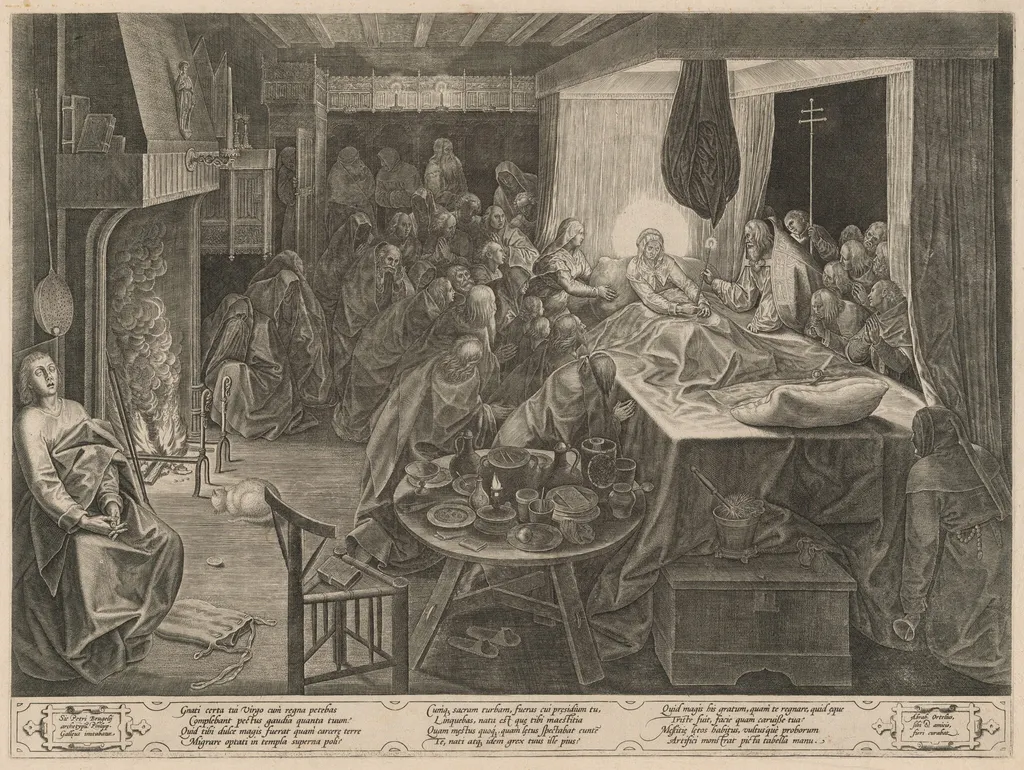
The Death of the Virgin is an ink print by the Renaissance artist Philip Galle. It dates from 1574 and is held in the collection of the National Gallery of Art.
- Inscription
- Inscribed:in plate, in lower margin in cartouche at left: Sic Petri Brugelij / archetijpu Philipp. / Galleus imitabatur (Thus Philips Galle reproduced the prototype by Pieter Bruegel; in plate, in lower margin in cartouche at right: Abrah. Ortelius, / sibi & amicis, / fieri curabat (On behalf of himself and his friends Abraham Ortelius took care of the production); in plate, in lower margin: Gnati regna tui Virgo cum regna petebas / Complebant pectus gaudia quanta tuum? / Quid tibi dulce magis fuerat quam carcere terre / Migrare optati in templa superna poli? / Cumq sacram turbam, fueras cui presidium tu, / Linquebas, nata est que tibi maestitia / Quam mestus quoq, quam letus spectabat eunte / Te, nati atq idem grex tuus ille pius? / Quid magis his gratum, quam te regnare, quid eque / Triste fuit, facie quam caruisse tua? Mestitie letos habitus, vultusque proborum / Artifici monstrat picta tabella manu. (Virgin, when you sought the secure realms of your son, what great joys filled your breast! What would have been sweeter for you than to migrate from the prison of the earth to the lofty temples of the longed-for heavens! And when you left the sacred group whose mentor you had been, what sadness sprang up in you. How sad as well as how joyful was that pious gathering of you and your son as they watched you go. What was a greater joy for them than for you to reign, what greater sadness than to miss your appearances? This picture, created by a skillful hand, shows the happy bearing of sadness on the faces of the just.) [Latin translation from Nadine Orenstein, ed., Pieter Bruegel the Elder: Drawings and Prints. Exhibition catalogue. New York: Metropolitan Museum of Art, 2001, p. 258.]; on verso, in graphite at lower left: JIE / B 116
- Markings
- Marked:none
About this work
Overview
The Death of the Virgin is a 1574 engraving on laid paper by Philip Galle, reproducing a composition originally painted by a Netherlandish artist.
Subject & Meaning
The scene depicts the Virgin Mary on her deathbed, surrounded by apostles, with skeletons visible under the bed and around the room, symbolizing mortality.
Technique & Style
Galle used cross-hatching, building up shadows and textures with tiny lines, to create a detailed image. Engraving allowed him to achieve depth through varying line density and direction.
History & Provenance
Galle, a Dutch publisher and engraver active in Antwerp, specialized in reproductive prints, disseminating works by earlier artists through engraving for wide circulation.
Own this work as a print
Artist & collection
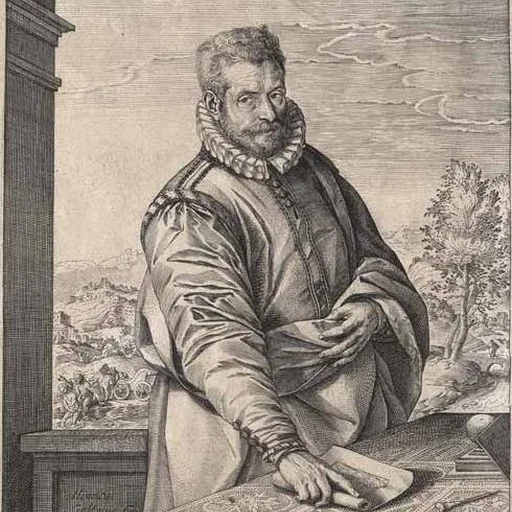
Artist
Philip (or Philips) Galle (1537 – March 1612) was a Dutch publisher, best known for publishing old master prints, which he also produced as designer and engraver. He is especially known for his reproductive engravings of paintings.

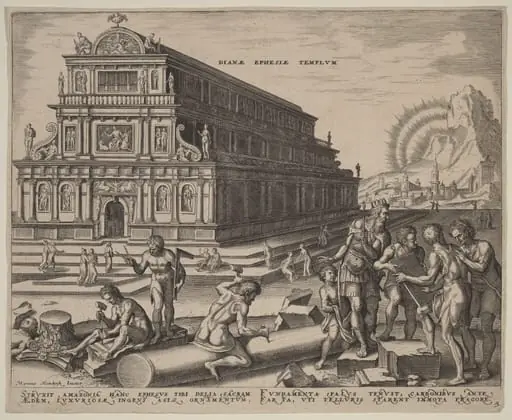 Dianae Ephesiae Templum (The Temple of Diana at Ephesus)
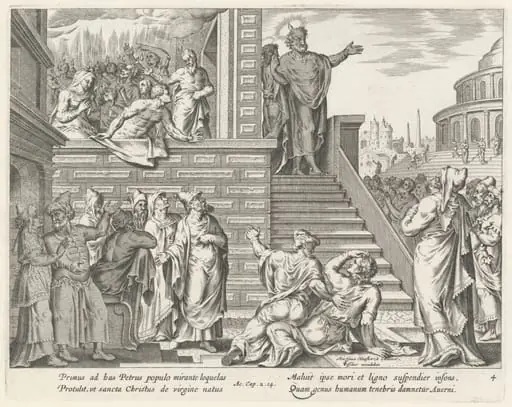 Saint Peter Speaks to the People about Christ
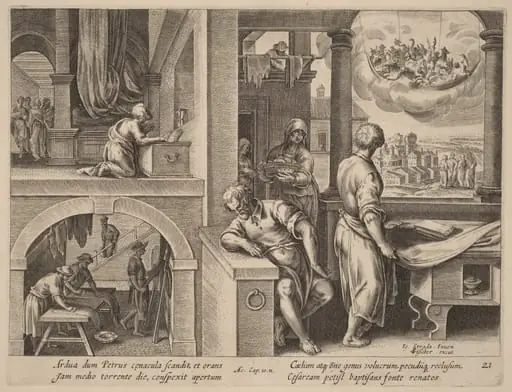 The Vision of Saint Peter
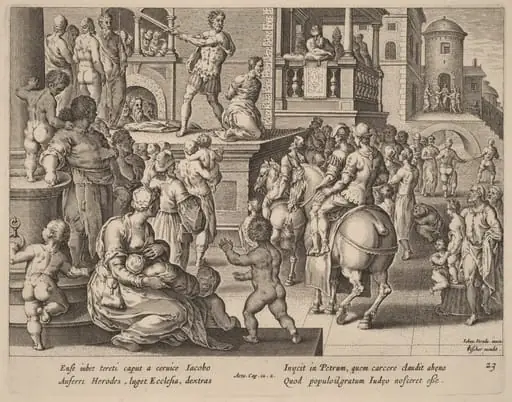 Beheading of Saint James
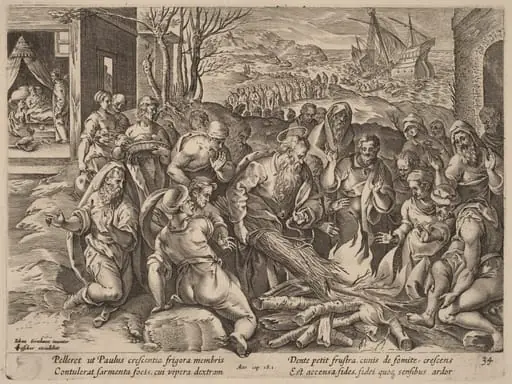 Saint Paul Shipwrecked on the Island of Melita
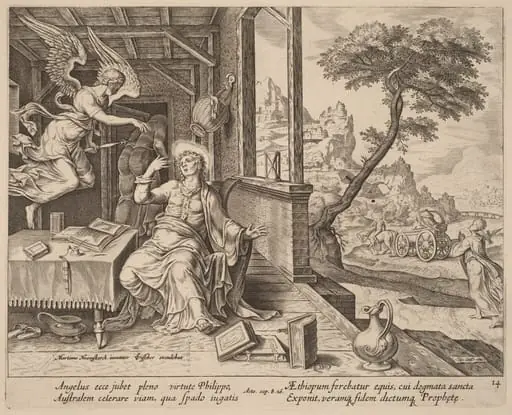 The Angel Orders Saint Philip to Accompany the Ethiopian Eunuch
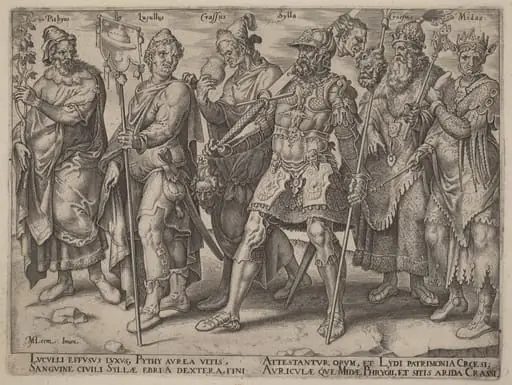 Notorious Examples of Wealth from Antiquity
 The Parable of the Wise and Foolish Virgins