Artwork
Giovanni Borgherini and His Tutor
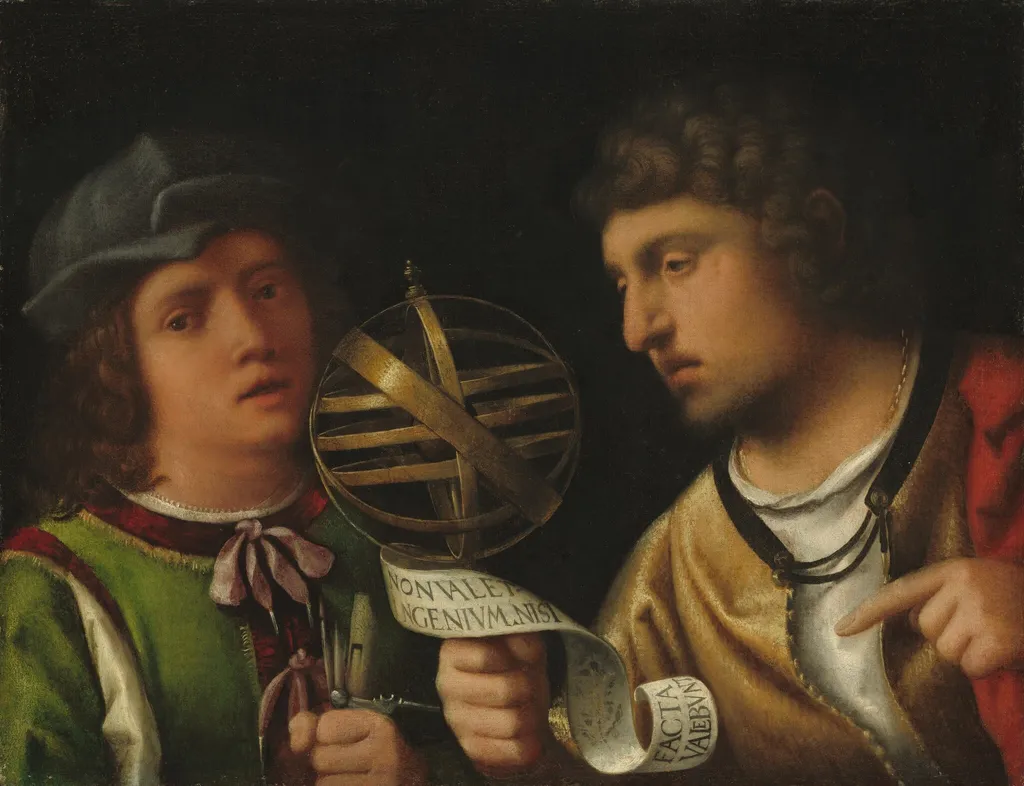
Giovanni Borgherini and His Tutor is an oil painting by the High Renaissance artist Giorgione. It dates from 1505 and is held in the collection of the National Gallery of Art.
- Inscription
- Inscribed:lower center on scroll: NON VALET. / INGENIVM.NISI / FACTA/ VALEBVNT (Talent has no worth unless accomplishment follows)
About this work
Subject & Meaning
This inscription underscores a moral theme of coherence between thought and action, a principle associated with Gabriel's life.
The painting depicts a dual portrait of the young Giovanni Borgherini alongside his tutor, set against a dark background. The elder figure, potentially identified as the Venetian humanist Trifone Gabriel, instructs the richly dressed youth while holding an armillary sphere and a scroll. The sphere alludes to the tutor's astronomical interests, while the scroll bears the Latin maxim "NON VALET INGENIVM NISI FACTA VALEBVNT," translating to the idea that talent holds no value unless followed by deeds.
This inscription underscores a moral theme of coherence between thought and action, a principle associated with Gabriel's life. The work likely commemorates Borgherini's education in Venice under his father's commission, symbolizing the humanist ideal of combining intellectual prowess with practical achievement.
Technique & Style
Executed in oil on canvas and measuring 47 by 60.7 cm, Giovanni Borgherini and His Tutor is a small-format portrait attributed to Giorgione and dated circa 1505. The composition places the richly dressed youth and his tutor against a dark background, with the elder figure holding an armillary sphere and a cartouche inscribed "NON VALET / INGENIVM.NISI / FACTA / VALEBVNT." Vasari's 1568 account praised the work for its exceptional flesh tints and subtle gradations of shadow across the two heads.
The painting's soft, suffused atmosphere and muted tonal fields without sharp contours are characteristic of Giorgione's style, though the chromatic brilliance of the garments and flesh against the dark ground is considered less typical. Some scholarly reservations about the work's quality, and consequently its attribution, stem from what may have been inappropriate restorations.
The work is associated with the High Renaissance movement and is held in the National Gallery of Art in Washington, D.C.
History & Provenance
Created circa 1505 in Venice, this oil on canvas portrait was likely commissioned by Salvi Borgherini for his son Giovanni, who resided in the city from 1504. The work is first documented in Giorgio Vasari's 1568 account of the Lives of the Artists, which describes it as residing in Florence with the sitter's sons. The painting remained within the Borgherini family lineage, eventually passing to Cavaliere Pier-Francesco Borgherini in Milan by the 17th century.
It was sold in 1923 to Sir Herbert Frederick Cook for his Doughty House collection in Richmond, Surrey. Following a 1932 sale, the work was acquired in 1960 by Michael Straight of Alexandria, Virginia, who donated it to the National Gallery of Art in Washington, D.C., in 1974.
Context
Critical commentary began with Giorgio Vasari’s 1568 description of the picture in the Borgherini household, noting its masterful flesh tones and nuanced shading. Scholars have linked the enigmatic tutor figure to the Venetian humanist Trifone Gabriel, whose political writings reflect the allegorical sphere held by the teacher. The work exemplifies early High Renaissance portraiture, combining a dark background with softly modeled heads and a blend of Venetian colorism and narrative detail.
Its provenance, from the Borgherini family to Sir Herbert Cook, Michael Straight, and finally the National Gallery of Art, illustrates the transnational circulation of Italian art in the 20th century.
Overview
Giovanni Borgherini and His Tutor is an oil on canvas painting from approximately 1505, attributed to the Venetian artist Giorgione. Now housed at the National Gallery of Art in Washington, D.C., the work depicts a young man receiving instruction from an older figure. This intimate scene offers a glimpse into the educational practices of the early 16th century, rendered with a notable depth and subtlety characteristic of the period.
Own this work as a print
Artist & collection


- Parable of the unjust steward (Luke 16:1-13)
 Parable of the unjust steward
 Chiromancer
 The Calling of Saint Matthew
 Flogging of the Four crowned
 Saint Mark the Evangelist
 The Saint Physicians Cosmas and Damian
 The Calling of Saint Matthew
 The Calling of Saint Matthew
 Portrait of Lorenzo Cybo
 Triple Portrait of a Goldsmith (Bartolomeo Carpan?)
 Plato and Diogenes