Artwork
Judith
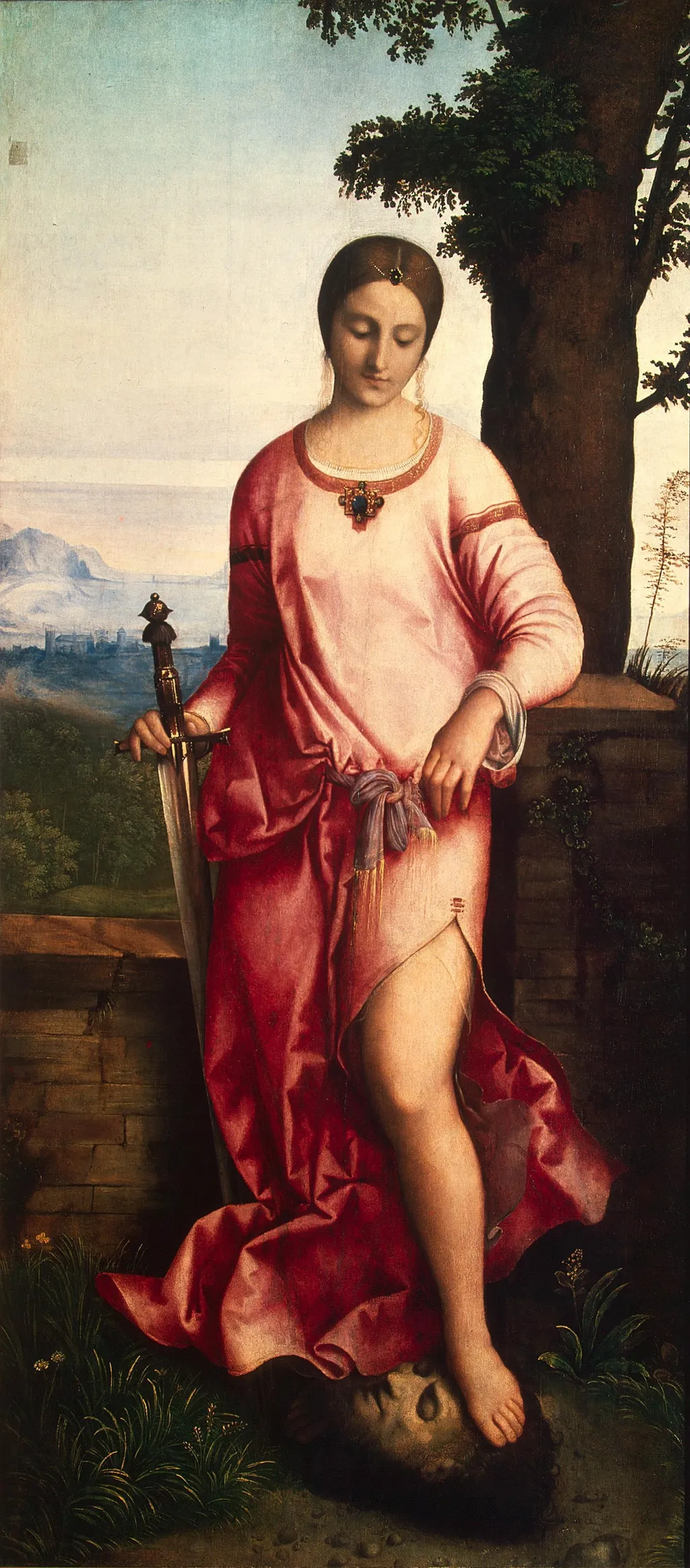
Judith is an oil painting by the High Renaissance artist Giorgione. It dates from 1504 and is held in the collection of the Hermitage Museum.
About this work
Subject & Meaning
Her pose derives from classical statuary, notably Phidias's Aphrodite Ourania, while her body type echoes Dürer's temptress in The Dream of the Doctor.
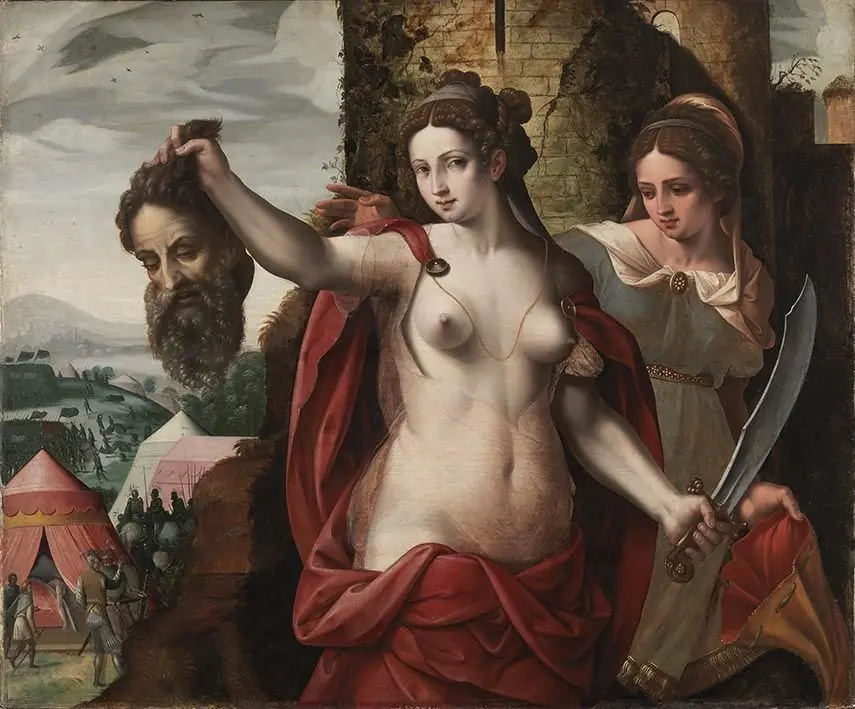
Giorgione's painting depicts Judith, the biblical heroine from the deuterocanonical Book of Judith who beheaded the Assyrian general Holofernes to save her people. Rather than narrating the violent act or her triumphant return to Bethulia, Giorgione shows Judith in a meditative, timeless moment: standing frontally, slightly below life-size, her gaze lowered toward the severed, swollen head of Holofernes that she pins beneath one bare foot. She wears a pink draped tunic over a white chemise fastened by a cruciform brooch, holds a long sword vertically by the hilt, and rests her elbow on a brick wall beside her.
The figure personifies the Jewish people and embodies civic virtue, with beauty triumphing over tyranny. Her pose derives from classical statuary, notably Phidias's Aphrodite Ourania, while her body type echoes Dürer's temptress in The Dream of the Doctor. The oak tree behind her, the meticulously rendered foreground plants, and the sfumato landscape with a distant towered city evoke Leonardo's influence.
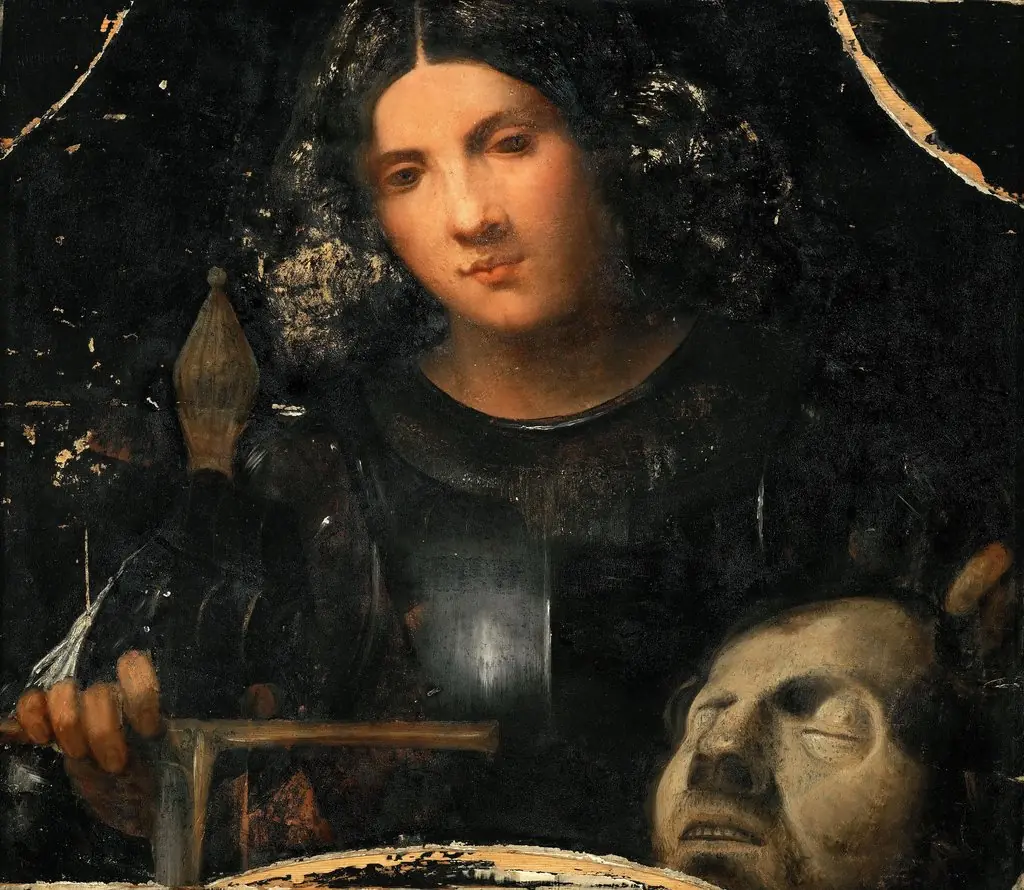
The contrast between her idealized oval face and Holofernes's battered head underscores the theme of virtue conquering brutality.
Technique & Style
The painting is an oil on wood panel, transferred to canvas in 1839 by the Hermitage restorer A. Sidorov due to deterioration of the original support, which may have been a cabinet door or panel. The composition features Judith standing in a vertical format (144 × 68 cm), her body rendered with a contrapposto stance, her right hand resting on the hilt of a vertically held sword while her left foot rests on the severed head of Holofernes. Her attire includes a pink tunic with intricate drapery and a white chemise with visible pleating at the neckline, secured by a belt and a cruciform brooch.
The background reveals a hilly landscape with a distant city and tower, treated in a Leonardesque sfumato, while a broad-leaved oak tree occupies the right side, enhancing the figure’s monumentality. The palette combines Venetian colorism with Northern European precision in the rendering of foreground vegetation and metallic highlights on the sword.
History & Provenance
Giorgione's Judith was painted circa 1504 in Italy, originally executed in oil on a wooden panel that may have served as the door or shutter of a piece of furniture, with a hollow on the right side that once accommodated a lock. The earliest documented owner was Pierre-Vincent Bertin; the panel then passed to a M. Forest in Paris before being acquired by the collector Pierre Crozat. By 1729 it was recorded by Pierre-Jean Mariette in the first volume of the Recueil Crozat, illustrated by an engraving by Antoinette Larcher, and at that time was attributed to Raphael.
The work remained with the Crozat collection, passing to Louis Antoine Crozat, Baron de Thiers. In 1772 it was purchased in Paris by agents of Catherine II of Russia and entered the Hermitage Museum in Saint Petersburg, where it remains. In 1839 the Hermitage restorer A. Sidorov transferred the painting from panel to canvas.
The painting is held in the State Hermitage Museum, Saint Petersburg, with inventory number GE-32196. It entered the museum in 1772 as part of a Paris purchase assembled by Catherine II from the Crozat collection, where it had been previously attributed to Raphael. Originally painted on panel, the work was transferred to canvas in 1839 by the Hermitage restorer A. Sidorov due to deterioration.
A major conservation campaign between 1967 and 1971 removed discolored varnish and overpaint, revealing original landscape details and stabilizing the paint layer.
Context
Giorgione's Judith (c. 1504) stands as a pivotal work of the High Renaissance Venetian school, marking a departure from traditional narrative depictions of the biblical heroine. Initially attributed to Raphael in the 18th century, the painting was definitively reattributed to Giorgione by scholars such as Giovanni Morelli and Ernst Liphart in the late 19th and early 20th centuries. The work synthesizes diverse influences: the Leonardesque sfumato and facial type, the monumental pose derived from classical statuary like the Aphrodite Ourania, and the meticulous detail of Northern European prints by artists such as Albrecht Dürer and Martin Schongauer.
Art historians like Jaynie Anderson and Tom Nichols note that the painting's introspective mood and the juxtaposition of Judith's serene beauty with the severed head of Holofernes anticipate the later femme fatale archetype, influencing figures like Gustav Klimt. As one of the few authenticated Giorgiones in the Hermitage, it exemplifies the artist's unique poetic brevity and early mastery of landscape integration.
Legacy
Giorgione's Judith is regarded as a cornerstone of his early career, with critics broadly agreeing on its attribution to the Venetian master. The painting's iconography of the biblical heroine was relatively novel in Venice at the time, making the work an important early example of the subject in the region. Art historians situate the composition at the beginning of a long tradition of depicting Judith as a femme fatale, a development that would culminate centuries later in Gustav Klimt's Judith I and Judith II.
The painting's critical reception has also evolved: originally attributed to Raphael and documented as such in the 1729 Recueil Crozat, it was reassigned to Giorgione by Penther around 1880, followed by Giovanni Morelli in 1891 and Ernst Liphart in 1910, an attribution now universally accepted.
Overview
Giorgione's oil painting, Judith, created around 1504, depicts the biblical heroine after her decisive act. This work is among the limited number of pieces confidently attributed to the Venetian artist within the collection of the Russian Hermitage Museum. The composition presents Judith in a moment of quiet contemplation following her execution of Holofernes, a popular subject in Renaissance art that allowed for explorations of virtue and sacrifice.
Artist & collection