Artwork
Portrait of a soldier with his squire
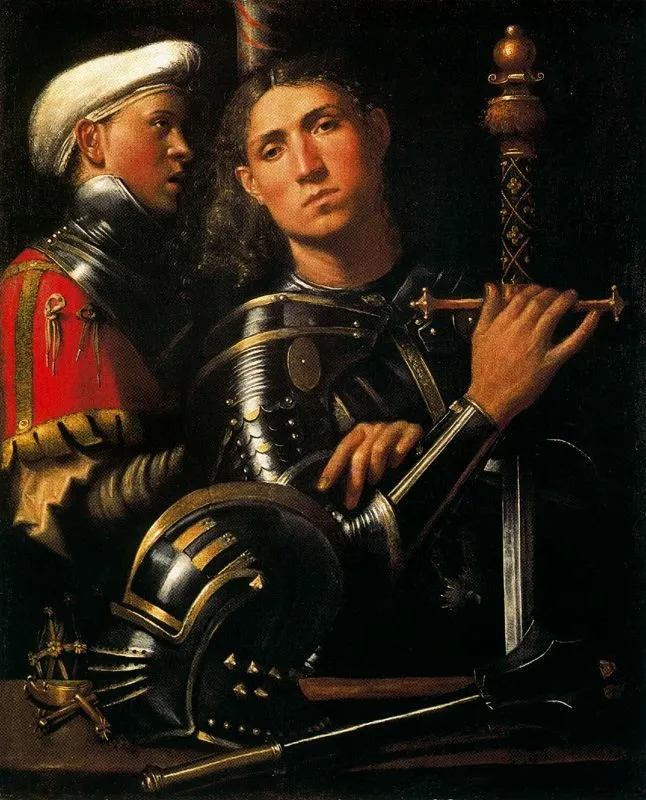
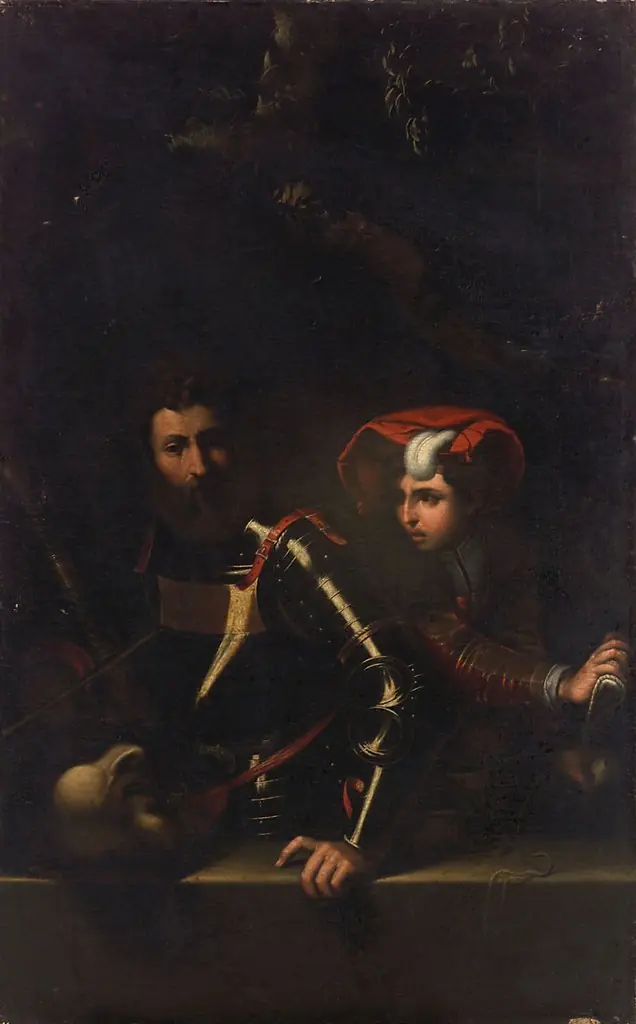
Portrait of a soldier with his squire is an oil painting by the High Renaissance artist Giorgione. It dates from 1502 and is held in the collection of the Uffizi Gallery.
About this work
Subject & Meaning
The armor’s gleaming surfaces and the parapet’s classical framing transform a martial scene into a reflective dialogue between generations.
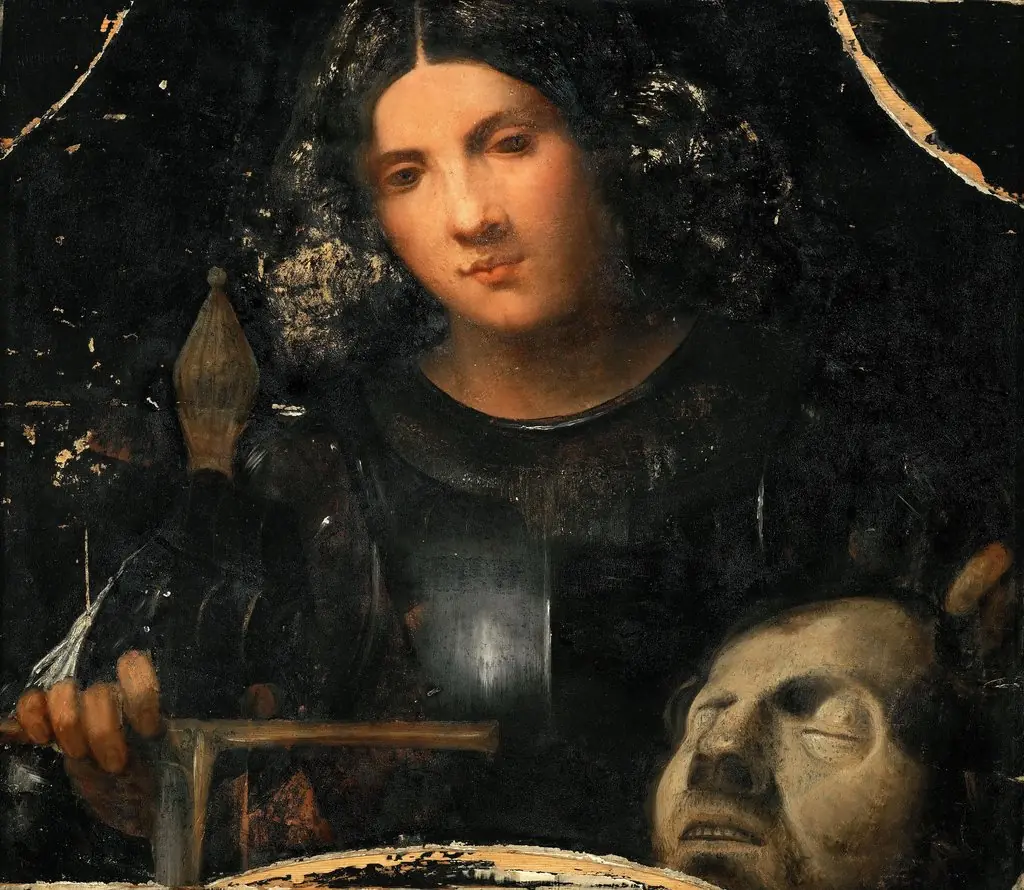
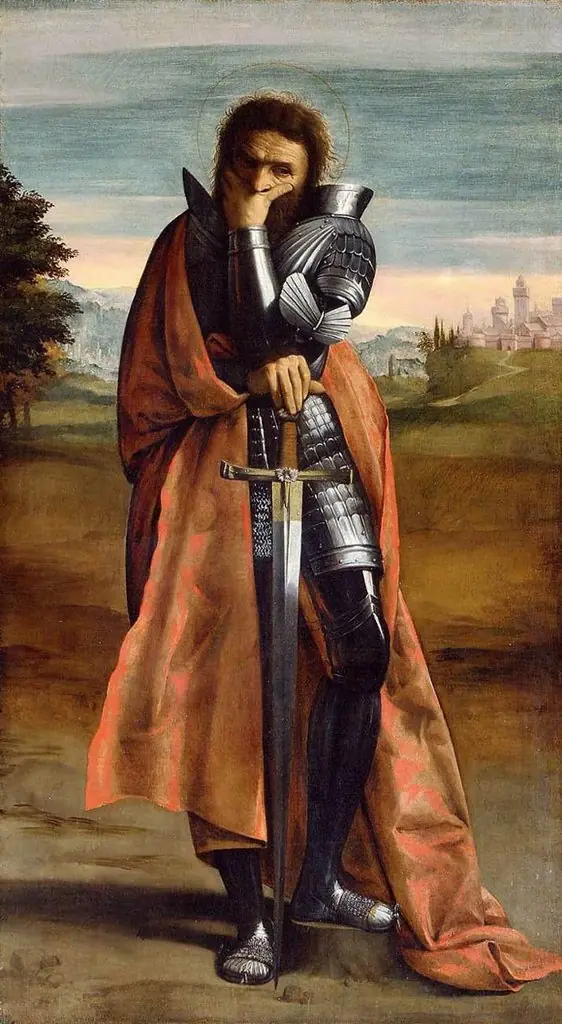
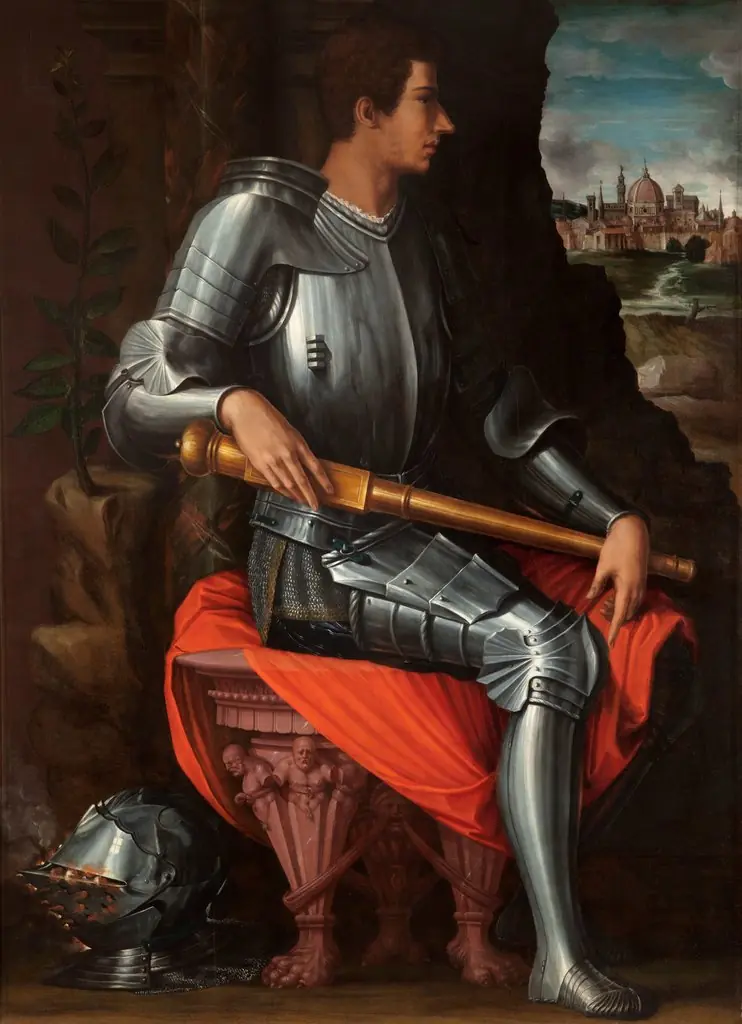
The double portrait presents a warrior in full burnished armor standing behind a parapet, gripping a two-handed sword vertically while a youthful squire holds a lance at his side.
The squire, turned toward the soldier and dressed in vivid red robes and a white cap, conveys a spoken message, while the warrior’s averted gaze and furrowed brow project a mood of brooding melancholy. The armor’s gleaming surfaces and the parapet’s classical framing transform a martial scene into a reflective dialogue between generations. The painting’s composition, with its half-length format and psychological tension, anticipates seventeenth-century genre portraiture rather than straightforward military commemoration.
Technique & Style
Executed in oil on canvas, the painting measures 90 × 73 cm and is set within a half-length format framed by a parapet.
The composition unfolds as a staged encounter: the soldier stands frontally in gleaming darkened armor, gripping a two-handed sword upright against the parapet; behind him, the youthful squire appears in profile, clad in vivid red drapery, a steel gorget, and a white cap, holding a lance and turned toward the warrior as if speaking. The palette is restrained yet luminous, with metallic accents on the visor and spurs contrasting against the subdued tones of the figures and background. Brushwork is smooth overall, though the squire’s red garment and the warrior’s reflective armor receive more pronounced highlights, lending a quietly metallic sheen to the scene.
The condition has undergone conservation; after a 1990 restoration, the attribution to Giorgione’s late phase gained renewed prominence, and the earlier hypothesis of a copy after a lost original was largely discounted.
History & Provenance
The painting, titled Portrait of a soldier with his squire, is dated to approximately 1502–1510, with some scholars narrowing the window to 1502–1505 to align with Giorgione's potential presence at the court of Caterina Cornaro in Asolo. The work's provenance traces back to the 1718 inventories of Prague Castle, where it was attributed to the school of Titian. It arrived in Florence in 1821 through an exchange with the Imperial Gallery of Vienna, now the Kunsthistorisches Museum.
Upon its arrival, the piece was already attributed to Giorgione, a classification confirmed in the 1825 inventory. Although the attribution was later questioned by critics such as Zampetti, who suggested it was a copy of a lost original, the 1990 restoration reinforced the theory of a late Giorgione creation rather than a derivative copy. Debates regarding the specific commission and the identity of the sitter, once linked to Gattamelata and later proposed as Bartolomeo d'Alviano, remain unresolved.
The painting is currently held by the Uffizi Gallery in Florence, Italy. It arrived at the museum in 1821 through an exchange with the Imperial Gallery of Vienna, now the Kunsthistorisches Museum. Prior to this transfer, the work was recorded in the 1718 inventories of Prague Castle, where it was attributed to the school of Titian.
Upon its arrival in Florence, the attribution to Giorgione was already established and subsequently confirmed in the 1825 inventory. The sources do not list specific accession numbers for the work, nor do they document any specific exhibition history beyond its permanent residence in the Uffizi.
Context
The attribution and dating of the painting have long divided scholars. When the canvas arrived in Florence in 1821 through an exchange with the Imperial Gallery in Vienna, it was already assigned to Giorgione, an attribution confirmed in the 1825 inventory; it had previously been listed in the 1718 inventories of Prague Castle under the school of Titian. Roberto Longhi (1946) reaffirmed the traditional Giorgionesque attribution, which Salvini (1954) accepted with reservations, while Zampetti (1968) dismissed it as a copy of a lost Giorgione original.
Other scholars have proposed collaborators and followers such as Paolo Morando (Cavazzola), Francesco Morone, Giovanni Francesco Caroto, and Romanino. A 1990 restoration revived the late-Giorgione attribution, and the lost-original hypothesis now appears less plausible than ever.
A dating of around 1502–1505 situates the work within Giorgione's possible presence at the court of Caterina Cornaro in Asolo, and its melancholy tone has been linked to the milieu of Pietro Bembo's Asolani (1505). The traditional identification with Erasmo da Narni (Gattamelata, d. 1443) has faded, with Bartolomeo d'Alviano proposed as an alternative sitter.
Legacy
The work's legacy rests on enduring scholarly debate over its authorship and identification. Early 19th-century provenance in Florence solidified its attribution to Giorgione, though 20th-century criticism, including Roberto Longhi's 1946 reaffirmation and later challenges by Zampetti (1968), questioned this, proposing it might be a lost Giorgione original or a copy. Subsequent attributions to figures like Bartolomeo d'Alviano emerged, while the painting's stylistic influence is noted for anticipating 17th-century genre scenes through its intimate narrative composition and detailed armor depiction.
Restorations, notably in 1990, revived interest in its late Giorgione phase, reinforcing its significance within Venetian Renaissance art discourse.
The painting's presence in major collections, including the Uffizi Gallery, and its documented exchanges, such as the 1821 swap with Vienna's Kunsthistorisches Museum, underscore its institutional recognition. Its legacy persists through continued academic engagement with its stylistic nuances and historical context.
Overview
Created in 1502, this oil painting by Giorgione portrays a soldier accompanied by his squire. The work belongs to the High Renaissance period and is part of the Uffizi Gallery’s collection in Florence.
Artist & collection