Artwork
Dead Christ Supported by Two Angels
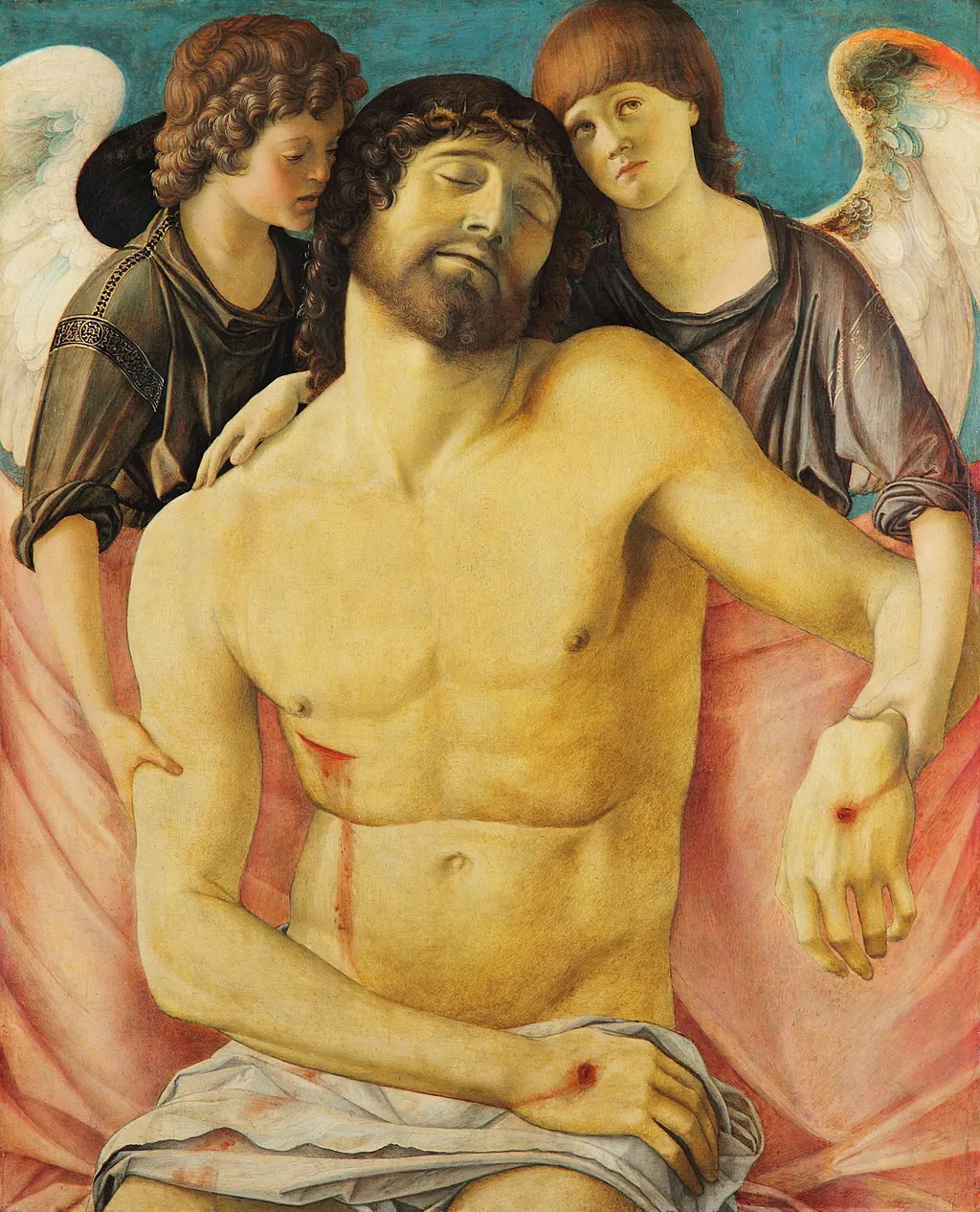
Dead Christ Supported by Two Angels is a tempera painting by the Early Renaissance artist Giovanni Bellini. It dates from 1472 and is held in the collection of the Gemäldegalerie Berlin.
About this work
Subject & Meaning
Such images were designed to evoke meditation on Christ’s suffering and to inspire empathy, functioning as devotional objects for private contemplation.
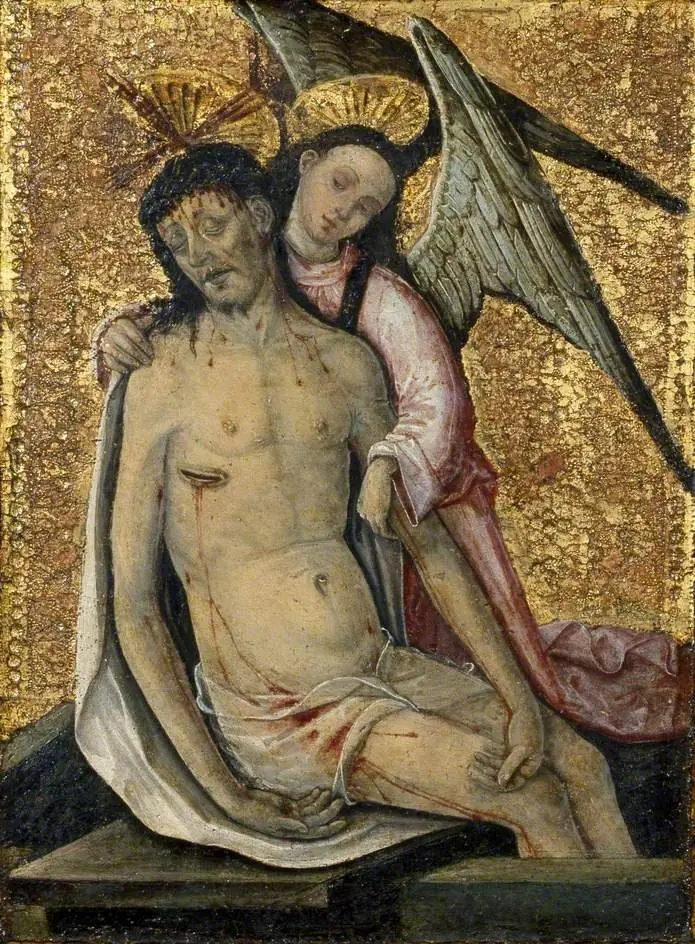
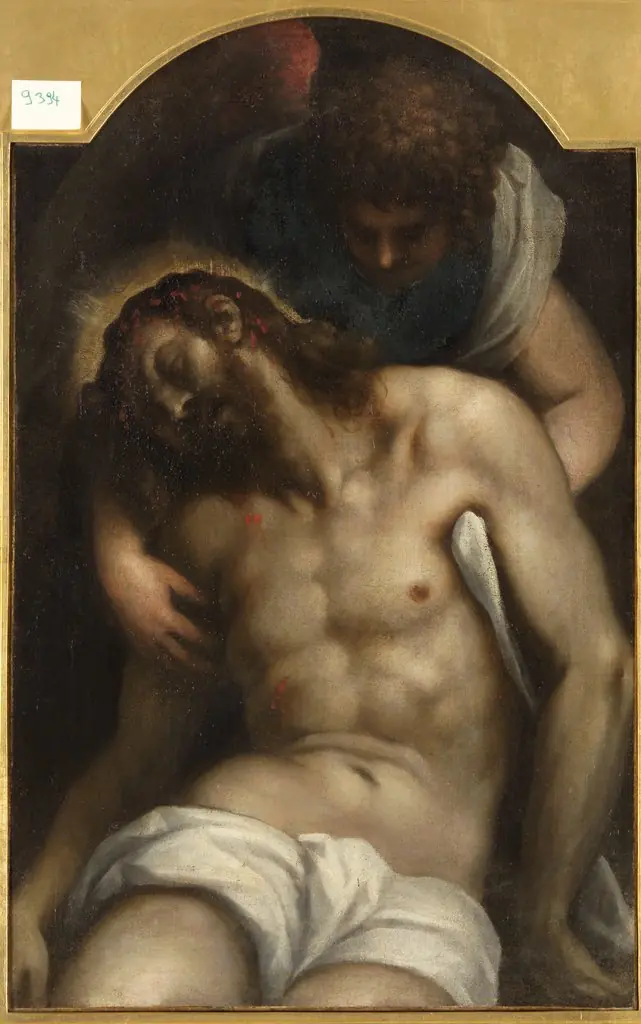
The painting depicts the dead Christ seated upright, supported by two angels who present his body to the viewer. Christ’s closed eyes, pale flesh, and visible wounds emphasize his lifelessness and the physical reality of the Passion. The angels’ youthful, almost aristocratic features and their gentle handling of the corpse contrast with the stark realism of the bloodied wounds and the draped red shroud, grounding the scene in both divine care and human sorrow.
This composition belongs to the Imago Pietatis tradition, which originated in Byzantium and spread in Italy from the thirteenth century onward. Such images were designed to evoke meditation on Christ’s suffering and to inspire empathy, functioning as devotional objects for private contemplation. Bellini’s treatment aligns with the Angel Pietà subtype, where angels rather than the Virgin support the body, a motif linked to Donatello’s marble reliefs in Padua and to French Gothic precedents.
Technique & Style
The artwork is executed in tempera, with some sources indicating the addition of oil, on a panel constructed from glued poplar planks. The support measures approximately 82.9 cm by 66.9 cm and features a prepared ground. The paint layer is reported to be in good condition overall.
Stylistically, the composition fills the picture plane with a high degree of verticality, set against a narrow band of blue sky. The handling of the medium achieves a sculptural effect, particularly in the anatomical modeling of Christ's torso, which mimics the appearance of an antique statue. The artist employs fine brushwork to render realistic details, such as the dried blood trails on the hands and the wound in the side.
A strong chiaroscuro effect is evident, creating contrast between the white loincloth, the crimson shroud, and the dark garments of the angels. The color palette is noted for its brightness and the use of a golden light that unifies the forms.
History & Provenance
Giovanni Bellini's tempera-on-panel Dead Christ Supported by Two Angels was likely produced for private devotion, possibly commissioned by Venetian patrician families for domestic chapels, though no original commission documents survive. Dating has been debated: scholarly estimates range from 1468 (Pignatti) to 1475 (Berenson and Gronau), with Dussler proposing 1480–1485. Stylistic affinities with the Pesaro Altarpiece and Bellini's near-exclusive shift to oil technique around 1475 have narrowed the current consensus to circa 1472–1475, with the Wikidata entry recording 1472.
The earliest documented owner is the English industrialist Edward Solly, in whose Berlin residence the panel was recorded in 1819. Solly's entire collection passed to the Royal Museums in 1821, and the painting was transferred to the newly constituted Gemäldegalerie in 1830, where it remains today.
Attribution was originally given to Andrea Mantegna by Waagen; Frizzoni reassigned it to Bellini in 1871, and the gallery formally accepted this attribution in 1878.
The painting is held by the Gemäldegalerie in Berlin, part of the Staatliche Museen zu Berlin – Preußischer Kulturbesitz. It was first documented in 1819 in the Berlin house of the English industrialist Edward Solly. With Solly's entire collection, it passed to the Royal Museums in 1821, and in 1830 was transferred to the newly constituted Gemäldegalerie.
The work has been exhibited in the show "Giovanni Bellini, crossed influences."
Context
Scholarly consensus identifies Dead Christ Supported by Two Angels as a pivotal work marking Giovanni Bellini's transition into his mature style, dated variously between 1472 and 1475. The painting represents the culmination of the artist's exploration of the Imago Pietatis, a devotional type rooted in Byzantine tradition but revitalized in Venetian art through the sculptural influence of Donatello's Paduan reliefs. Attribution was historically debated; initially assigned to Andrea Mantegna by Waagen in the 19th century, it was definitively reattributed to Bellini by Frizzoni in 1871 and confirmed by Crowe and Cavalcaselle by 1877.
Art historians note the work's synthesis of intense anatomical realism, particularly in the depiction of Christ's wounds, with a soft, golden light that idealizes the figure and anticipates the high Venetian colorism of the late 15th century. This specific composition is regarded as Bellini's final variation on the theme of angels supporting the dead Christ, distinguishing it from his earlier, more skeletal representations.
Legacy
The Berlin panel is regarded as the culminating painted treatment of the Imago Pietatis in Giovanni Bellini's career, marking the apex of a motif he returned to repeatedly from the 1450s onward, as seen in the versions at the Museo Poldi Pezzoli, the Museo Correr, the National Gallery in London, and the polyptych in SS. Giovanni e Paolo in Venice. Its composition descends from the Engelpietà type that entered Italian art from 14th-century France and International Gothic, and it reflects the sculptural influence of Donatello's 1449 bronze altarpiece for the Basilica del Santo in Padua, whose treatment of Christ's torso and supporting angels shaped Venetian renderings of the subject.
The painting is also linked stylistically to Andrea Mantegna, Bellini's brother-in-law, whose own Man of Sorrows with Two Angels offers a parallel devotional image. The work's harmonious, sculptural depiction of Christ's body is credited with prefiguring the neo-Hellenic ideal later pursued by Tullio Lombardo, and its golden luminosity helped define the light thereafter associated with Venetian painting. It was included in the exhibition "Giovanni Bellini, crossed influences."
Overview
Giovanni Bellini's painting, "Dead Christ Supported by Two Angels," dates from approximately 1465 to 1470. This tempera work, a significant example of Italian Renaissance art, is currently held in the Gemäldegalerie, Berlin. It depicts the deceased Christ held by two angelic figures, representing an early phase of Bellini's mature artistic development, characterized by its detailed execution and emotional restraint.
Own this work as a print
Artist & collection

Artist
Giovanni Bellini (Italian: ; Venetian: Zuane Belin; c. 1430 – 29 December 1516) was an Italian Renaissance painter, probably the best known of the Bellini family of Venetian painters. He was raised in the household of…