Artwork
Assumption of the Virgin Mary
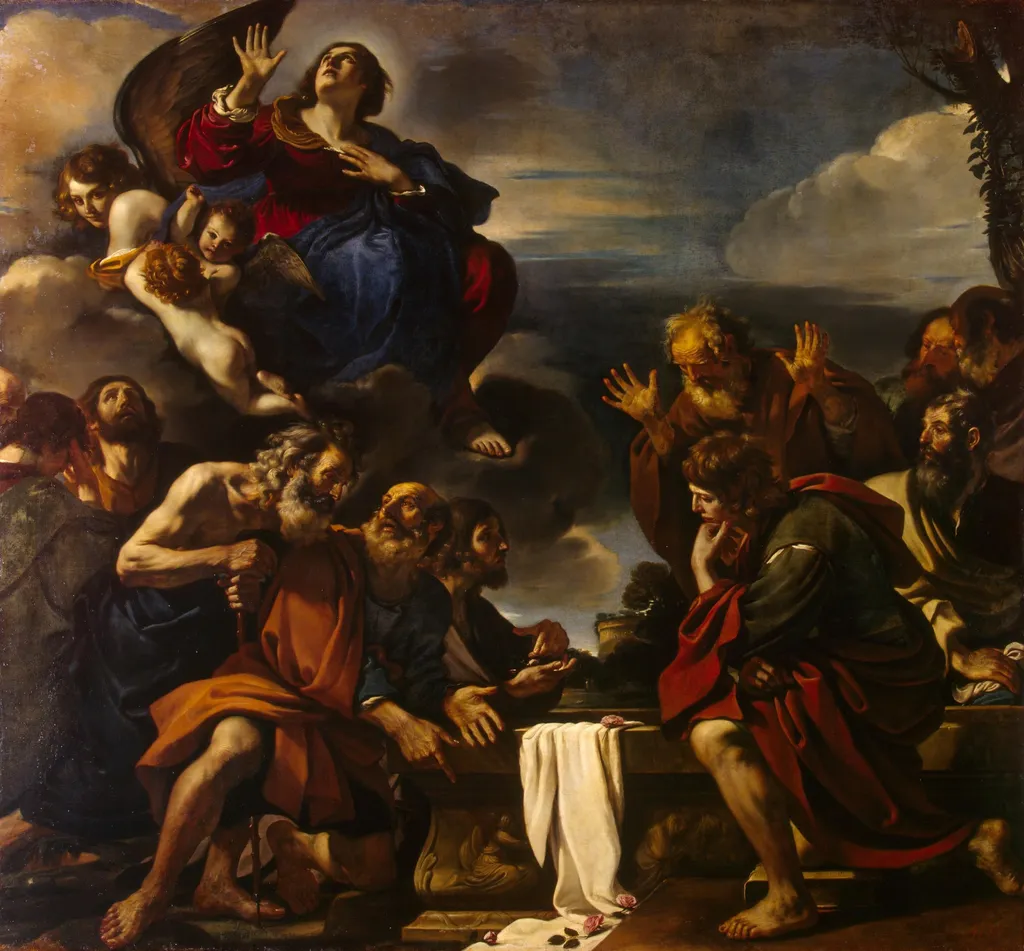
Assumption of the Virgin Mary is an oil painting by the Early Baroque Italian artist Guercino. It dates from 1623 and is held in the collection of the Hermitage Museum.
About this work
Guercino painted this during his early career, before he became one of the most sought‑after painters in Italy.
Assumption of the Virgin Mary is a painting by the Italian artist Guercino, made around 1623. It was created with oil paint on canvas. The work shows the biblical scene of Mary being taken up to heaven.
Guercino painted this during his early career, before he became one of the most sought‑after painters in Italy. Today the canvas hangs in the State Hermitage Museum in Saint Petersburg. If you liked this, you might want to explore more about the State Hermitage Museum.
Overview
The Assumption of the Virgin Mary is an oil-on-canvas painting by the Italian Baroque artist Giovanni Francesco Barbieri, known as Guercino (1591-1666), executed around 1623. Measuring 307 by 332 cm, it is among the largest and most ambitious works from the artist's early maturity. The painting depicts the bodily assumption of the Virgin Mary into heaven, a subject drawn from apocryphal texts rather than the New Testament. Acquired by the Hermitage Museum in Saint Petersburg in the early 1840s, it remains in that collection, displayed in hall 237. The work occupies a significant position in Guercino's oeuvre as a pivotal composition marking his transition from the vigorous naturalism of his early years toward a more measured, classically inflected Baroque manner influenced in part by Guido Reni.
Subject & Meaning
The painting illustrates the Assumption of Mary, an event that became Catholic dogma in 1950 under Pius XII but had long been celebrated in Christian art. The composition is divided between two zones: above, the Virgin rises heavenward on clouds, supported by winged putti, her body slightly turned, face lifted upward, hand to her breast in a gesture combining wonder and acceptance; below, approximately eleven apostles cluster around her empty stone tomb, their reactions varying from arms raised in astonishment to leaning forward to verify the mystery, to animated discussion among themselves. The tomb is draped with a white cloth scattered with pink flowers, serving as material evidence of the miraculous event. The iconography follows established conventions of the subject while emphasizing emotional immediacy: the apostles' varied responses invite the viewer to share in their astonishment, and the ascending Virgin forms the luminous focal point of the composition, her red mantle and blue robe creating a chromatic anchor against the turbulent sky.
Technique & Style
Guercino employed oil on canvas, working on a substantial scale that amplifies the theatrical impact of the scene. The palette is dominated by saturated blues, crimson reds, and warm earth tones, set against a turbulent sky of dark gray and ochre clouds with patches of golden light. Strong chiaroscuro models the figures, with dramatic light falling from upper left and deep shadows pooling in the lower right. The brushwork varies across the surface: smooth, finished handling characterizes the flesh and drapery, while looser, more expressive strokes appear in the sky and background landscape, where distant trees and architectural forms are suggested formative. Denis Mahon, in his 1947 stylistic analysis, observed that the painting shows greater detachment from the artist's earlier works such as the San Crisogono and the Assunta of Cento, with more defined figures and a more soberly diffused light, particularly on the draperies. He characterized the Baroque tremor that animates the Hermitage Assumption as distant from the vigorous contrast of the earlier 'gran macchia,' instead describing it as a diffuse and light Renian tremor, perhaps a memory of Reni's 1617 Assumption in Genoa, an influence that entered Guercino's poetic discourse only after the Aurora of the Casino Ludovisi.
History & Provenance
The earliest documentary record of the painting appears in Carlo Cesare Malvasia's Felsina Pittrice, where under the year 1623 he notes: 'Un'Assunzione della B.V. con i dodici apostoli al Sig. Co. Alessandro Tanari.' The work was commissioned by Count Alessandro Tanari and remained in his family for over two centuries. Around 1844, the Tanari family sold the painting to the Hermitage Museum; this transaction is recorded in Giampietro Zanotti's edition of Malvasia, which though dated 1841 was actually printed in 1844, allowing the editor to note the sale. The museum's official website gives the date as 1843, while the English Wikipedia article states 1841, noting acquisition for the Hermitage by order of Tsar Nicholas I through Pavel Krivtsov, first secretary to the Russian Imperial embassy in Rome. Gaetano Giordani reportedly regretted that Italy had lost 'such a significant work by the famous artist.' The painting arrived in Saint Petersburg in 1842. Before its departure from Italy, a copy was made in 1840, now preserved in the Pinacoteca at the Vatican. An early copy of the figure of John the Evangelist, in a red cloak in the foreground, survives in the Doria Pamphilj Gallery in Rome and was for a time considered an oil sketch by Guercino himself; another early copy of that same figure was auctioned at Christie's in London on 25 October 1985.
Context
The Assumption of the Virgin Mary belongs to a critical juncture in Guercino's career. The Bolognese artist had established his reputation with dramatic, large-scale commissions, but this work signals an opening toward the more refined classicism associated with Guido Reni, whose 1617 Assumption for Sant'Ambrogio in Genoa provided a direct model for the treatment of the apostles. The painting's style has been compared to Guercino's contemporaneous Burial of St. Petronilla, and one figure has been identified as identical to his Saint Matthew in Dresden. Mahon's analysis places the work within a broader pattern of experimentation in Guercino's practice following the Aurora fresco of the Casino Ludovisi, a turning point after which the artist, previously resistant to Reni's influence, began incorporating elements of his rival's manner into his own distinctive idiom. The commission by Alessandro Tanari reflects the continued demand for large-scale religious narratives among Bolognese aristocratic patrons in the early 1620s, a market in which Guercino was increasingly competitive following his move to Rome in 1621.
Legacy
The Assumption of the Virgin Mary has maintained its standing as a major work of Guercino's early maturity, preserved and prominently displayed at the Hermitage Museum for nearly two centuries. Its acquisition by Tsar Nicholas I represents a significant instance of nineteenth-century Russian imperial collecting of Italian Baroque painting, part of a broader pattern of cultural transfer that drew criticism from Italian commentators like Giordani. The existence of multiple early copies, including the 1840 Vatican copy made before the painting's departure from Italy and the versions of the John the Evangelist figure in Rome and at auction, attests to the work's reputation and influence among contemporaries. In scholarly literature, the painting has served as a key document in tracing Guercino's stylistic evolution, particularly the shift from his early manner toward a more classical Baroque sensibility. Mahon's 1947 analysis remains foundational for understanding this transition, and the work continues to be cited in discussions of the relationship between Guercino and Reni, two of the most significant painters of the Bolognese school. Its presence in the Hermitage has ensured consistent public access and sustained scholarly attention, distinguishing it from many comparable works that remain in less accessible private or ecclesiastical collections.
Own this work as a print
Artist & collection
Artist
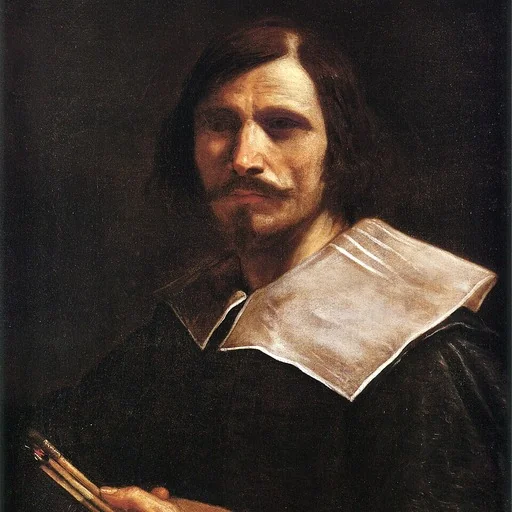
Giovanni Francesco Barbieri (8 February 1591 – 22 December 1666), better known as (il) Guercino (Italian pronunciation: ), was an Italian Baroque painter and draftsman from Cento in the Emilia region, who was active in Rome and Bologna.