Artwork
Cardinal Francesco Cennini
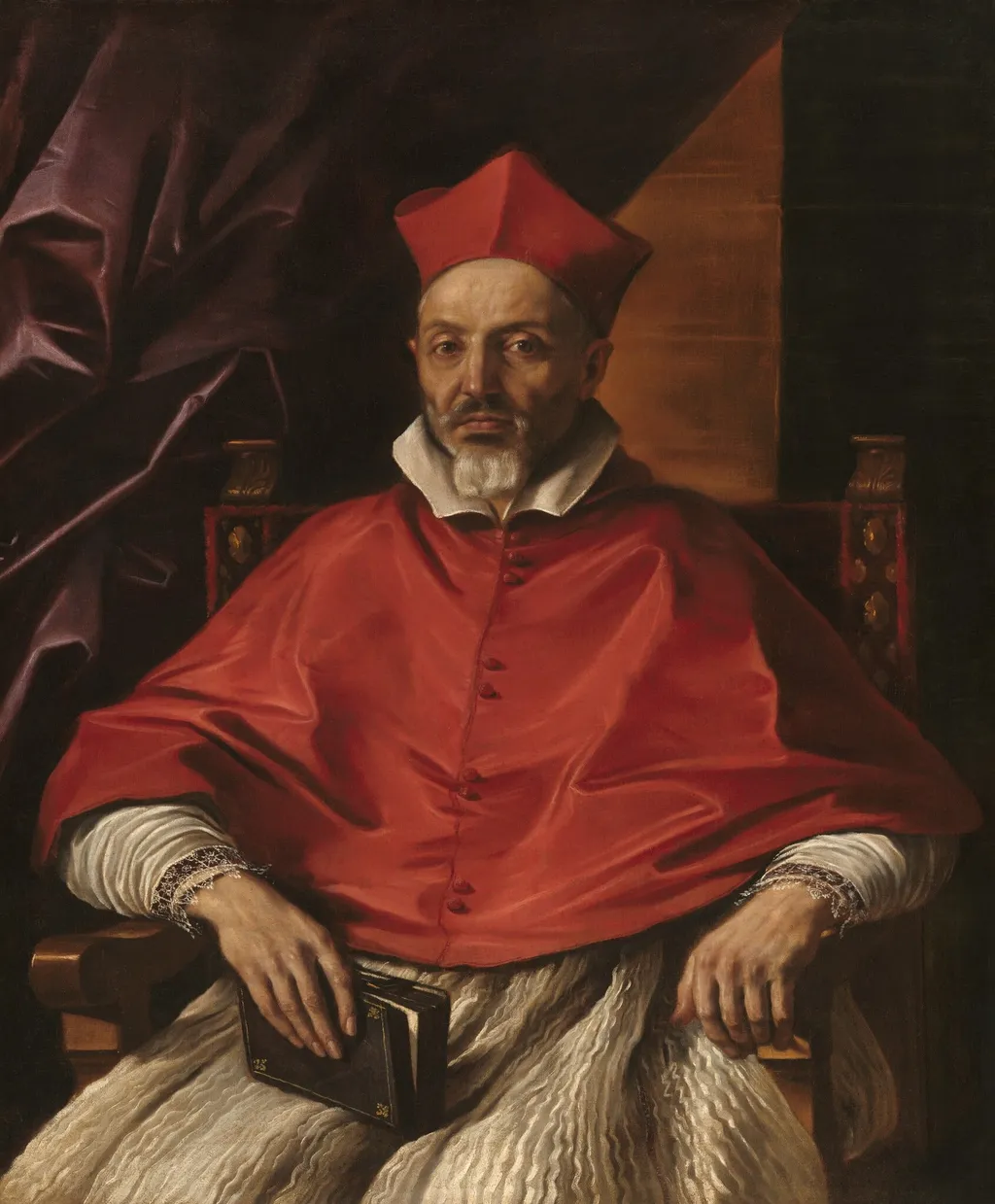
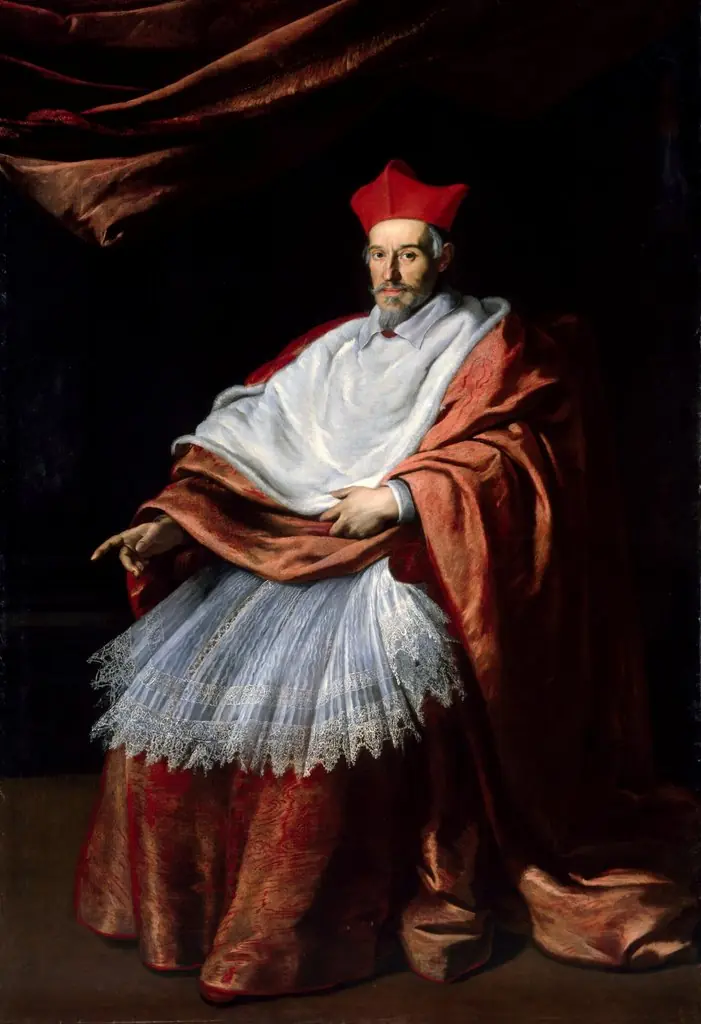
Cardinal Francesco Cennini is an oil painting by the Baroque artist Guercino. It dates from 1625 and is held in the collection of the National Gallery of Art.
About this work
Subject & Meaning
The composition emphasizes the subject's institutional authority rather than individual personality, presenting him as a solemn ecclesiastical figure.
The work depicts Cardinal Francesco Cennini seated frontally on an ornate chair, dressed in traditional red cardinalatial robes with a stiff collar and a short white beard. His hands rest firmly on the armrests, grasping a leather-bound volume with metal clasps, while a dark diagonal curtain isolates the figure against the background. The composition emphasizes the subject's institutional authority rather than individual personality, presenting him as a solemn ecclesiastical figure.
Art historical analysis interprets this austere and sculptural treatment as a deliberate shift toward a more idealized, classical representation of church dignity, contrasting with the artist's earlier, more naturalistic style. The frontal pose and controlled, cooler color palette serve to project an image of rigid, unyielding power.
Technique & Style
Executed in oil on canvas, the portrait measures 117.4 by 96.2 cm. The cardinal is shown frontally, seated on a carved armchair, wearing the traditional red cardinal's robes, which are rendered with careful attention to the folds of the mantle and the layering of textiles. His hands rest firmly on the armrests, holding a leather-bound volume with metal clasps. The face, framed by a short white beard and a large stiff collar, is illuminated by even light that sculpts the features with strong plastic relief. A dark curtain arranged diagonally behind the figure isolates the sitter and intensifies his presence.
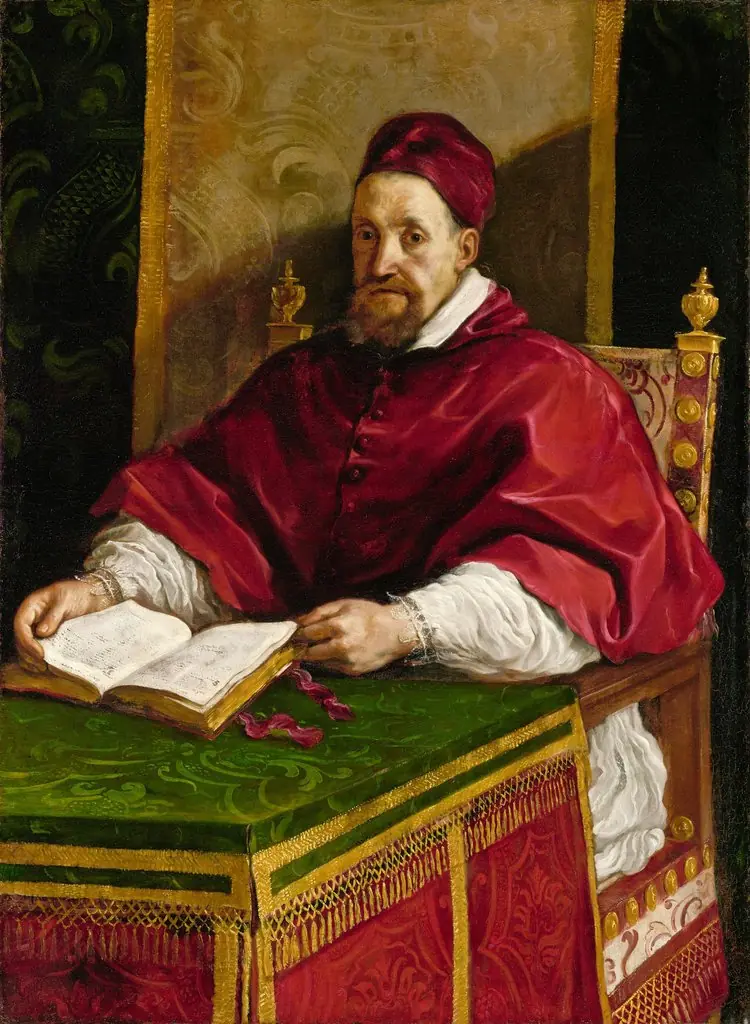
According to Denis Mahon's interpretation, the 1625 portrait marks a turning point in Guercino's portraiture compared with the more natural, human likeness of Pope Gregory XV (1622–23). The handling here is more abstract and solemn: the cardinal appears as an institutional figure rather than an approachable individual, and the head is treated with an almost sculptural intensity meant to impose itself on the viewer. The frontal pose reinforces the figure's authority, while the color remains vivid but cooler and more controlled than in earlier works.
Mahon observes that the touch is firmer, almost severe, departing from the spontaneity typical of Guercino's portraits of 1619–20, a stiffening of language possibly reflecting a reaction to criticism of the Gregory XV portrait's naturalism and an alignment with classicizing-idealist principles favored by contemporary theorists such as Passeri.
History & Provenance
The portrait of Cardinal Francesco Cennini was executed by Guercino around 1625. It first appears in the collection of Dr. J. Seymour Maynard in London, who sold it at Christie's on 29 January 1954 (lot 58). The work was subsequently acquired by Thomas Agnew & Sons, London, and that same day resold to the David M. Koetser Gallery in New York, London and Zurich.
Samuel H. Kress purchased it in 1955, and in 1961 he gifted the painting to the National Gallery of Art, Washington, where it remains. No earlier ownership is documented.
The painting is held in the permanent collection of the National Gallery of Art in Washington, D.C., as part of the Samuel H. Kress Collection. It was acquired by the museum in 1961 as a gift from the Kress Foundation, having been purchased the previous year by the foundation from the David M. Koetser Gallery. The work's inventory history traces back to Dr. J. Seymour Maynard of London, who sold it at Christie's on January 29, 1954, before it passed through Thomas Agnew and Sons and the Koetser Gallery.
Regarding exhibition history, the portrait was displayed in Bologna from September 10 to November 10, 1986. It appeared in the exhibition titled "Nell'età del Correggio e dei Carracci. Pittura in Emilia dei secoli XVI e XVII" at the Pinacoteca Nazionale, the Accademia delle Belle Arti, and the Museo Civico Archeologico, where it was cataloged as number 166.
Context
The portrait of Cardinal Francesco Cennini has been treated as a significant pivot in Guercino's development as a portraitist. According to Denis Mahon's reading, the 1625 canvas marks a turn away from the warmer, more spontaneous manner of his earlier portraits, such as the more naturalistic likeness of Pope Gregory XV (1622–23), toward a more solemn, institutional mode of representation. Mahon links this shift to a possible reaction against criticism of the Gregory XV portrait's naturalism, suggesting an alignment with the more classicizing ideals favored by contemporary theorists like Giovanni Battista Passeri.
He also situates the Cennini alongside Guido Reni's 1625 portrait of Cardinal Ubaldini, reading both as expressions of a shared Emilian cultural climate balancing individual characterization with idealized ecclesiastical dignity. The painting was published by Mahon in 1981 and featured in the 1986 Bologna exhibition Nell'età del Correggio e dei Carracci (no. 166), securing its place in the scholarly reassessment of early Seicento Emilian portraiture.
The work's provenance, from the collection of Dr. J. Seymour Maynard through Christie's in 1954, the Agnew and Koetser galleries, and ultimately the Samuel H. Kress Foundation's 1961 gift to the National Gallery of Art, has been documented by Fern Rusk Shapley in the Kress Collection catalogues, providing the foundational reference for subsequent study.
Legacy
The painting's scholarly legacy is closely tied to the writings of Sir Denis Mahon, who published it in 1981 and later featured it in his 1986 exhibition catalogue Nell'età di Correggio e dei Carracci. Mahon read the portrait as a pivotal moment in Guercino's development, marking a shift away from the naturalistic immediacy of his earlier portrait of Pope Gregory XV (1622–23) toward a more solemn, institutional mode of representation. He argued that the abstracted, sculptural handling and cooler palette reflected a response to contemporary criticism and a turn toward the classicizing ideals championed by theorists such as Passeri.
Mahon also situated the work alongside Guido Reni's 1625 portrait of Cardinal Ubaldini, framing both as expressions of a shared Emilian cultural climate balancing individual likeness with ecclesiastical dignity. The painting's inclusion in the 1986 Bologna exhibition and its 1961 accession to the National Gallery of Art through the Kress Foundation secured its place in subsequent Italian-school catalogues and connoisseurship literature.
The work has been cited in subsequent catalogues, including Shapley's 1979 Catalogue of Italian Paintings at the National Gallery of Art, cementing its status within the standard corpus of Guercino studies.
Overview
Guercino's Cardinal Francesco Cennini, painted in 1625, is an oil on canvas portrait that exemplifies the Italian early Baroque style. Created by Giovanni Francesco Barbieri, known as Guercino, this work showcases the artist's approach to portraiture during a significant period of his career. It captures the likeness of a high-ranking cleric, reflecting the artistic trends and patronage of 17th-century Italy.
Own this work as a print
Artist & collection
Artist
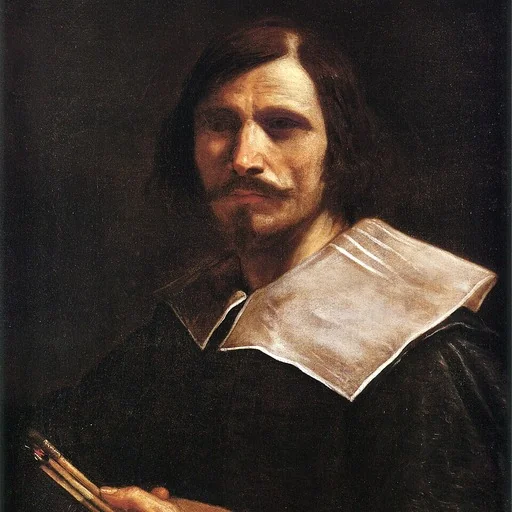
Giovanni Francesco Barbieri (8 February 1591 – 22 December 1666), better known as (il) Guercino (Italian pronunciation: ), was an Italian Baroque painter and draftsman from Cento in the Emilia region, who was active in Rome and Bologna.