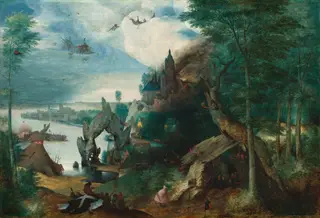
Artwork
The Temptations of Saint Anthony
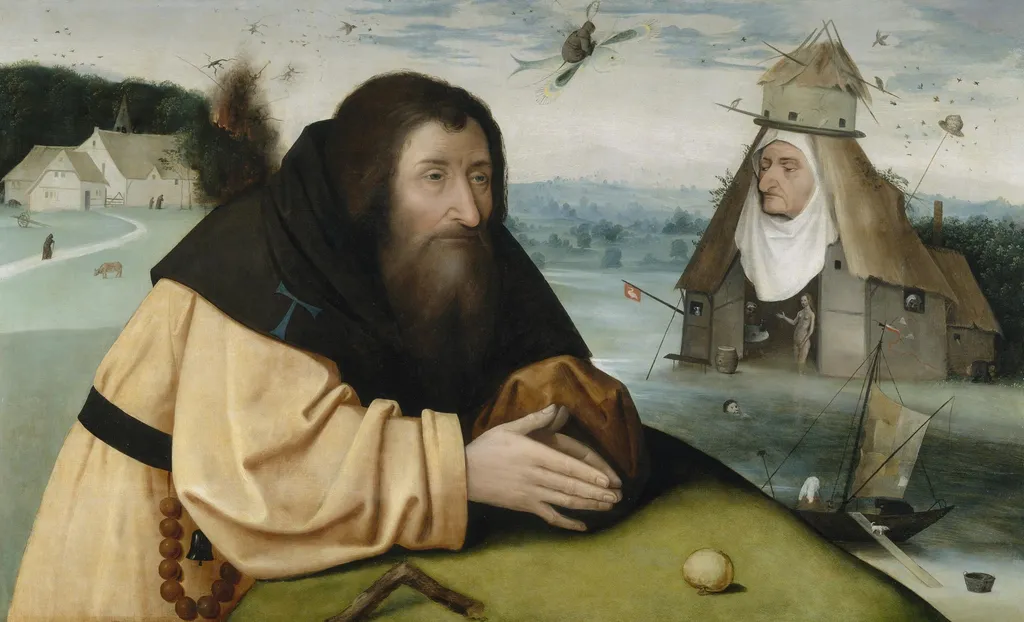
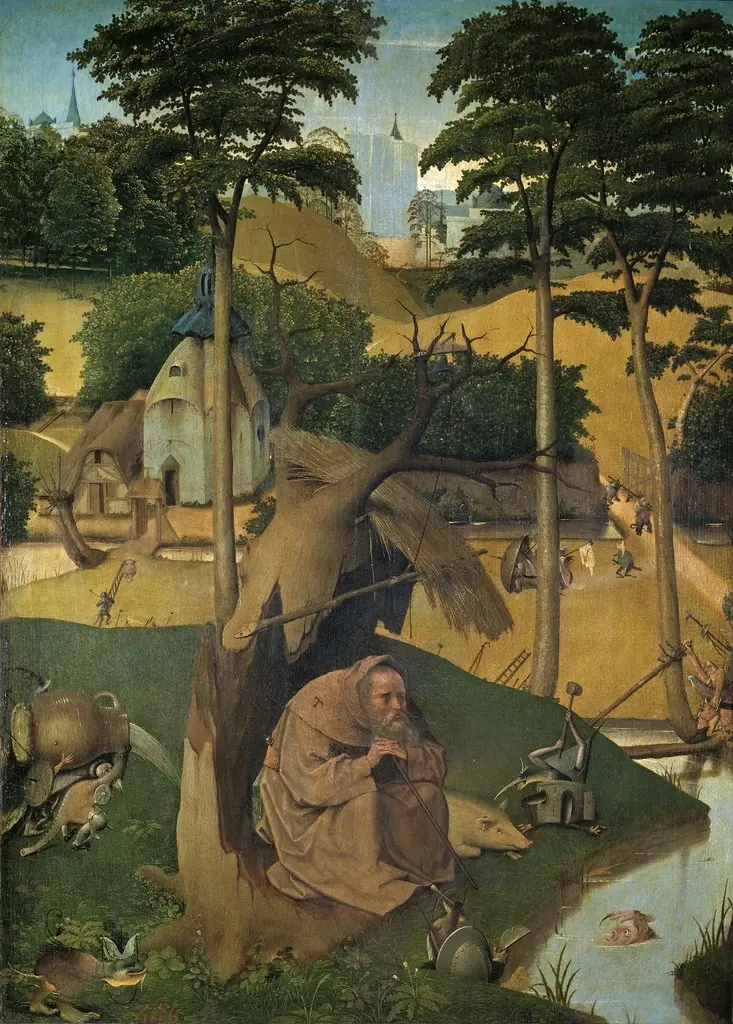
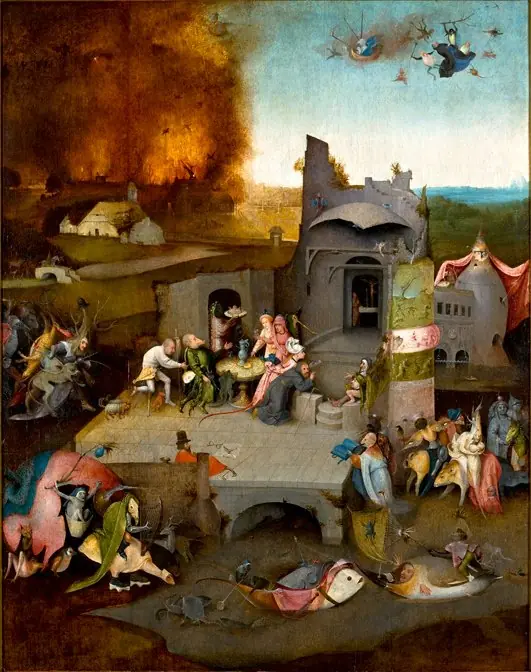
The Temptations of Saint Anthony is an oil painting by the Northern Renaissance artist Hieronymus Bosch. It dates from 1510 and is held in the collection of the Museo del Prado.
About this work
Subject & Meaning
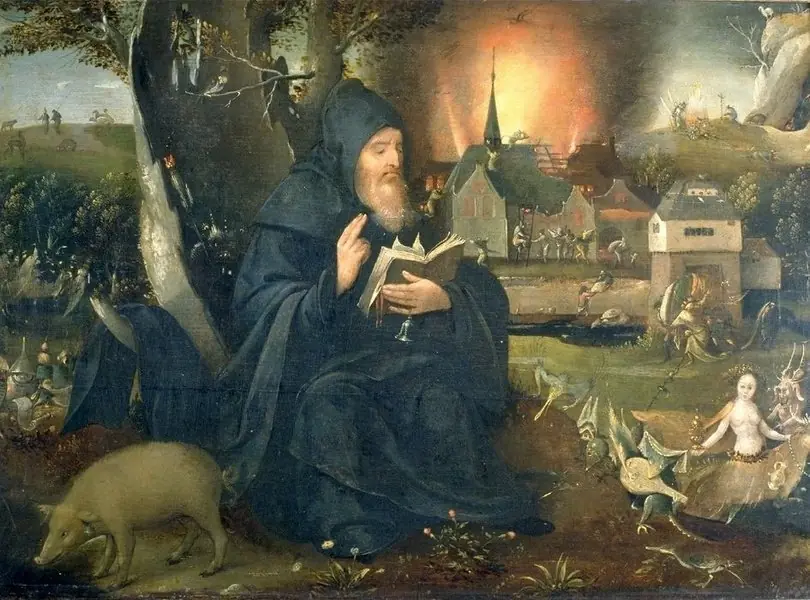
The painting depicts Saint Anthony the Great, identifiable by his tau-shaped habit, in a complex scene of spiritual trial.
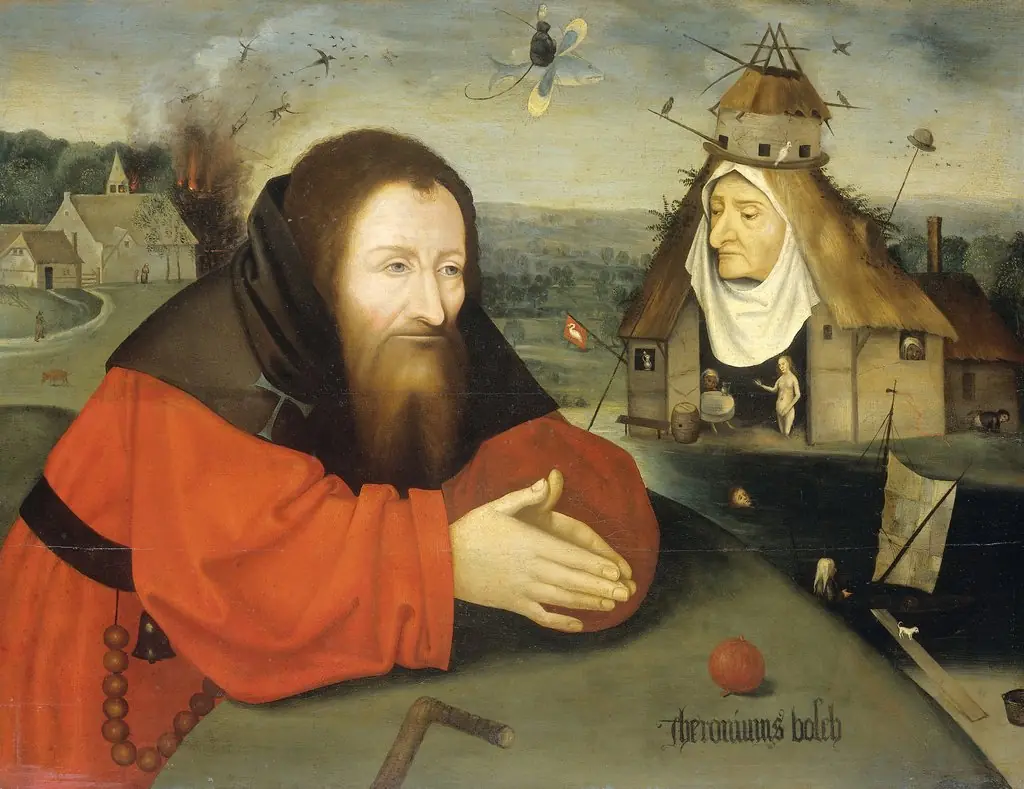
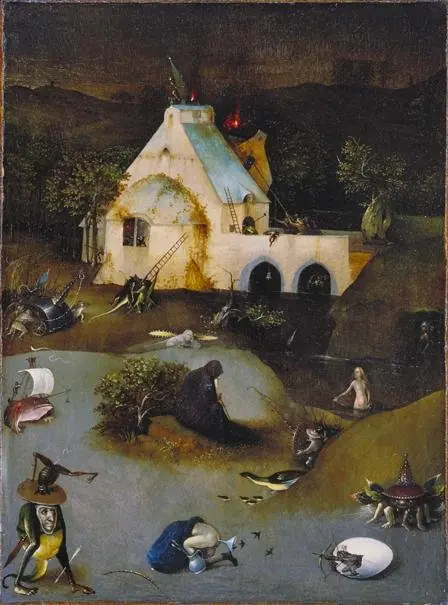
The painting depicts Saint Anthony the Great, identifiable by his tau-shaped habit, in a complex scene of spiritual trial. He is shown praying, seated on a mossy rock, while supernatural temptations surround him: demons assault a monastery in the background, a naked woman and a pitcher of wine tempt him at the door of an enigmatic house, and a monk rides a winged fish in the sky. The work is rich in symbolic elements, including a house topped by a giant old woman's head with a pigeon loft, a swan sign, a woman at a window, and a barrel, all linked to contemporary moral allegories.
Two other versions exist, one in the Rijksmuseum and another in the Escurial, and the Prado's version entered the museum in 1948 after a complex provenance involving seizure during the Mendizábal desamortization and display at the Museum of the Trinidad.
Technique & Style
Executed in oil on oak panel, the work measures 70 cm in height and 115 cm in width. The composition centers on Saint Anthony, shown in half-length at left, identifiable by the Tau-shaped hood of his habit, kneeling in prayer amid rocky terrain. To his right, a distorted house with a colossal, hooded woman’s head surmounted by a dovecote frames a brothel-like interior, where a nude woman and a wine jug appear at a doorway; outside, a defecating figure recalls a motif from Bosch’s Rotterdam Pedlar.
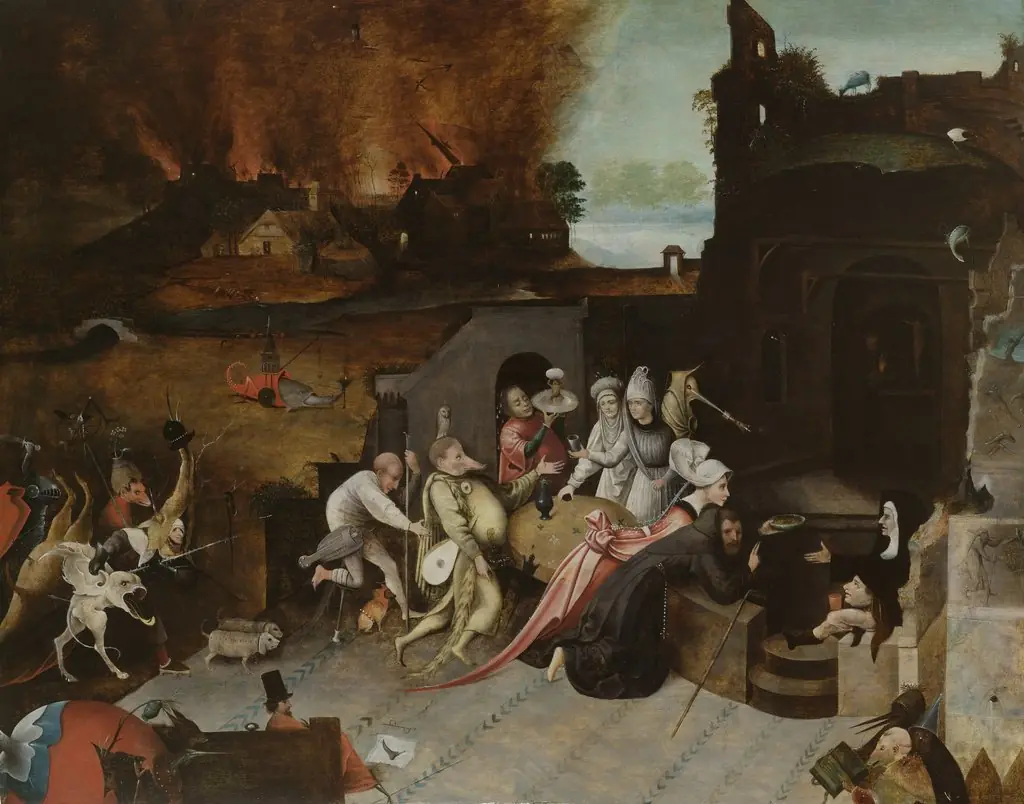
In the middle ground, a burning monastery and airborne demons occupy the left, while a swimmer and a small sailboat occupy the right. Above, a monk riding a winged fish echoes figures on the inner shutters of the Lisbon Temptation of Saint Anthony triptych. The handling departs from Bosch’s autograph manner, with smoother modeling and less complex brushwork, leading scholars to attribute it to a follower or workshop assistant rather than the master himself.
History & Provenance
The Temptations of Saint Anthony is attributed to a follower or workshop of Hieronymus Bosch and dated circa 1510–1515 based on dendrochronological analysis that sets the earliest possible creation at 1486. The oak panel (70 × 115 cm) was likely produced during Bosch’s lifetime, though its composition and technique differ from his autograph works, leading scholars to propose either a lost original or a studio pastiche using the master’s models.
The painting entered Spanish ecclesiastical ownership before 1836, when it was confiscated during the Mendizábal disentailment. It was displayed at the short-lived Museo de la Trinidad from 1838 and transferred to the Museo del Prado in 1872. Loaned to the Basilica of San Francisco el Grande in 1882, it spent the 1930s at the Ministry of Foreign Affairs before returning to the Prado in 1948, where it remains.
The work is held by the Museo del Prado, Madrid, where it is inventoried as oil on oak, 70 cm high by 115 cm wide.
It entered the Prado from the Museo de la Trinidad in 1872 after being seized during the 1836 Mendizábal desamortización from a Spanish convent or church. The Prado lists the attribution to the studio or followers of Hieronymus Bosch, dating the panel to the early sixteenth century.
Exhibited in the Prado’s 2016 centennial show Bosch: The 5th Centenary Exhibition, the painting has also been shown in 1882 at the Basilica of San Francisco el Grande and loaned in 1930 to the Ministry of Foreign Affairs.
Context
Scholarly debate centers on attribution and dating. Dendrochronology places the Prado panel’s oak no earlier than 1486, with stylistic analysis proposing a production around 1510–1515, during Bosch’s lifetime.
Early twentieth‑century critics such as Gustav Glück and Jacques Combe argued the composition derived from a lost original; later studies, including those by Jan Victor Lucien Brans and a team led by Carmen Garrido, favored a later pastiche by a follower or workshop assistant. Pilar Silva Maroto, curator of the Prado’s 2016 Bosch centenary exhibition, detected minor pentimenti inconsistent with a studio copy but allowed the possibility that the work was produced by an artist employed in Bosch’s workshop or one of his assistants using the master’s models.
The painting’s reception has been shaped by its inclusion in major Bosch retrospectives, where it is presented as part of the broader corpus of works connected with the master’s circle.
Legacy
The painting has inspired numerous later interpretations, including copies in the Rijksmuseum, Amsterdam, and the Escurial, where the original's brothel scene was replaced by a crucifix. Early 19th-century ownership by a Spanish convent ended with seizure during the Mendizábal disentailment, after which it entered the Prado collection in 1872 and remained on display there until 1948. Contemporary scholarship views the work as either a lost original copy or a pastiche by a Bosch workshop assistant, with dendrochronological data placing the panel's felling between 1543 and 1554, well after Bosch's death in 1516.
Stylistic differences from Bosch's authenticated works have led to debates over authorship, though the Prado's 2016 exhibition catalog notes subtle pentimenti that do not confirm an original lost work. The composition's complex iconography, including demonic assaults and symbolic temptations, has been widely analyzed for its influence on Northern Renaissance art.
Overview
Created circa 1510 by the Brabant painter Hieronymus Bosch, this oil painting on oak panel portrays the legendary temptations of Saint Anthony the Great. The work forms part of a larger series in which Bosch explored religious narratives through densely populated, fantastical scenes. Today the panel belongs to the collection of the Museo del Prado in Madrid.
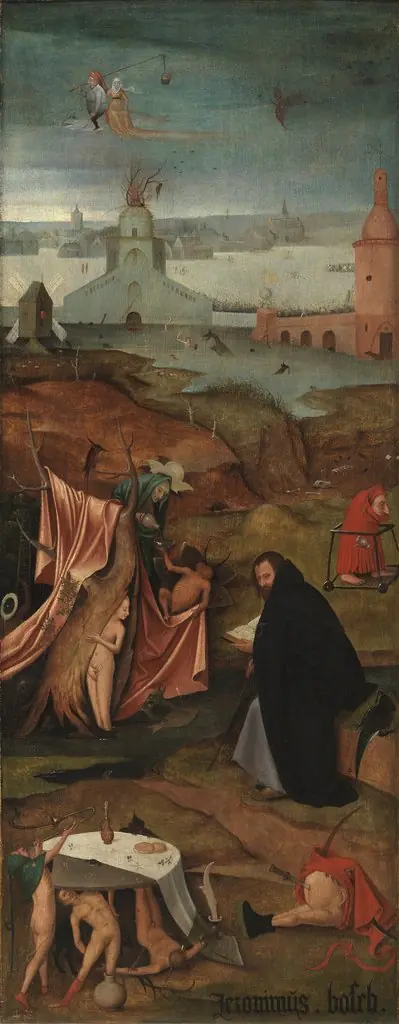
Artist & collection
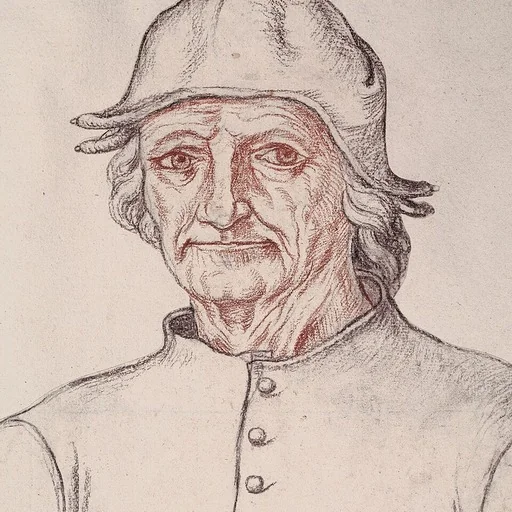
Artist
Hieronymus Bosch (; Dutch:; born Jheronimus van Aken; c. 1450 – 9 August 1516) was a Dutch painter from Brabant. He is one of the most notable representatives of the Early Netherlandish painting school. His work,…