Artwork
The Troubadour
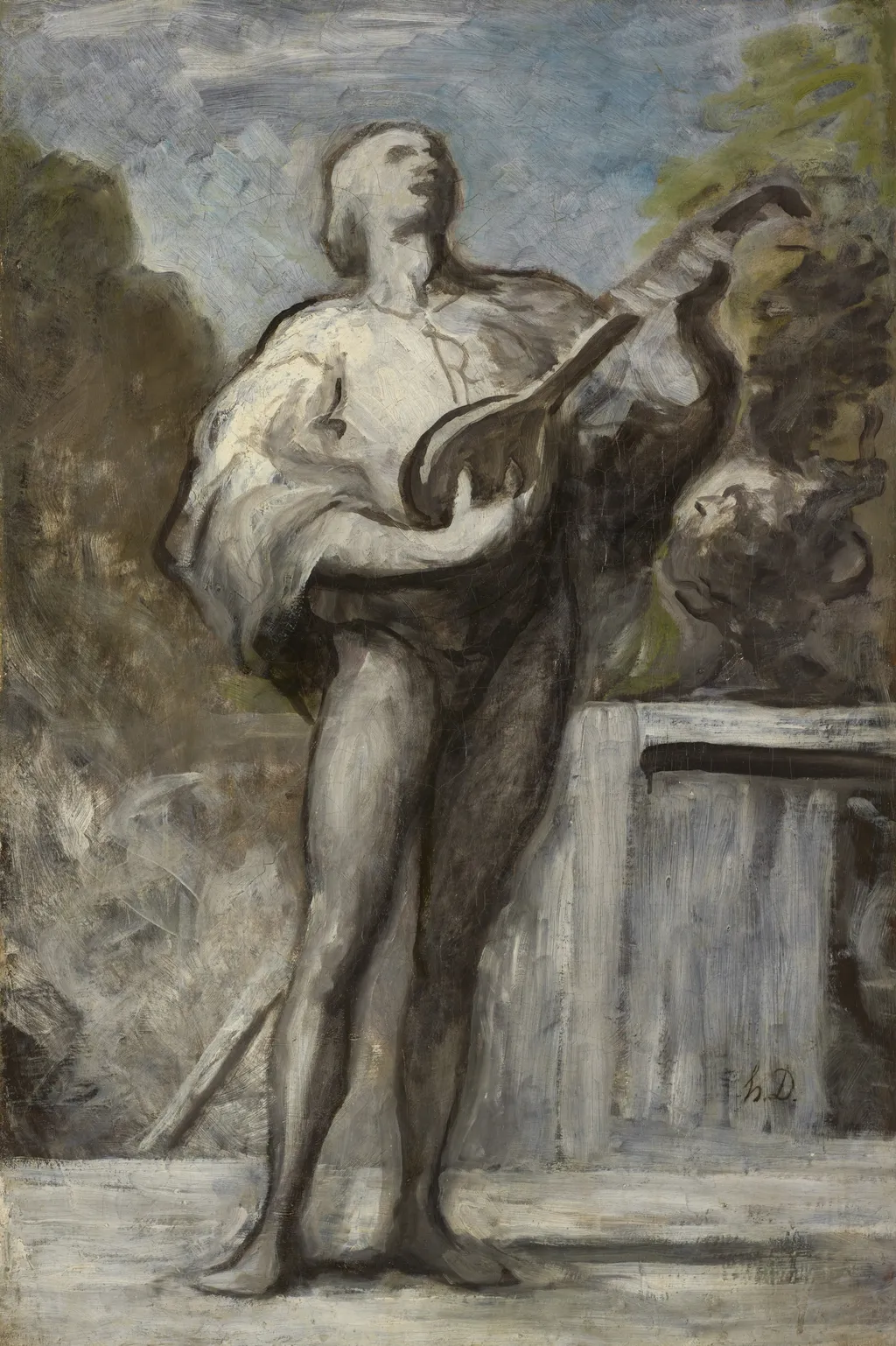
The Troubadour is an unspecified painting by the Realist artist Honoré Daumier. It dates from 1868 and is held in the collection of the Cleveland Museum of Art.
About this work
Technique & Style
8 cm in width and depicts a seated troubadour in a theatrical pose, his head and gesturing hands rendered with Daumier's characteristic expressive emphasis.
The Troubadour is painted in oil on canvas, executed in Daumier's later career when his figure style had coalesced into broad, simplified forms and incisive contours. The composition employs a muted palette of earthy browns, ochres, and subdued greens, concentrating attention on the central figure. Handling is confident yet economical, defining volume through decisive strokes rather than fine detail.
The painting measures 83.6 cm in height by 56.8 cm in width and depicts a seated troubadour in a theatrical pose, his head and gesturing hands rendered with Daumier's characteristic expressive emphasis.
History & Provenance
Honoré Daumier executed the painting The Troubadour in France in 1868. The work later belonged to the collection of Justin K. Thannhauser before its acquisition by the Cleveland Museum of Art, which holds it under accession number 1958.23.
Legacy
Honoré Daumier's The Troubadour (1868) influenced later narrative painting through its dramatic chiaroscuro and psychological intensity, particularly shaping Realist approaches to literary subjects. The work entered the Cleveland Museum of Art collection via Justin K. Thannhauser's bequest, cementing its institutional legacy as a key transitional piece between Romanticism and Realism.
The painting's composition informed contemporaries' treatment of historical narrative, with its expressive figures and atmospheric depth cited in 19th-century European art criticism as a precursor to modernist storytelling in visual art.
Overview
Honoré Daumier’s 1868 canvas titled The Troubadour is part of the collection at the Cleveland Museum of Art. The work depicts a solitary figure outdoors, engaged in music, and exemplifies Daumier’s interest in everyday subjects rendered with a painterly vigor that distinguishes his later output.
Subject & Meaning
The central figure is a man in loosely draped attire, standing amid an indistinct landscape of trees and sky while cradling a lute. His posture and focused expression suggest a moment of private performance, evoking the romantic notion of the wandering minstrel who brings art to public spaces.
Context
During the 1860s Daumian expanded beyond his well‑known caricatures to explore genre scenes that captured ordinary life. The Troubadour aligns with this shift, illustrating a solitary musician, a subject that resonated with contemporary audiences fascinated by the romantic ideal of the itinerant artist.
Own this work as a print
Artist & collection
Artist
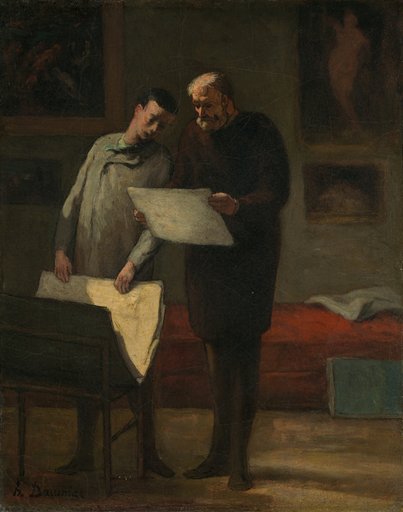
Honoré-Victorin Daumier (French: ; 26 February 1808 – 10 or 11 February 1879) was a French painter, sculptor, and printmaker, whose many works offer commentary on the social and political life in France, from the…









![Seated Satyr Leaning Backward [recto], by Jean-Baptiste Deshays](https://artifactworldgallery.com/img/jean-baptiste-deshays--seated-satyr-leaning-backward-recto--46579a155129856e-w320.webp)