Artwork
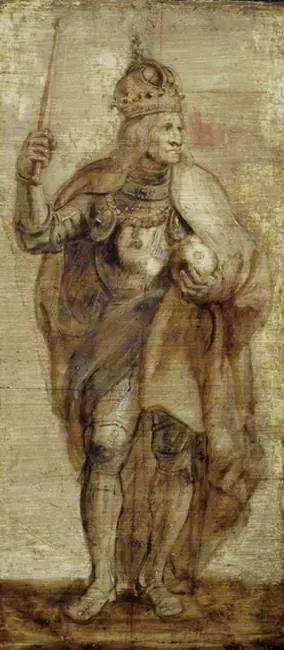
Statue of Frederick III in a niche
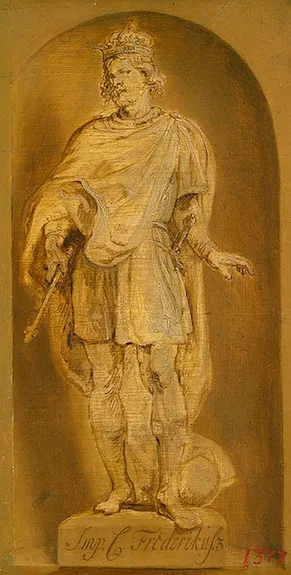
Statue of Frederick III in a niche is an oil painting by the Flemish Baroque painting artist Peter Paul Rubens. It dates from 1634 and is held in the collection of the Hermitage Museum.
About this work
He’s dressed in old-fashioned armor and robes, holding a sword in one hand and a staff in the other.
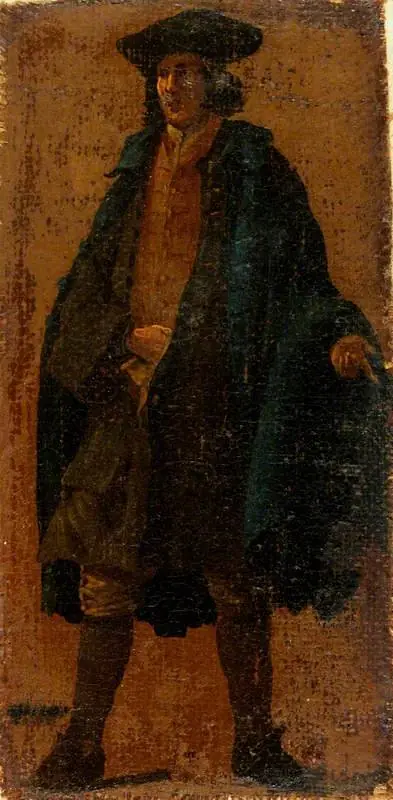
This painting shows a tall man in a golden-brown frame shaped like an arch. He’s dressed in old-fashioned armor and robes, holding a sword in one hand and a staff in the other. His face looks serious, with a crown on his head and a fur draped over his shoulder.
The artist signed it in the corner, P.P. Rubens, and added the year 1634. The colors are warm and earthy, with shadows making his clothes look textured.
Next, check out chiaroscuro to see how light and dark create depth like this.
Subject & Meaning
The work portrays Frederick III, Holy Roman Emperor, identified by his sword and sceptre, within a decorative niche. Peter Paul Rubens created the portrait in 1634 using oil paint on oak panel, reflecting the subject's imperial authority and status. The composition emphasizes the emperor's political prominence through the symbolic attributes he holds.
Technique & Style
Created in 1634, the Statue of Frederick III in a niche is an oil painting executed on an oak panel support. The work measures 38.5 cm in height and 20.5 cm in width. As a portrait genre piece, it depicts the Holy Roman Emperor Frederick III holding a sword and sceptre within a niche setting. The piece is classified as a painting originating from Flanders.
History & Provenance
The painting was created by Peter Paul Rubens in 1634, executed in oil on oak panel in Flanders. It depicts Frederick III, Holy Roman Emperor, shown with a sword and sceptre.
The work later entered the collection of Catherine II of Russia. It is now held by the Hermitage Museum, which remains its current location.
Legacy
The niche statue of Frederick III, attributed to Peter Paul Rubens and created in 1634, circulated through elite collections such as the Hermitage Museum after Catherine II acquired it, shaping perceptions of imperial portraiture in Northern Europe. Its compositional vigor influenced later court artists who sought to emulate Rubens's blend of authority and realism in rendering sovereigns. The work's prominence in Hermitage displays reinforced the narrative of Frederick III as a model ruler, guiding 18th-century diplomatic gift exchanges across European courts.
Overview
Created in 1634 by the Flemish painter Peter Paul Rubens, this oil on canvas presents a portrait of Frederick III, Holy Roman Emperor. The figure stands within a shallow architectural niche, rendered in the warm, earthy palette typical of Rubens’s mature Baroque style. The work is held in the collection of the State Hermitage Museum in St. Petersburg.
Context
The work belongs to Rubens’s later period, when he was active as both artist and diplomat, and aligns with the Counter‑Reformation’s visual agenda that favored vivid, emotionally resonant imagery. By portraying a historical ruler with grandeur, Rubens reinforced contemporary ideals of authority and divine right.
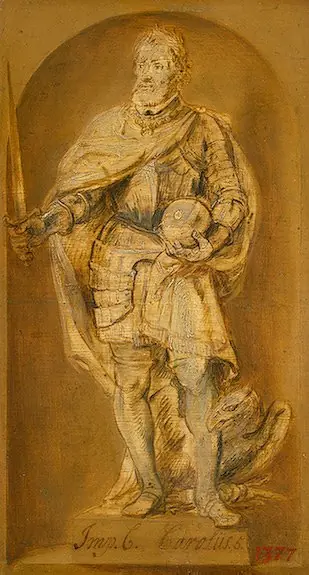
Artist & collection
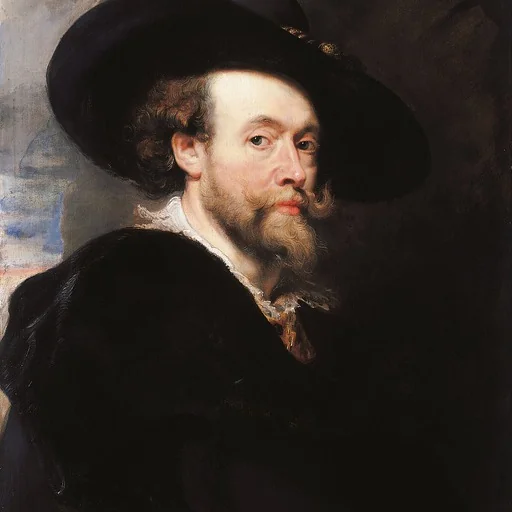
Artist
Sir Peter Paul Rubens ( ROO-bənz; Dutch:; 28 June 1577 – 30 May 1640) was a Flemish artist and diplomat.