Artwork
Danae
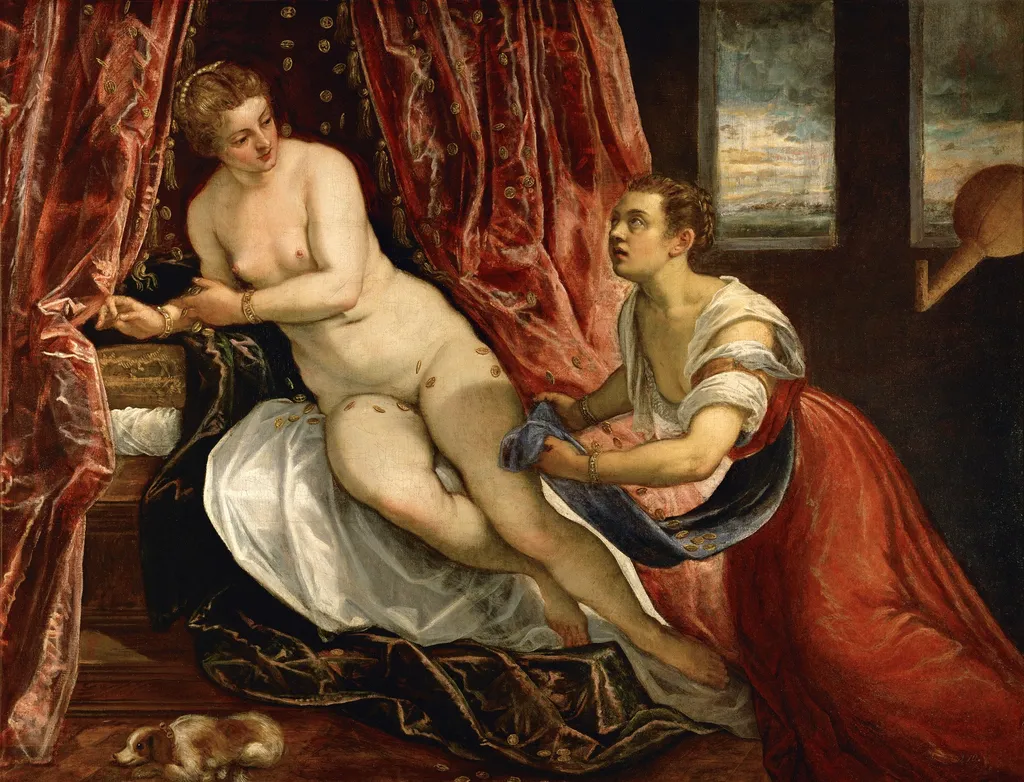
Danae is an oil painting by the Mannerist artist Jacopo Tintoretto. It dates from 1570 and is held in the collection of the Museum of Fine Arts of Lyon.
About this work
Subject & Meaning
Zeus enters as a shower of gold, impregnating her and fathering Perseus, whose later accidental killing of Acrisius fulfills the prophecy.
The painting depicts the myth of Danae as told in Ovid's Metamorphoses: Acrisius, warned by an oracle that he would be killed by his grandson, imprisons his daughter Danae in a bronze chamber. Zeus enters as a shower of gold, impregnating her and fathering Perseus, whose later accidental killing of Acrisius fulfills the prophecy. In Tintoretto's version, Danae is shown nude on a bed, attended by a maidservant who gathers the golden coins from her body, underscoring the materialization of Zeus's seduction.
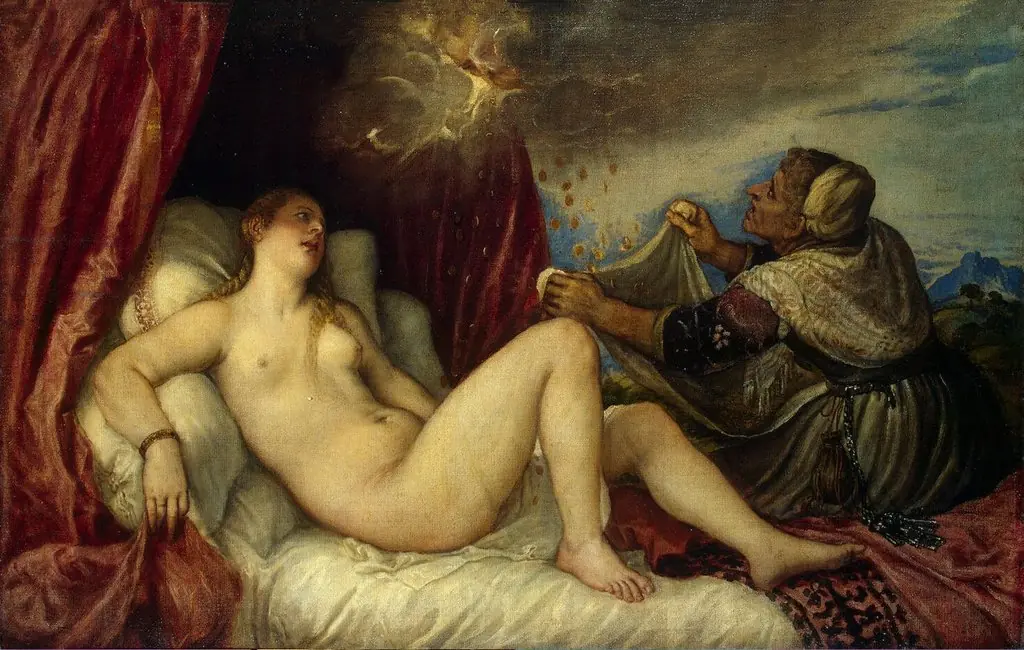
The scene is stripped of Titian's poetic idealization; instead, Danae appears calculating, her focus on counting the gold, while the young maidservant occupies the foreground, contrasting with Titian's older servant. A sleeping dog in the lower left, traditionally a symbol of marital fidelity, is used ironically here, given Zeus's adulterous act. Some critics suggest the figure of Danae was modeled on Veronica Franco, a celebrated Venetian courtesan, implying a contemporary Venetian reading of the myth tied to the king of France's 1574 encounter with her.
Technique & Style
Executed in oil paint on canvas around 1570, this work measures 142 by 182 cm. The painting exemplifies the Venetian school and Mannerist movement through its handling of color and form. Tintoretto employs a rapid, loose brushwork technique that creates a shimmering effect across the surface. The composition is defined by strong diagonal lines formed by the figures' bodies and the drapery folds.
Stylistically, the figures exhibit an elongated plasticism characteristic of the artist. The palette features vibrant, glittering colors that enhance the depiction of the golden rain and the nude form. Unlike the poetic approach of contemporaries, the treatment here emphasizes a direct, almost prosaic interaction with the falling gold, rendered with a dynamic and fluid application of paint.
History & Provenance
Jacopo Tintoretto painted the oil-on-canvas Danae around 1570, shortly before 1574; the original patron remains unidentified. The canvas left Venice and was acquired in Paris in 1624 by George Villiers, 1st Duke of Buckingham. In 1649 his successor sold the painting in Antwerp to Emperor Ferdinand III of Habsburg, who purchased it through his brother, Archduke Leopold Wilhelm.
The work was subsequently displayed at Prague Castle until 1718, after which it was likely transferred to the imperial gallery at the Belvedere Palace in Vienna. In 1809, Napoleonic troops seized the painting and sent it to France, and in 1811 the French state assigned it to the Museum of Fine Arts of Lyon, where it has remained since.
Context
Painted c. 1570, Tintoretto's Danae belongs to the Venetian school and exemplifies the Mannerist style, with its elongated figures, shimmering color, rapid brushwork, and a composition dominated by the diagonals formed by the two women's bodies and the drapery folds. The golden-shower episode was a popular Renaissance subject, frequently used by artists as a pretext for the female nude, and Tintoretto's treatment is notably less poetic than Titian's celebrated versions (of which Titian painted four Danaes). Whereas Titian's maidservant is typically shown as an old woman, Tintoretto places a young attendant in the foreground, and the scene is read by some critics as a possible commemoration of the 1574 meeting between King Henry III of France and the Venetian courtesan Veronica Franco, who may have served as a model.
The painting's provenance, from Venice to Paris (1624, Buckingham), Antwerp (1649, Ferdinand III), Prague, the Belvedere in Vienna, and finally Lyon (1811), situates it within major Habsburg and European collections before its Napoleonic-era transfer to the Museum of Fine Arts of Lyon.
Legacy
Tintoretto's Danae (c. 1570) is frequently analyzed for its departure from the poetic sensuality found in Titian's versions of the myth. Critics interpret the work as a cynical depiction of greed, portraying Danae as an avaricious figure rather than a romanticized victim, with some hypothesizing that the figure models the Venetian courtesan Veronica Franco to celebrate her 1574 meeting with King Henry III of France. The painting's provenance underscores its high standing among European collectors; it passed through the prestigious collections of George Villiers, Duke of Buckingham, and Emperor Ferdinand III of Habsburg before being seized by Napoleonic troops in 1809.
Since its assignment to the Museum of Fine Arts of Lyon in 1811, the work has remained a significant example of Venetian Mannerism, noted for its diagonal composition and rapid brushwork.
Overview
Jacopo Tintoretto's Danae, executed around 1570, depicts the mythological figure Danae receiving the golden shower of Zeus in the form of a luminous stream of coins. The composition centers on the reclining nude, whose body is illuminated against a darkened interior, creating a dramatic contrast characteristic of the Venetian school's engagement with light and shadow. Danae lies on a bed draped in rich red velvet, her pose modest yet receptive, with one arm shielding her chest while the other interacts with the falling gold.
A standing female attendant, likely a nurse or maid, occupies the right foreground, holding a blue cloth and observing the divine event. The painting reflects Tintoretto's mature style, blending the coloristic richness of Titian with a dynamic, almost theatrical arrangement of figures. Created during a period when the artist was producing numerous mythological subjects for private patrons, this work emphasizes the psychological tension and physical immediacy of the narrative.
The dimly lit room focuses the viewer's attention on the interaction between the mortal woman and the divine intervention, showcasing Tintoretto's ability to infuse classical mythology with a sense of urgent, human drama.
Own this work as a print
Artist & collection
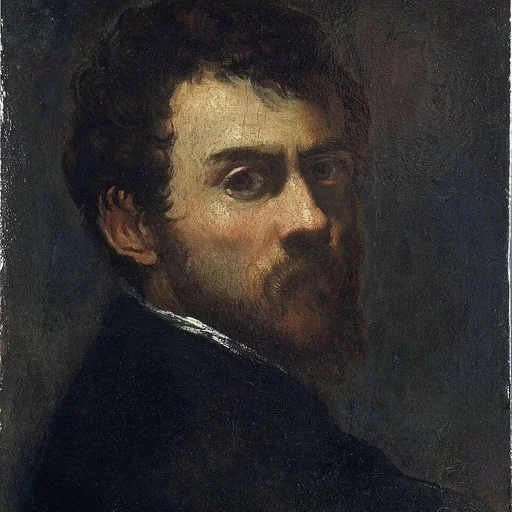
Artist
Jacopo Robusti (late September or early October 1518 – 31 May 1594), best known as Tintoretto ( TIN-tə-RET-oh; Italian:; Venetian: ), was an Italian Renaissance painter of the Venetian school.