Artwork
Turkish Women in the Countryside near Istanbul
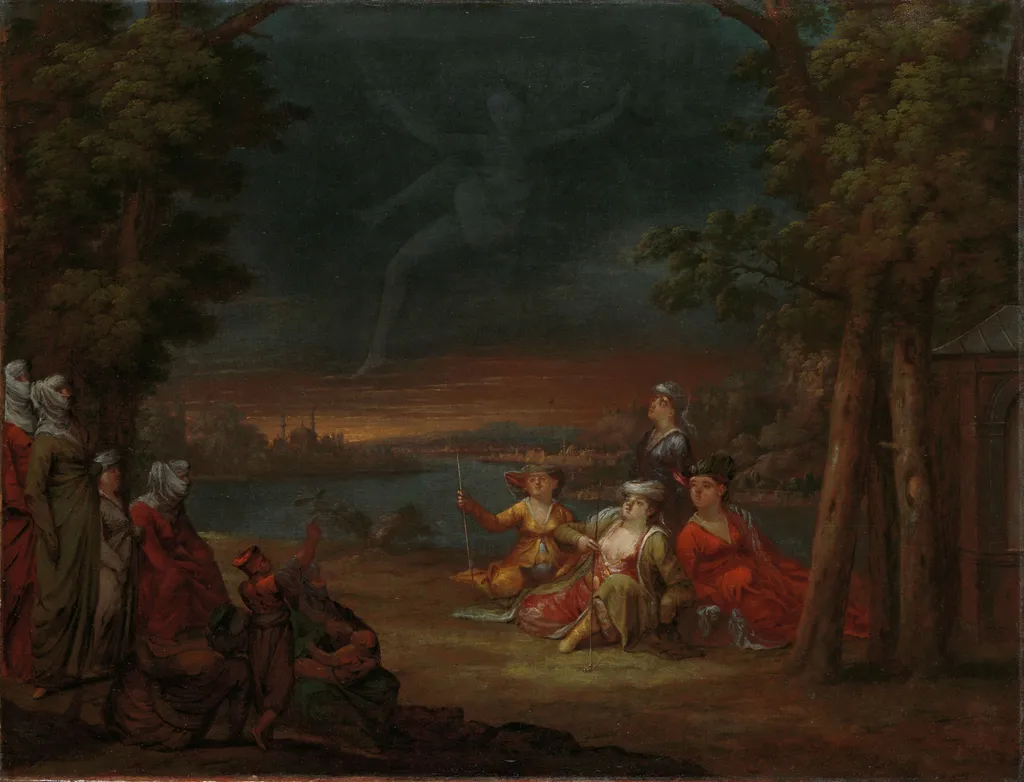
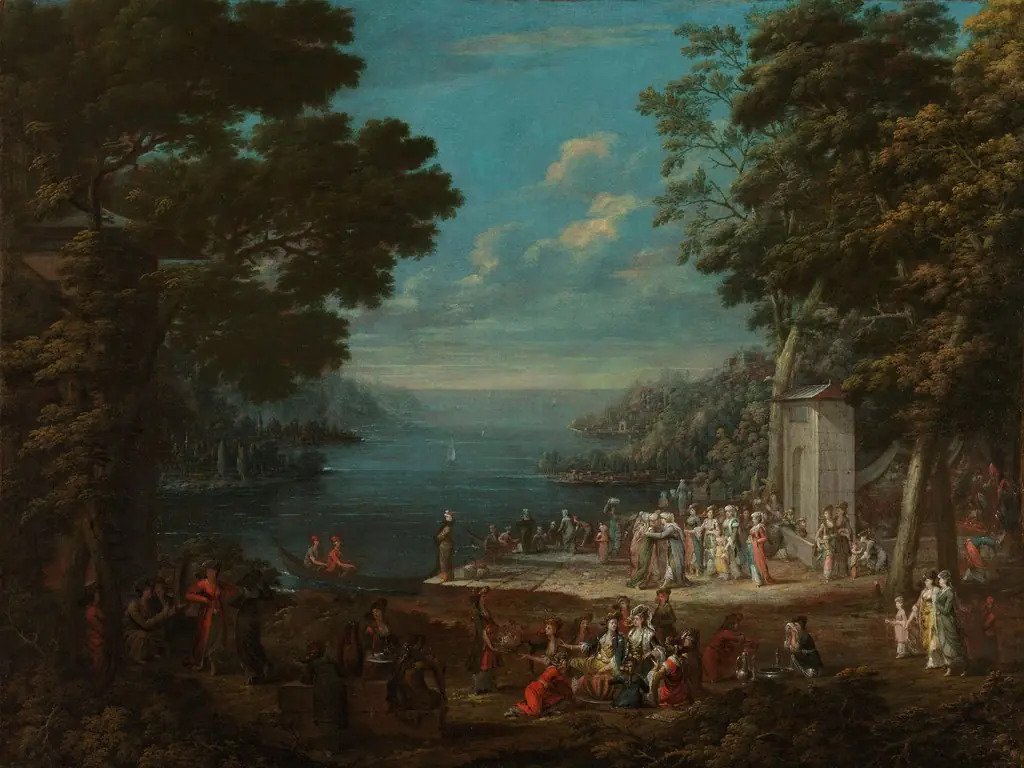
Turkish Women in the Countryside near Istanbul is an oil painting by the Orientalist artist Jean Baptiste Vanmour. It dates from 1728 and is held in the collection of the Rijksmuseum.
About this work
Technique & Style
The work is painted in oil on canvas, aligning with Vanmour’s habitual practice of using oil mediums to render detailed costume and setting.
The work is painted in oil on canvas, aligning with Vanmour’s habitual practice of using oil mediums to render detailed costume and setting. The support is a medium-weight canvas, prepared with a ground suitable for oil, and the handling shows the artist’s characteristic smooth, evenly applied paint layers that emphasize clarity of line and local color over pronounced impasto.
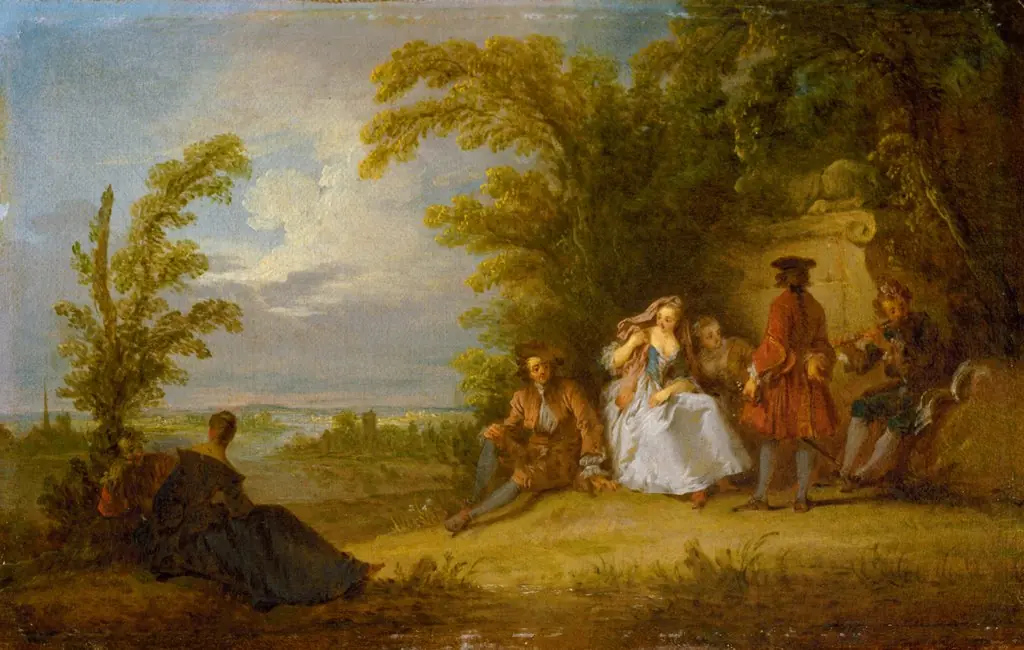
Stylistically, the composition balances a topographically descriptive view of the Bosphorus with a genre-like scene of women in local dress, executed with a restrained palette and careful attention to the patterns of textiles and architectural elements. The figures are arranged in a measured, almost frieze-like manner, typical of Vanmour’s approach to ethnographic reportage.
History & Provenance
The painting Turkish Women in the Countryside near Istanbul by Jean Baptiste Vanmour was created in 1728. Executed in oil on canvas, the work measures 44 cm in height and 58 cm in width. Historical records indicate that the piece was owned by Cornelis Calkoen and Nicolaas Calkoen.
It is currently held by the Rijksmuseum, having entered the collection through the Directie van de Levantse handel en de Navigatie op de Middellandse Zee, the Koninklijk Kabinet van Zeldzaamheden, and the Nederlandsch Museum voor Geschiedenis en Kunst.
The painting Turkish Women in the Countryside near Istanbul by Jean Baptiste Vanmour is held in the collection of the Rijksmuseum in Amsterdam. It is part of the museum's holdings from the Directie van de Levantse handel en de Navigatie op de Middellandse Zee, specifically within the Koninklijk Kabinet van Zeldzaamheden and the Nederlandsch Museum voor Geschiedenis en Kunst. The work, executed on canvas in 1728, was previously owned by collectors Cornelis Calkoen and Nicolaas Calkoen before entering the national collection.
The provided sources do not contain specific details regarding the artwork's accession number or a documented history of public exhibitions.
Context
The painting portrays Turkish women in a rural setting near Istanbul, reflecting Vanmour's interest in Orientalist subjects during the early 18th century. It was created in 1728 as an oil on canvas work measuring 44 cm by 58 cm and was originally owned by Cornelis Calkoen and Nicolaas Calkoen before entering the collection of the Rijksmuseum. Scholars have examined the piece as part of Vanmour's broader role in documenting Ottoman life, situating it within the trajectory of European artists who engaged with Ottoman themes in the Dutch Golden Age.
Overview
Turkish Women in the Countryside near Istanbul is an oil painting created in 1728 by Jean Baptiste Vanmour, a Flemish-French artist known for capturing Ottoman life during the Tulip Era. The work is part of the Orientalist movement and is now held in the Rijksmuseum collection.
Subject & Meaning
The painting depicts a serene yet active scene of Turkish women in a rural Istanbul setting, near a waterfront. Figures engage in various postures, with one central woman gesturing toward the water with a long stick, suggesting everyday life or possibly a narrative hint, though the specific meaning of her gesture is left to interpretation.
Legacy
As part of the Rijksmuseum's collection, Turkish Women in the Countryside near Istanbul contributes to the historical record of Orientalist art and the documentation of Ottoman life during the 18th century, offering insights into both the subject matter and the artistic practices of its time.
Own this work as a print
Artist & collection
Artist
Jean Baptiste Vanmour or Van Mour (9 January 1671 – 22 January 1737) was a Flemish-French painter, remembered for his detailed portrayal of life in the Ottoman Empire during the Tulip Era and the rule of Sultan Ahmed III.