Artwork
The Great Statue of Amida Buddha at Kamakura, Known as the Daibutsu, from the Priest's Garden
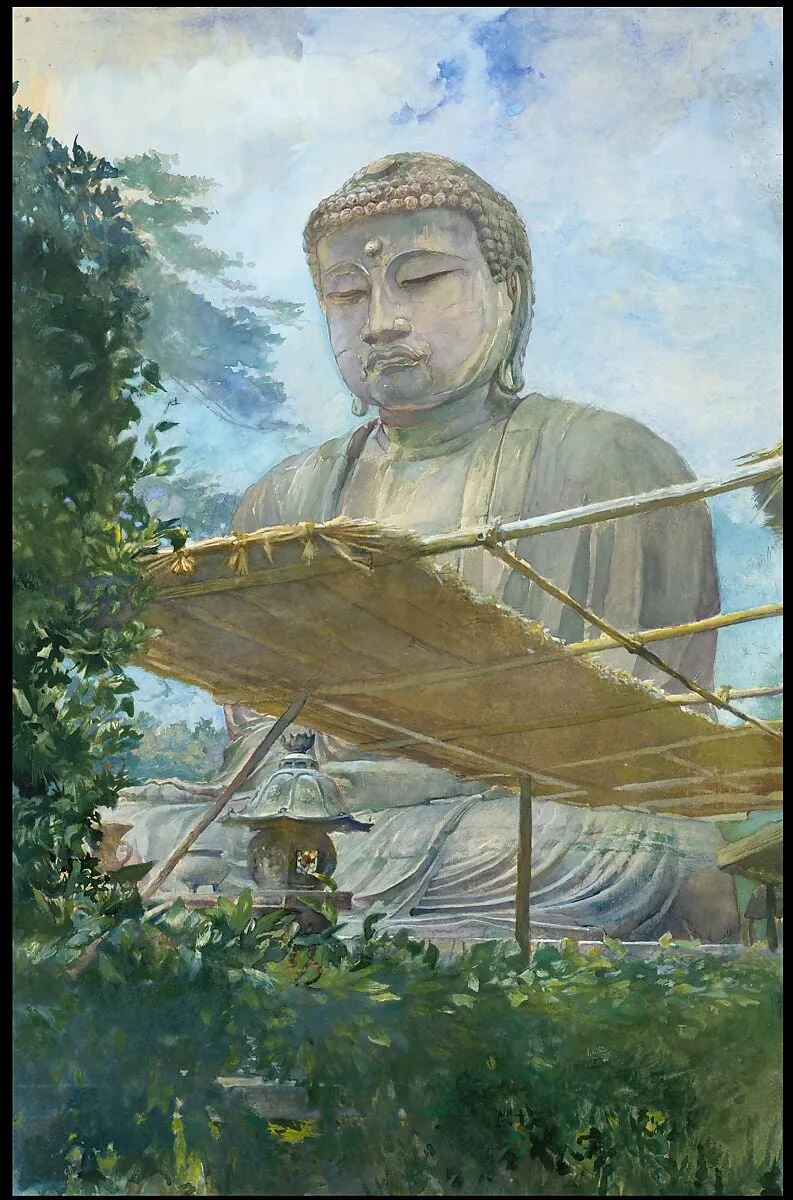
The Great Statue of Amida Buddha at Kamakura, Known as the Daibutsu, from the Priest's Garden is a watercolor work on paper by the American Impressionist artist John La Farge. It dates from 1887 and is held in the collection of the Metropolitan Museum of Art.
About this work
He used thin layers of watercolor, letting the paper show through to soften the light.
You see a quiet garden with a giant bronze Buddha peeking through the trees. The statue’s face is calm, half-hidden by leaves and branches.
La Farge painted this in 1887 after traveling to Japan. He used thin layers of watercolor, letting the paper show through to soften the light. The mix of American watercolor style and Japanese subject was unusual then.
Look up other works in the subject: Buddha.
Overview
The Great Statue of Amida Buddha at Kamakura, Known as the Daibutsu, from the Priest's Garden is an 1887 watercolor and gouache painting by American artist John La Farge (1835-1910). Measuring 19 1/4 x 12 1/2 inches (48.9 x 31.8 cm) on off-white wove paper, the work depicts the celebrated Kamakura Daibutsu, a colossal bronze Buddha cast in 1252, from the vantage point of a priest's garden. The painting is held in the American Wing of the Metropolitan Museum of Art, New York, having been acquired in 1966 as a gift from the family of Maria L. Hoyt (accession number 66.143). It stands as a significant example of La Farge's engagement with Japanese subjects and his mastery of watercolor as a medium for monumental composition.
Subject & Meaning
The painting centers on the Kamakura Daibutsu, a fifty-foot-high bronze Amida Buddha renowned for its peaceful demeanor and unusual open-air setting amid mountains and trees. La Farge presents the statue from a deliberately low angle, so the figure rises imposingly above the viewer, eyes closed in meditation, draped in robes that pool in heavy folds. A thatched bamboo and straw shelter occupies the middle ground, partially obscuring the lower body, while dense green foliage fills the left side and foreground. A small bronze lantern appears near the figure's base. The composition emphasizes the statue's colossal scale and spiritual serenity, juxtaposing the man-made monument against the natural world that surrounds it. The choice of the priest's garden viewpoint suggests an intimate, devotional encounter rather than a tourist's distant observation, framing the Buddha as an object of contemplation within a lived religious landscape.
Technique & Style
La Farge executed the work in watercolor and gouache on off-white wove paper, employing the loose, fluid brushwork characteristic of his watercolor practice. Visible washes and wet-on-wet blending in the sky and foliage demonstrate his technical facility, while even light and soft shadows unify the scene. The palette consists of muted greens, grays, and warm ochres, with a pale blue sky and soft white clouds. The artist's handling balances atmospheric effects with architectural precision, capturing both the monumental solidity of the bronze statue and the transient qualities of light and vegetation. The work's bold, monumental composition belies the intimacy of the watercolor medium, showcasing La Farge's ability to translate the experience of colossal scale onto a sheet of modest dimensions.
History & Provenance
The painting originated from La Farge's 1886 trip to Japan with the writer and historian Henry Adams. During this journey, La Farge used watercolor, the familiar medium of the traveling artist, to create studies for illustrations and to paint sheets for exhibition. He executed this particular composition after his return to New York in 1887, working from a watercolor sketch done during his travels as well as photographs that he and Adams had taken. The work was later given to the Metropolitan Museum of Art by the family of Maria L. Hoyt in 1966, entering the collection as object number 66.143 in the American Wing. It is currently located in the American Paintings and Sculpture galleries and is licensed under CC0 1.0 Universal for unrestricted use.
Context
John La Farge was born in 1835 into a wealthy French emigre family in New York City. Educated at Jesuit institutions including Mount St. Mary's College in Maryland and St. John's College (now Fordham University), he initially pursued law before turning to art after receiving early drawing lessons from his maternal grandfather. By the 1880s, La Farge had established himself as a leading American artist with particular expertise in watercolor and stained glass. His 1886 journey to Japan with Henry Adams placed him within a broader pattern of American cultural figures seeking aesthetic and spiritual renewal in East Asia during the late nineteenth century. The Kamakura Daibutsu had already become an iconic subject for Western artists and photographers, but La Farge's treatment distinguishes itself through its combination of on-site sketching, photographic reference, and studio refinement. The work exemplifies how American artists of this period engaged with Japanese culture not merely as exotic spectacle but as a source of formal innovation and contemplative subject matter.
Legacy
The painting occupies an important place in La Farge's oeuvre as a document of his Japanese sojourn and as a demonstration of watercolor's capacity for monumental expression. It represents a moment when American artists were increasingly looking beyond Europe for artistic inspiration, contributing to the broader cultural phenomenon of Japonisme that influenced painting, decorative arts, and design throughout the late nineteenth century. The work's afterlife has been shaped by its inclusion in the Metropolitan Museum's collection, where it serves as a touchstone for understanding American artists' encounters with Asian religious art. Its open-access status has facilitated widespread reproduction and study, extending its reach beyond museum walls. The painting remains a key artifact for scholars examining transnational artistic exchange, the role of travel and photography in artistic practice, and the elevation of watercolor from sketching medium to finished art form in American hands.
Artist & collection

Artist
John La Farge (March 31, 1835 – November 14, 1910) was an American artist whose career spanned illustration, murals, interior design, painting, and popular books on his Asian travels and other art-related topics.

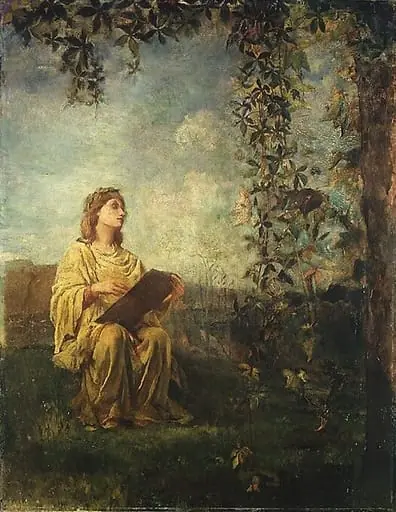 The Muse of Painting
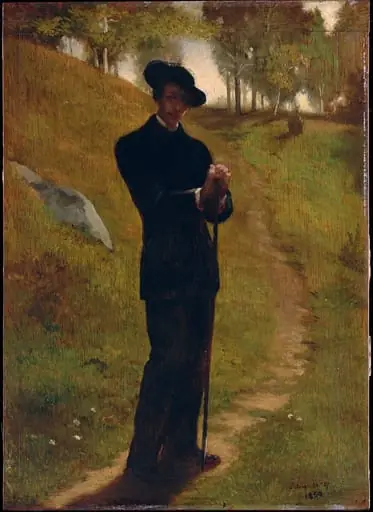 Portrait of the Painter
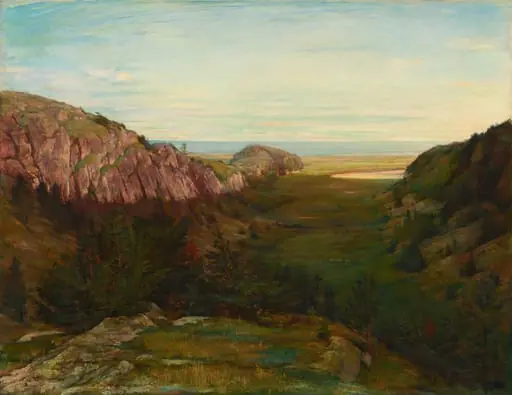 The Last Valley - Paradise Rocks
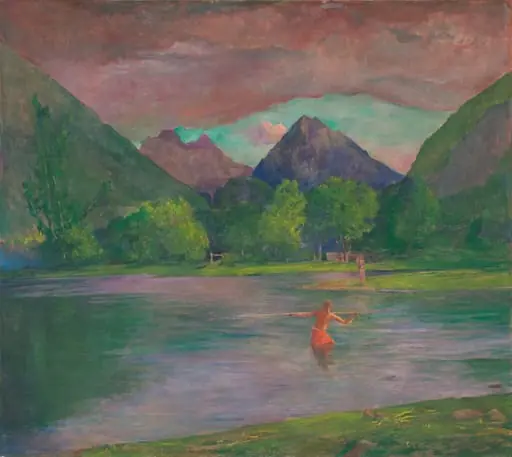 The Entrance to the Tautira River, Tahiti. Fisherman Spearing a Fish
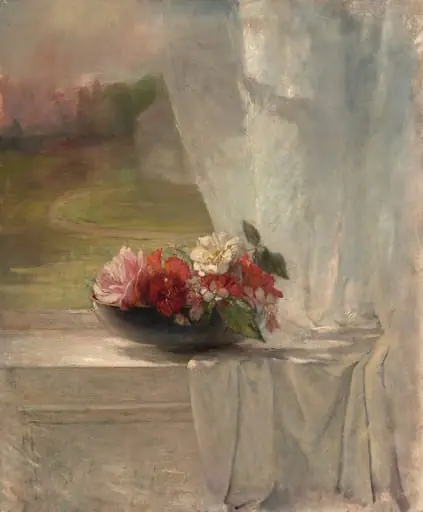 Flowers on a Window Ledge
 Autumn Study, View over Hanging Rock, Newport, R.I.
 The Island of Moorea Looking across the Strait from Tahiti, January 1891
 Double Study of Dawn, Moorea Seen across the Water, Tahiti