Artwork
Family of Monkeys
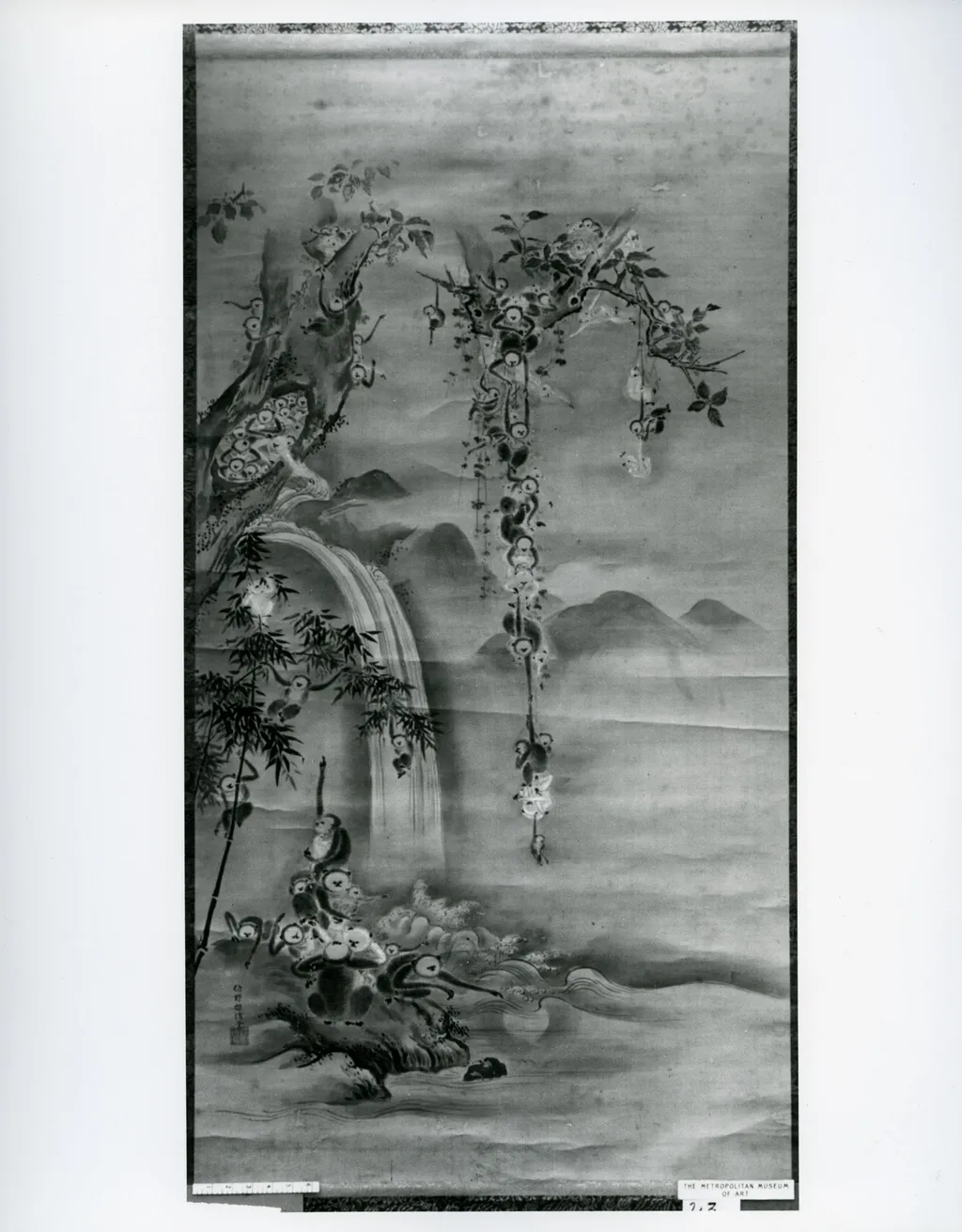
Family of Monkeys is an unspecified painting by the Kanō school artist Kanō Tanshin. It dates from 1692 and is held in the collection of the Metropolitan Museum of Art.
About this work
Technique & Style
The painting’s stylistic balance between figural grouping and landscape elements reflects the formal conventions of late‑17th‑century Japanese polychrome works.
Family of Monkeys is a 1683 Edo‑period painting by Kanō Tanshin, created in Japan and now housed in the Metropolitan Museum of Art. The work measures 152.4 cm in height by 76.8 cm in width, a format that accommodates a vertical composition. Its subject, a group of monkeys alongside a tree and a waterfall, exemplifies the narrative clarity and decorative patterning characteristic of the Kanō school, where figures are rendered with bold outlines and flat areas of colour.
The painting’s stylistic balance between figural grouping and landscape elements reflects the formal conventions of late‑17th‑century Japanese polychrome works.
History & Provenance
The painting Family of Monkeys was created by Kanō Tanshin in 1683, as documented in the artist’s dated inscription. The work depicts a group of monkeys in a wooded setting near a cascading stream, characteristic of the Kanō school’s naturalistic yet stylized approach to animal subjects. By the late 19th or early 20th century, the painting entered a Japanese collection before being acquired by the Metropolitan Museum of Art, where it has been held since at least the mid-20th century.
No record of a formal commission survives, suggesting it was likely executed as an independent work for a private patron.
The painting Family of Monkeys, created by Kanō Tanshin in 1683, is currently held in the collection of the Metropolitan Museum of Art in New York. While the provided records confirm its location within this institution and detail its physical dimensions as 152.4 by 76.8 centimeters, they do not specify a unique inventory or accession number for the work. Furthermore, the available sources contain no information regarding a specific exhibition history for this piece, listing only its creation date, artist, and subject matter rather than past display venues or loan records.
Overview
Kanō Tanshin, a prominent Japanese painter and head of the Kanō school's Kajibashi branch, completed Family of Monkeys in 1692. This painting showcases a lively group of monkeys situated within a natural landscape featuring a waterfall and trees. The artwork is currently part of the collection at The Metropolitan Museum of Art, representing Tanshin's distinctive approach to traditional Japanese painting, which often incorporated elements from nature.
Subject & Meaning
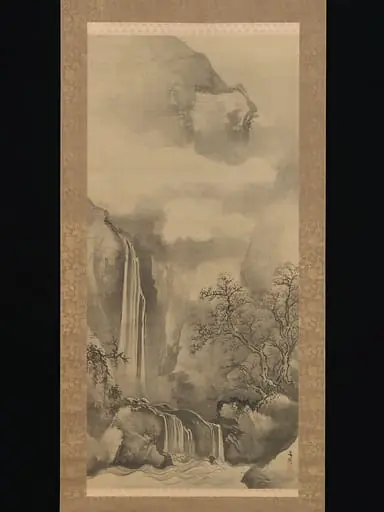
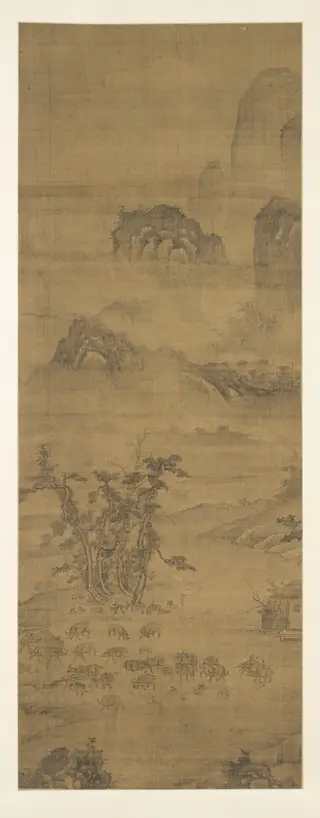
The painting portrays a dynamic scene of simian life, with several monkeys engaged in various activities around a prominent waterfall. Water cascades in a broad, gentle curve, anchoring the composition. To the left, robust trees with abundant foliage frame the scene, while distant, soft hills and a pale sky complete the background.
The monkeys themselves are depicted with animated simplicity, climbing, resting, and interacting with their arboreal environment, conveying a sense of natural vitality.
Context
As the head of the Kajibashi branch, Kanō Tanshin occupied a significant position within the influential Kanō school. His artistic practice, however, was distinguished by a willingness to move beyond the school's established imitative conventions. Tanshin's dedication to observing and incorporating nature into his work, alongside his synthesis of styles, garnered recognition even from figures outside the Kanō tradition.
Notably, the artist Hanabusa Itchō, known for his critical stance towards the Kanō school, commended Tanshin's innovative approach.
Own this work as a print
Artist & collection

Artist
Kanō Tanshin (Morimasa) (狩野 探信; 1653–1718) was a Japanese painter. He was the son of Kanō Tan'yū by his second wife and led the Kajibashi branch of the Kanō school after 1674. Stylistically, he had a Tosa-like approach…