Artwork
Bathing the Red Horse
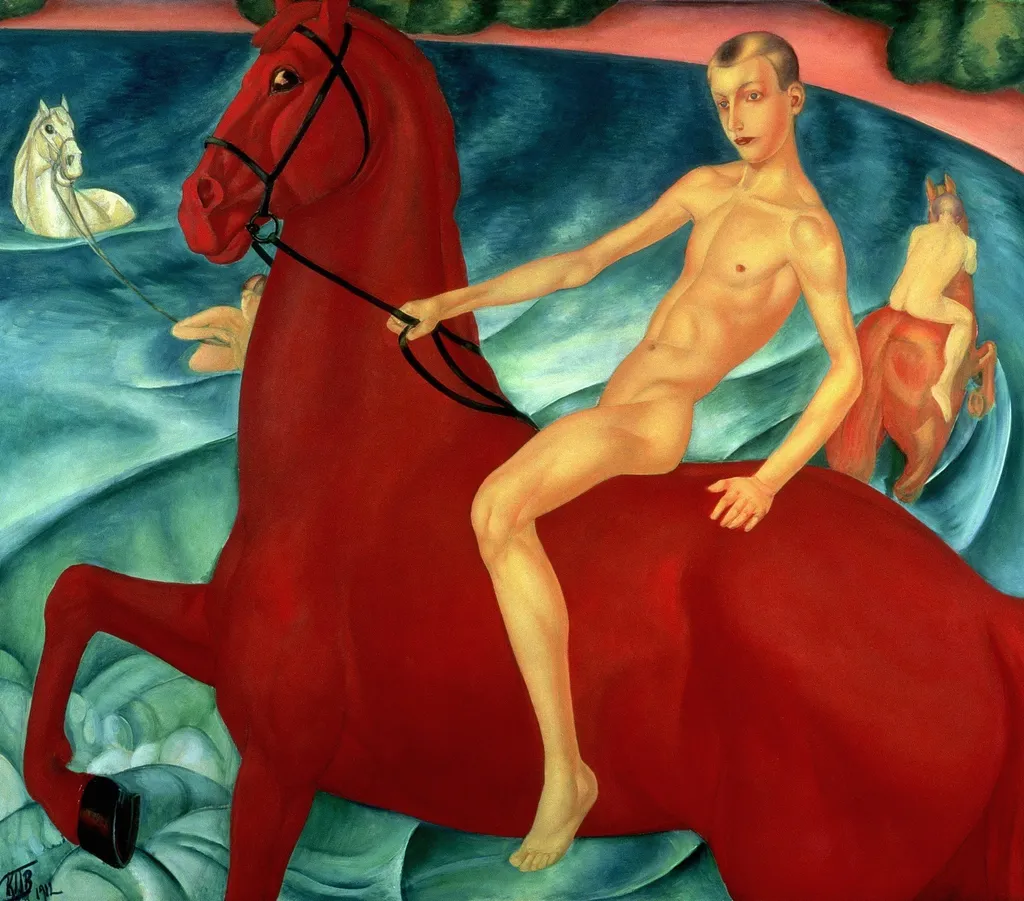
Bathing the Red Horse is an oil painting by the Avant-garde artist Kuzma Petrov-Vodkin. It dates from 1912 and is held in the collection of the Tretyakov Gallery.
About this work
Subject & Meaning
The painting depicts a young naked rider on a red horse immersed in water, a scene that combines everyday genre with symbolic resonance.
The painting depicts a young naked rider on a red horse immersed in water, a scene that combines everyday genre with symbolic resonance. The red horse, rendered in a vivid, unmodulated hue, stands out against a cool blue-green lake and reflects Petrov-Vodkin's fascination with Russian Orthodox icons such as the Miracle of the Archangel Michael, where a fully red horse signifies spiritual confrontation. The work is interpreted as a metaphor for the fate of Russia, linking the strength of the horse with the vulnerability of the youthful rider, and it prefigures the red symbolism of the Soviet era.
Scholars note its influence on Russian avant‑garde and its synthesis of Byzantine iconography, French post‑impressionism, and Petrov-Vodkin's own spherical perspective theory.
Technique & Style
Bathing the Red Horse is an oil painting on canvas measuring 160 by 186 cm. The composition demonstrates Petrov-Vodkin's theory of spherical perspective, evident in the curved, ascending shoreline of the lake and the semicircular arrangement of the three horses and boys. The large, almost square canvas features a tight foreground framing that crops the horse's ears and legs outside the edges, emphasizing the animal's monumental scale. Stylistically, the work employs a striking color contrast between the cold blue-green tones of the background water and the unmodulated, vivid scarlet of the foreground horse.
This bold palette and use of flat color planes reveal the influence of Russian icons, specifically Novgorod icons like the Miracle of the Archangel Michael, as well as the modernist aesthetics of Henri Matisse and Paul Cézanne.
History & Provenance
Kuzma Petrov-Vodkin painted Bathing the Red Horse in 1912 while living in Khvalynsk in the Volga region. He executed the first and second versions of the composition at the farm Mishkina Pristan near the village of Gusyovka. The initial versions, which included a fourth figure holding the horse, were either destroyed or painted over by the artist upon his return to St. Petersburg; the second version survives only through a black-and-white photograph.
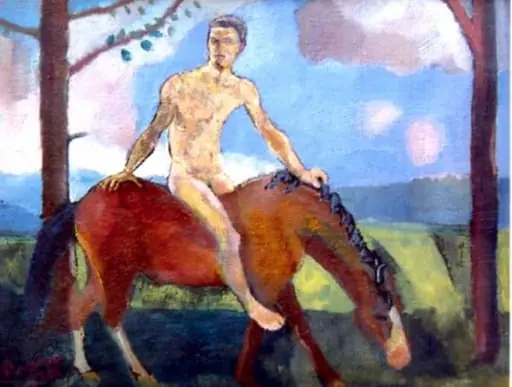
The horse depicted was Maltchik, a neighbor's animal, and the rider was the artist's student, Sergey Kalmykov, who had painted a similar subject in 1911 that may have inspired Petrov-Vodkin.
The painting was exhibited in 1912 at a Mir iskusstva exhibition. In 1914, it was shown at the Baltic Exhibition in Malmö, Sweden, where the artist received a medal from the King of Sweden. Due to World War I, the Russian Revolution, and the Russian Civil War, the canvas remained in Sweden for decades.
It was finally returned to the artist's family in 1950. The widow of Petrov-Vodkin entrusted the painting to the collector Casimira Basevich, who subsequently donated it to the Tretyakov Gallery in 1961.
The painting is held by the Tretyakov Gallery, Moscow, where it remains today.
It is inventoried as accession no. 11667. The work entered the Gallery’s holdings in 1961 after being donated by K. K. Bassevich, who had received it from the artist’s widow in 1950.
It was first exhibited in 1912 at the Mir iskusstva show in Russia. In 1914 it traveled to the Baltic Exhibition in Malmö, Sweden, where the artist received a medal. After prolonged wartime and revolutionary disruptions, the painting returned to Russia only in 1950 before entering the Tretyakov Gallery in 1961.
Context
Exhibited at the Mir iskusstva show in 1912, the painting immediately garnered critical acclaim and established Kuzma Petrov-Vodkin's reputation across Russia, though its unconventional color palette sparked controversy. Critics noted the work's synthesis of French Post-Impressionism, specifically the influence of Henri Matisse and Pierre Puvis de Chavannes, with the flat, vibrant aesthetics of restored Novgorod icons. The piece is frequently analyzed as a symbolic manifesto of the Russian avant-garde, with some scholars comparing its cultural impact to Kazimir Malevich's Black Square.
Contemporaries interpreted the red horse as a prefiguration of the Soviet era or a metaphor for Russia itself, balancing the fragility of the nude rider against the animal's monumental power. After winning a medal in Malmö in 1914, the canvas remained abroad due to the First World War and subsequent revolutions, only returning to the artist's family in 1950 before entering the Tretyakov Gallery collection in 1961.
Legacy
Upon its debut at the 1912 Mir iskusstva exhibition, Bathing the Red Horse immediately drew both acclaim and controversy in Russia, establishing Petrov-Vodkin’s reputation among peers and securing national attention.
The painting’s symbolic force persisted across decades: contemporaries interpreted it as a metaphor for Russia’s fate, contrasting the fragile youth with the majestic red horse, while later critics linked its red palette to the coming Soviet era. Its compositional innovations, spherical perspective and bold color contrasts, quickly became touchstones for Russian avant-garde practice.
After wartime and revolutionary upheaval delayed its return, the work was eventually restituted in 1950 and entered the Tretyakov Gallery in 1961, cementing its status as a canonical modern Russian masterpiece.
Overview
Created in 1912, Bathing the Red Horse is an oil painting by Russian artist Kuzma Petrov‑Vodkin. The work presents a nude boy guiding a vivid red horse through shallow water, set against a backdrop of trees and a clear sky. Currently the canvas is part of the collection of the State Tretyakov Gallery in Moscow.
Own this work as a print
Artist & collection
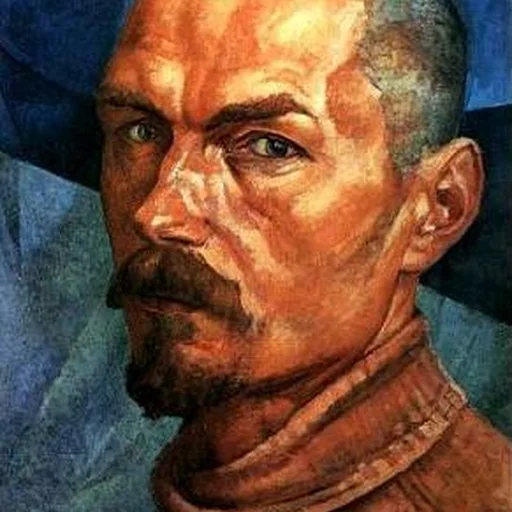
Artist
Kuzma Sergeyevich Petrov-Vodkin (Russian: Кузьма́ Серге́евич Петро́в-Во́дкин; November 5, 1878 – February 15, 1939) was a Russian and Soviet painter.