Artwork
Buddha's Conversion of Five Bhiksu

Buddha's Conversion of Five Bhiksu is an unspecified painting by the Ming dynasty painting artist Li Sheng. It dates from 1355 and is held in the collection of the Cleveland Museum of Art.
About this work
History & Provenance
The painting was created in 1355 in China by Li Sheng, who was active from around 1324 until after 1375.
The painting was created in 1355 in China by Li Sheng, who was active from around 1324 until after 1375. It entered the collection of the Cleveland Museum of Art, where it remains on display. Its provenance traces directly to the artist's workshop before being acquired by the museum.
The painting titled Buddha's Conversion of Five Bhiksu, created by Li Sheng around 1355, is part of the Cleveland Museum of Art's collection, inventory number 1997.92, and has been displayed there as part of its permanent collection exhibitions.
This work originates from China and is classified as a painting from the mid-14th century.
Context
Scholarship on Li Sheng's Buddha's Conversion of Five Bhiksu emphasizes its significance within Yuan dynasty Buddhist painting, reflecting broader artistic engagement with Pure Land iconography. The work is part of the Cleveland Museum of Art's collection, documented in its records as accession 1997.92, and exemplifies regional stylistic developments in 14th-century Chinese Buddhist art. Its subject matter aligns with narrative cycles depicting key moments in the Buddhist tradition, contributing to understanding of devotional practices in late imperial China.
Overview
Created in 1355 by the Chinese painter Li Sheng, Buddha’s Conversion of Five Bhiksu is a narrow, horizontal composition that depicts a mist‑shrouded mountain setting. The work is part of the collection of the Cleveland Museum of Art, where it is displayed as an example of Yuan‑period religious painting.
Subject & Meaning
The scene illustrates the moment the Buddha initiates the ordination of five wandering monks, or bhiksu, a narrative drawn from Buddhist tradition. The small group of figures gathers near a modest temple, emphasizing the humility of the disciples against the vast, contemplative landscape that surrounds them.
Technique & Style
Li Sheng employs a restrained palette of soft grays, muted greens, and earthy browns, punctuated by occasional red and blue accents that draw attention to specific details. Brushwork suggests atmospheric depth, with distant peaks rendered in delicate washes, while the foreground features more defined trees and rock formations. A line of calligraphic text runs along the top, likely a poem or explanatory note.

Artist & collection

 明 佚名 舊傳夏珪 長江萬里圖 卷 (前半) |First half of Ten Thousand Li of the Yangzi River
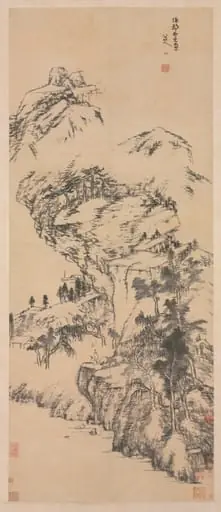 Landscape after Guo Zhongshu
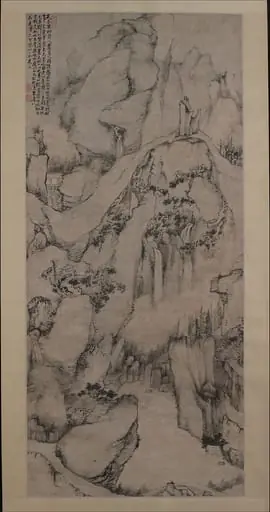 清 戴本孝 天台異松圖 軸 紙本|The Strange Pines of Mount Tiantai
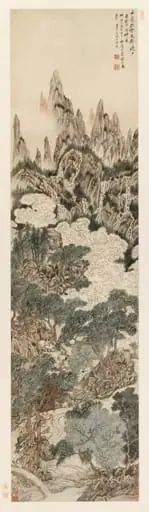 Morning Sun over Heavenly Citadel Peak
 A Hundred Sparrows in a Lofty Grove
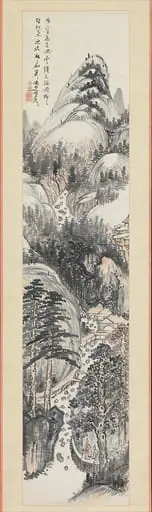 Untitled
 Green Peaks under Clear Sky: After Huang Gongwang
 Landscape in the Style of Huang Gongwang
 View from the Keyin Pavilion on Paradise (Baojie) Mountain
 清 王翬 溪山雨霽圖 軸|Clearing after Rain over Streams and Mountains
 Mt. Taibo in the Style of Wang Meng
- Buddha's Conversion of Five Bhiksu