Artwork
Still Life with Melon and Peaches
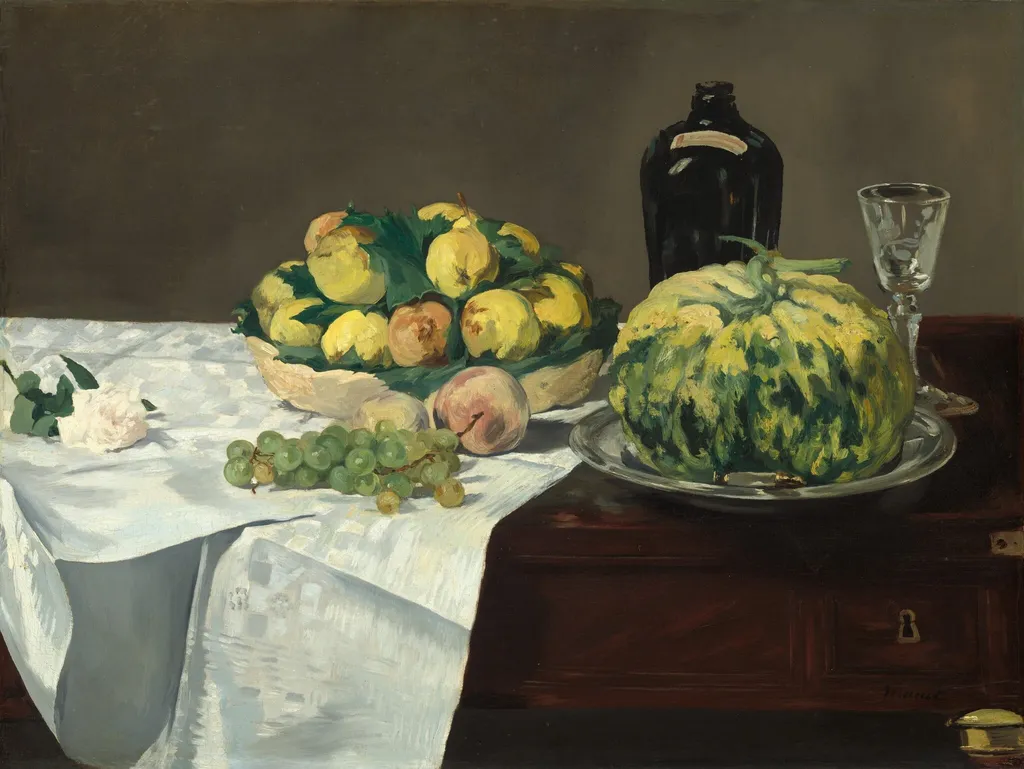
Still Life with Melon and Peaches is an oil painting by the Impressionist artist Édouard Manet. It dates from 1866 and is held in the collection of the National Gallery of Art.
- Inscription
- Inscribed:lower right: Manet
About this work
Technique & Style
Still Life with Melon and Peaches is executed in oil on canvas, a medium and support consistent with Manet's standard practice for still lifes of the period.
Still Life with Melon and Peaches is executed in oil on canvas, a medium and support consistent with Manet's standard practice for still lifes of the period. The painting measures 68.3 by 91 centimeters, a horizontal format suited to the arrangement of fruit on a tabletop. Stylistically, the work belongs to the still-life genre and reflects the painterly handling associated with Manet's mid-1860s production, in which broad, fluid brushwork and a restrained tonal palette are used to model form and convey the textures of ripe melon and peaches.
The composition is classified as a still life, and the canvas's condition has been preserved through successive private and institutional ownerships, ultimately entering the National Gallery of Art in 1960 as a gift.
History & Provenance
Manet painted Still Life with Melon and Peaches in 1866, an oil on canvas work first documented in the collection of Léopold Baugnée in Brussels and later sold at the Galerie Ghémar auction in March 1875 (no. 44). The painting entered the stock of Durand‑Ruel in 1910, passed through the dealer Eugène Glaenzer by 1913, and was acquired by Eugene and Agnes Ernst Meyer, who gifted it to the National Gallery of Art in 1960. No record of a specific commission exists in the documented ownership chain. The work’s creation date is consistently recorded as 1866.
The painting is held at the National Gallery of Art in Washington, D.C., where it was accessioned in 1960 as a gift from Eugene and Agnes Ernst Meyer. Its provenance includes the collection of Léopold Baugnée in Brussels, sold at Galerie Ghémar in 1875, and later owned by Perouse in Paris. By 1910 it was deposited with Durand-Ruel in New York and Paris, and it was likely sold through Eugene Glaenzer to the Meyers by 1913.
The work was included in the 1983 Manet exhibition at the Grand Palais, Paris, and the Metropolitan Museum of Art, New York.
Overview
Edouard Manet's Still Life with Melon and Peaches, executed in 1866, is a quintessential example of his mature approach to the still life genre. The composition arranges a selection of fruit and tableware upon a surface draped with a white cloth, featuring a sliced melon, peaches, grapes, lemons in a bowl, and a single flower alongside a glass. Manet employs a direct, unblended application of oil paint, utilizing bold contrasts between the bright highlights on the fruit and the deep, shadowed background to create a sense of immediate presence.
The work reflects the artist's shift away from academic idealism toward a focus on the optical reality of light and color, characteristics central to the emerging Impressionist movement. Painted during a period when Manet was refining his technique to capture the fleeting effects of illumination, the piece demonstrates his ability to elevate mundane domestic subjects through rigorous observation and a modern sensibility. The arrangement avoids traditional narrative or allegorical weight, focusing instead on the formal relationships of form, texture, and tonal value.
This painting stands as a significant contribution to Manet's exploration of still life, bridging his earlier Realist concerns with the lighter palette and looser brushwork that would define his later career.
Subject & Meaning
The composition centers on a white-draped table laden with various foodstuffs and domestic items. A prominent melon rests on a plate, accompanied by a bowl overflowing with lemons and peaches. Grapes, a single flower, and a glass complete the arrangement, creating a rich tableau of natural forms. Manet elevates these ordinary objects through his focused attention, inviting contemplation of their inherent beauty and presence.
Own this work as a print
Artist & collection
Artist
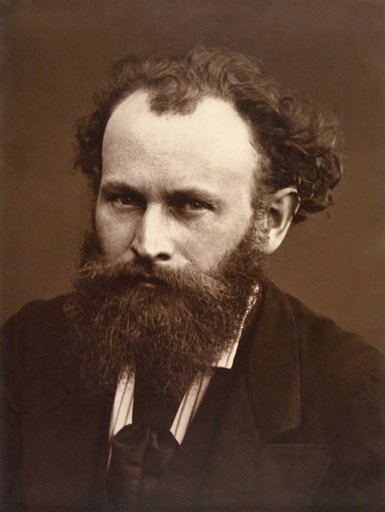
Édouard Manet was a French modernist painter. He was one of the first 19th-century artists to paint modern life, as well as a pivotal figure in the transition from Realism to Impressionism.