Artwork
Interior, after Dinner
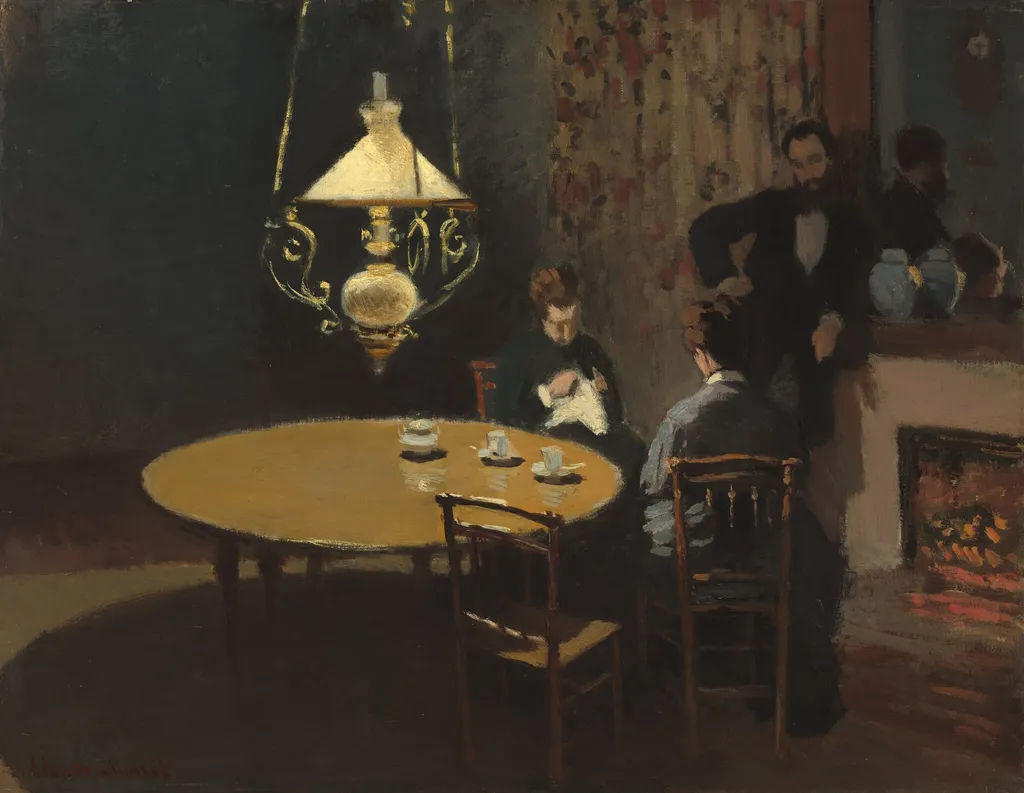
Interior, after Dinner is an oil painting by the Impressionist artist Claude Monet. It dates from 1868 and is held in the collection of the National Gallery of Art.
- Inscription
- Inscribed:lower left: Claude Monet
About this work
Subject & Meaning
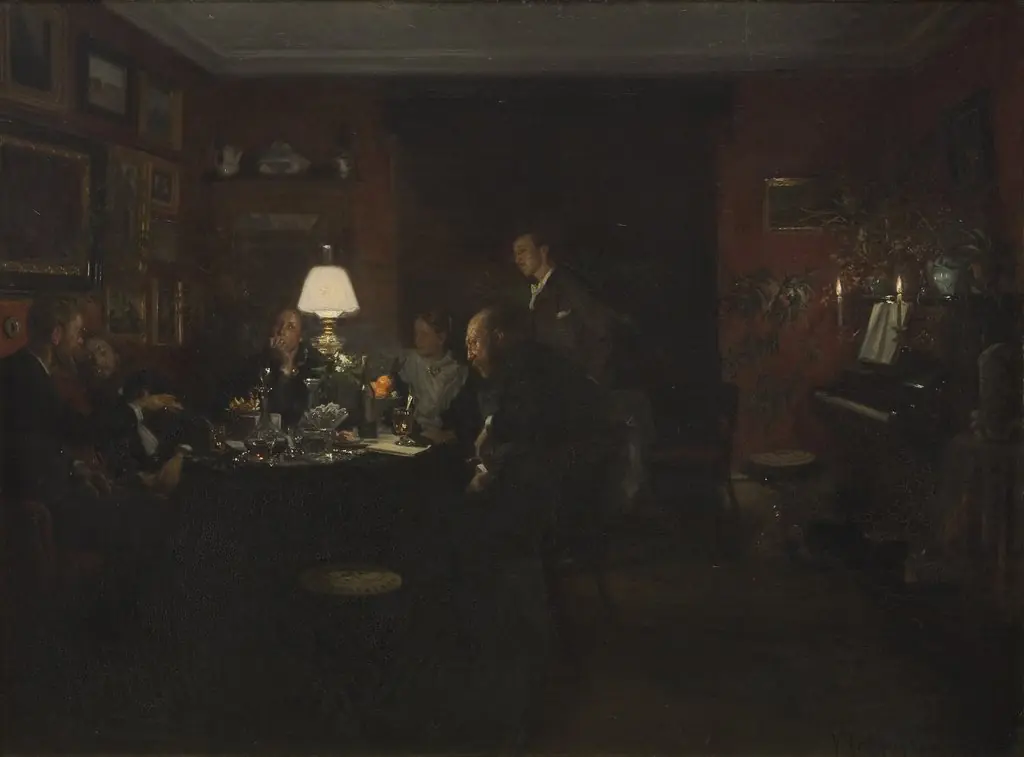
The painting depicts a quiet interior scene following a dinner, featuring two women seated at a table and a man standing near a fireplace.
The painting depicts a quiet interior scene following a dinner, featuring two women seated at a table and a man standing near a fireplace. The work is interpreted as a nocturnal companion to The Dinner, capturing a moment of domestic intimacy through subtle lighting from a ceiling oil lamp and firelight. Art historian Hollis Clayson describes it as an exemplary naturalist nighttime interior that quietly assesses diffuse lamplight and firelight within a social gathering.
The composition includes a central hanging lamp illuminating the table and creating reflections on the wood, while a lit fireplace provides secondary illumination, leaving much of the room in shadow. A mirror above the fireplace reflects the scene, and the man near the mantle may be identified as Monet's friend Frédéric Bazille. Camille Doncieux is positively identified as the woman in the gray gown, depicted a year before her marriage to Monet.
Technique & Style
Claude Monet executed Interior, after Dinner in 1868 using oil paint on a canvas support measuring 50.2 cm in height and 65.4 cm in width. The work is distinguished by its naturalist handling of diffuse lamplight from a ceiling oil lamp and firelight from a fireplace, which illuminate the scene while leaving the remainder of the room in shadow. This interplay of light sources creates subtle reflections on the wooden table and the large mirror above the mantel.
The painting features a red signature, "Claude Monet," located in the lower left corner. As one of only two interior night scenes in Monet's oeuvre, the composition focuses on the quiet subtleties of evening illumination within a domestic setting.
History & Provenance
Claude Monet created Interior, after Dinner during the winter of 1868–1869 while residing in Étretat with Camille Doncieux and their newborn son. The work serves as a companion piece to The Dinner, depicting the same gathering later in the evening, and is one of only two interior night scenes in the artist's oeuvre. The painting was originally owned by Eugène Deudon, who sold it to Paul Durand-Ruel in Paris on March 8, 1899.
By 1921, the work had passed to Asea Vestar Stern in Sweden and subsequently to Mme. Nordeen of Stockholm. It later entered the inventory of the Hirschl and Adler Galleries in New York before being sold to Paul Mellon in Upperville, Virginia, in 1966. Mellon presented the painting as a gift to the National Gallery of Art in Washington, D.C., in 1983.
Interior, after Dinner is held in the collection of the National Gallery of Art in Washington, D.C. Its accession number is 1983.18.361. The work entered the collection through a gift from Paul Mellon in 1983 after its purchase in 1966 from Hirschl and Adler Galleries, New York. It was previously owned by Eugène Deudon, sold to Paul Durand-Ruel in 1899, then to Stern, Asea Vestar, and Mme. Nordeen before its sale to Paul Mellon.
The painting has been exhibited as part of the National Gallery of Art's holdings, though specific exhibition venues beyond its permanent display at the museum are not detailed in the sources.
Context
Interior, after Dinner, painted by Claude Monet in 1868, depicts a quiet domestic scene following an evening meal, capturing subtle effects of lamplight and firelight within a nocturnal interior. The work shows two women seated at a table and a man standing near a fireplace, with Camille Doncieux identified as the woman in gray. Art historian Hollis Clayson describes it as an exemplary naturalist nighttime interior in its assessment of diffuse lamplight.
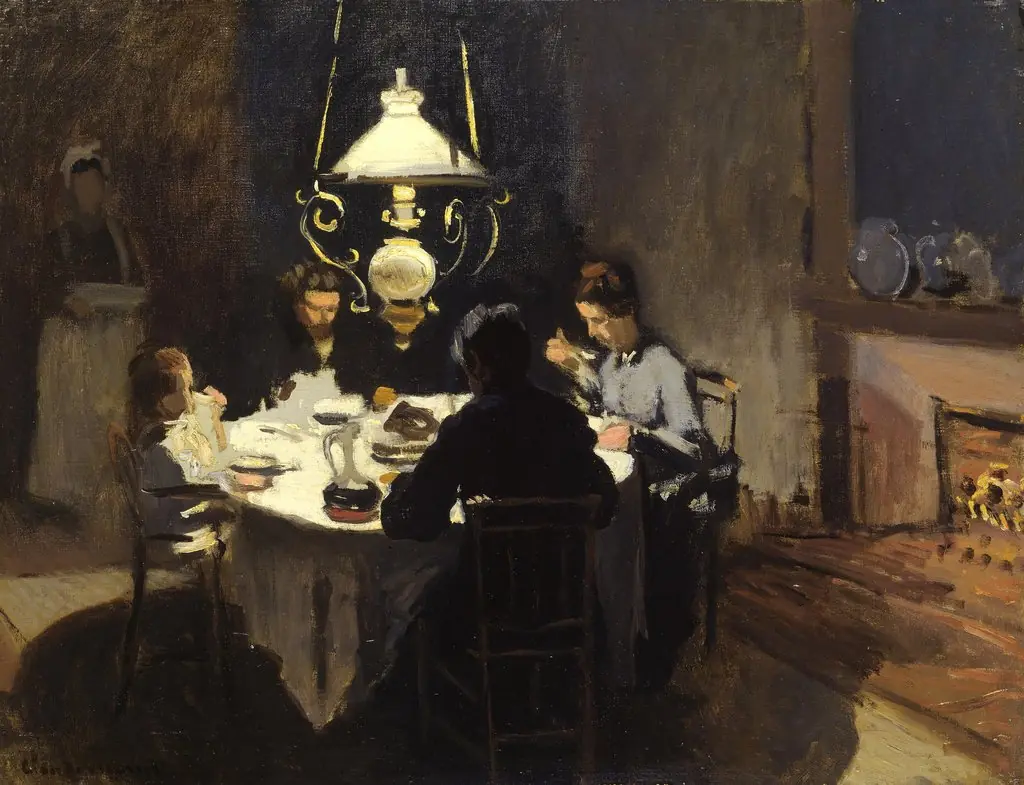
The painting serves as a companion to The Dinner and represents one of Monet’s rare interior night scenes, reflecting his exploration of domestic life during the winter of 1868–1869 in Étretat.
The work entered the collection of the National Gallery of Art, Washington, D.C., through a 1966 acquisition from Paul Mellon and a 1983 gift, having previously been sold by Paul Durand-Ruel in 1899 and later acquired by Paul Mellon.
Scholarly discussion highlights its significance within Monet’s oeuvre as part of a productive period and its relationship to other works such as The Luncheon, while its provenance reflects a documented chain of ownership from Eugène Deudon to Paul Durand-Ruel, then to Paul Mellon.
External sources including the National Gallery of Art and Spanish-language encyclopedias confirm its creation date, medium, and location within Monet’s broader context of marine and domestic scenes in Étretat.
Legacy
Interior, after Dinner is recognized as one of Monet’s rare nighttime interiors and has been cited as an exemplary work in the naturalist tradition for its subtle handling of lamplight and firelight in a domestic setting. Art historian Hollis Clayson highlights the painting’s quiet assessment of diffuse illumination, situating it within a broader discourse on naturalist interior scenes of the late 1860s. Its status as a pendant to The Dinner underscores Monet’s deliberate exploration of light and atmosphere across a single evening’s progression, a pairing that remains singular in his oeuvre.
The work’s subsequent inclusion in major collections, including the National Gallery of Art, Washington, has secured its presence in scholarly and public discourse on Monet’s early development.
Overview
Claude Monet’s oil painting titled Interior, after Dinner was executed in the winter of 1868–1869. The work depicts a modest interior space shortly after a meal, with a table set, dishes remaining, and daylight streaming through a window onto the floor. The composition is restrained, focusing on the quiet ambience of domestic life.
Own this work as a print
Artist & collection
Artist
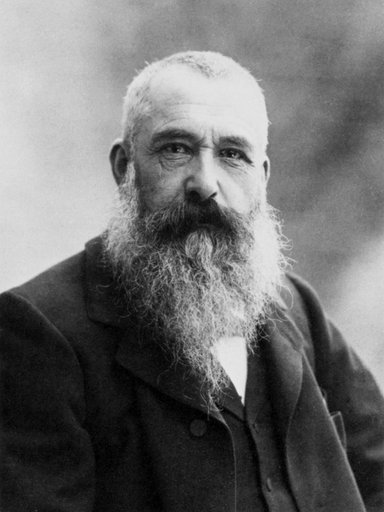
Oscar-Claude Monet was a French painter and founder of Impressionism who is seen as a key precursor to modernism, especially in his attempts to paint nature as he perceived it.