Artwork
Madonna and Child
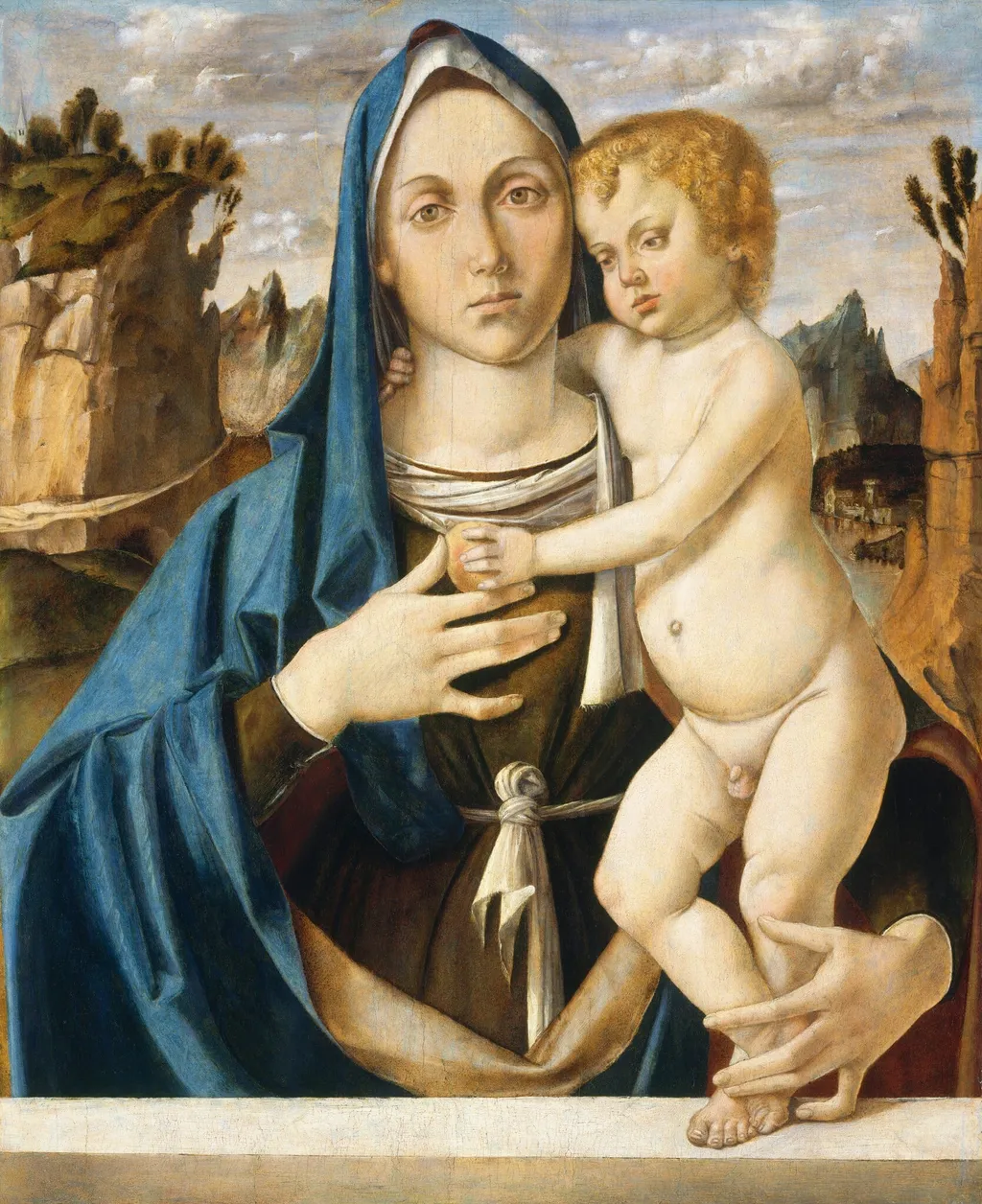
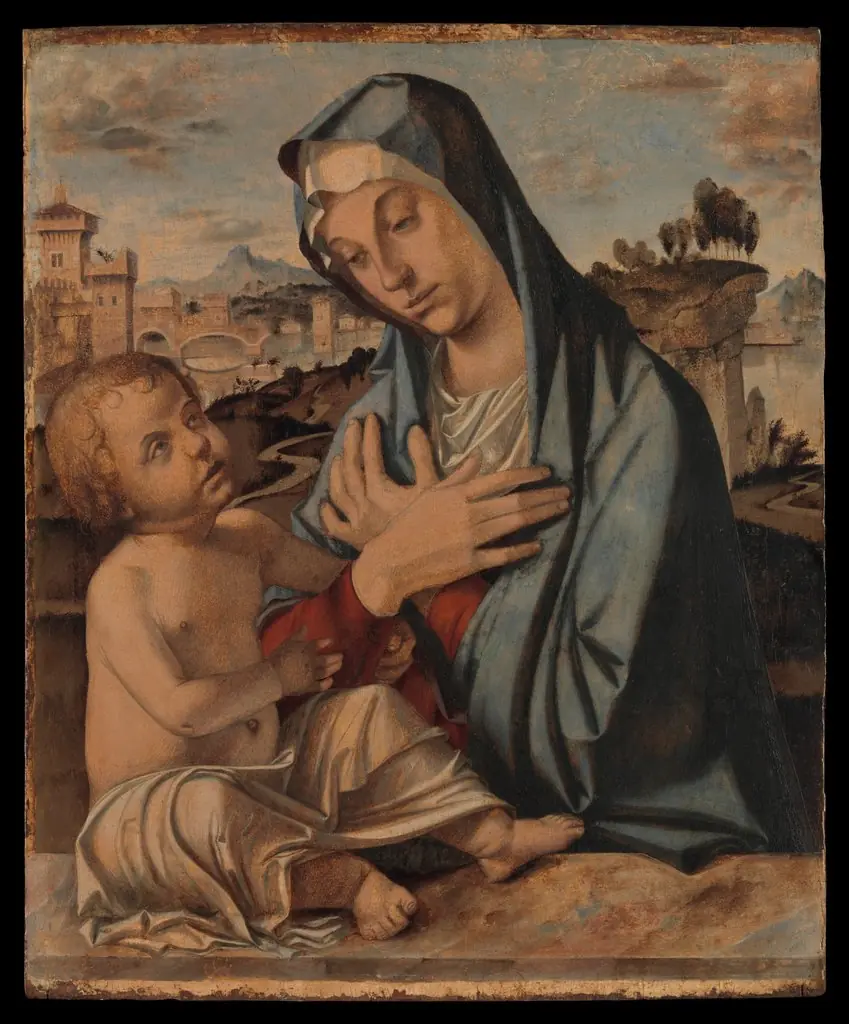
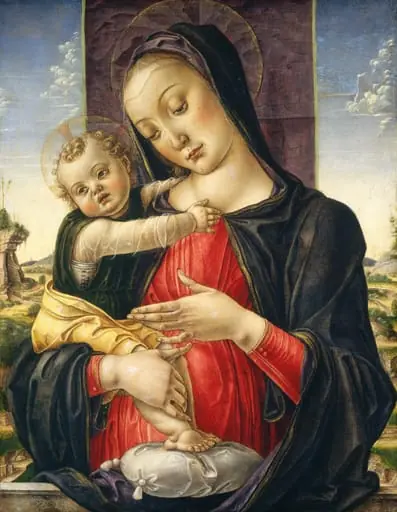
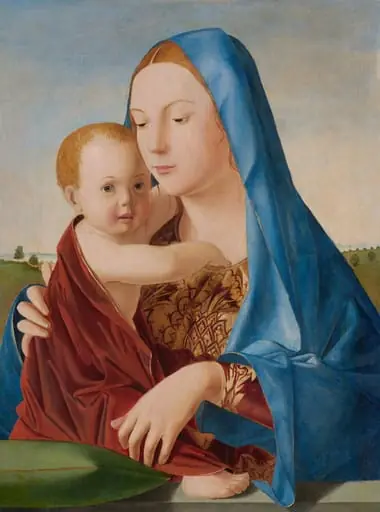
Madonna and Child is an oil painting by the Early Renaissance artist Bartolomeo Montagna. It dates from 1490 and is held in the collection of the National Gallery of Art.
About this work
Subject & Meaning
The work portrays the Virgin Mary holding the Christ Child, the two figures identified in the catalogue as the painting's sole subjects.
The painting depicts the Madonna and Child, a foundational devotional subject in Christian art. The work portrays the Virgin Mary holding the Christ Child, the two figures identified in the catalogue as the painting's sole subjects. As a religious genre work, it belongs to the long tradition of Madonna and Child imagery, in which Mary is venerated as the mother of the incarnate Christ and the Child is presented as both her infant son and the savior of mankind.
Such images functioned as objects of personal devotion and as visual expressions of core Christian beliefs about the Incarnation, Mary's perpetual virginity, and the divine nature of her son. The intimate half-length format typical of late fifteenth-century Venetian devotional panels would have invited the viewer into quiet contemplation of the maternal bond and, by extension, of the sacred mystery it signified.
Technique & Style
Bartolomeo Montagna’s Madonna and Child (1490) is executed in oil on a poplar panel, a common support for Italian Renaissance paintings. The medium allows for subtle layering and luminous glazes, evident in the delicate modeling of the figures’ flesh and drapery folds. The handling is precise, with fine linear detail in the Virgin’s veil and Christ Child’s curls, reflecting Montagna’s refined technique.
Stylistically, the work exhibits a restrained elegance, characterized by balanced composition, delicate chiaroscuro, and a serene, idealized treatment of sacred figures. The panel remains in stable condition, preserving its original surface qualities.
History & Provenance
Bartolomeo Montagna's Madonna and Child, an oil on poplar panel dated 1490, was probably purchased in Italy by Robert Curzon, later 14th Baron Zouche, who brought it to Pelham Park, Pulborough, Sussex. It descended through inheritance to his son Robert Nathaniel Cecil George Curzon, 15th Baron Zouche, then to the latter's sister Darea Curzon, Baroness Zouche, and subsequently to her cousin Mary Cecil Frankland, Baroness Zouche. In 1920 the painting was sold to Thomas Agnew & Sons in London, passing in 1924 to C. Morland Agnew and Ansdell.
It later entered the collection of Count Alessandro Contini Bonacossi in Rome before being acquired in October 1929 by the Samuel H. Kress Foundation in New York. The Kress Foundation gifted the work in 1939 to the National Gallery of Art in Washington, D.C., where it remains in the Kress Collection.
The painting is held by the National Gallery of Art, Washington, D.C., as part of the Samuel H. Kress Collection, accessioned as 1939.1.29. Its provenance traces from probable purchase in Italy by Robert Curzon, later 14th Baron Zouche, to successive family members until sold in 1920 to Thomas Agnew & Sons, London, then to C. Morland Agnew and Ansdell in 1924. It was acquired by Count Alessandro Contini Bonacossi in Rome and purchased by the Samuel H. Kress Foundation in October 1929, before being gifted to the National Gallery of Art in 1939.
Overview
Bartolomeo Montagna's Madonna and Child, created around 1490, exemplifies early Renaissance painting. Executed in oil on a poplar panel, this work portrays the Virgin Mary tenderly cradling the Christ Child. It reflects Montagna's characteristic approach to religious subjects, for which he was widely recognized during his career as an Italian painter.
Context
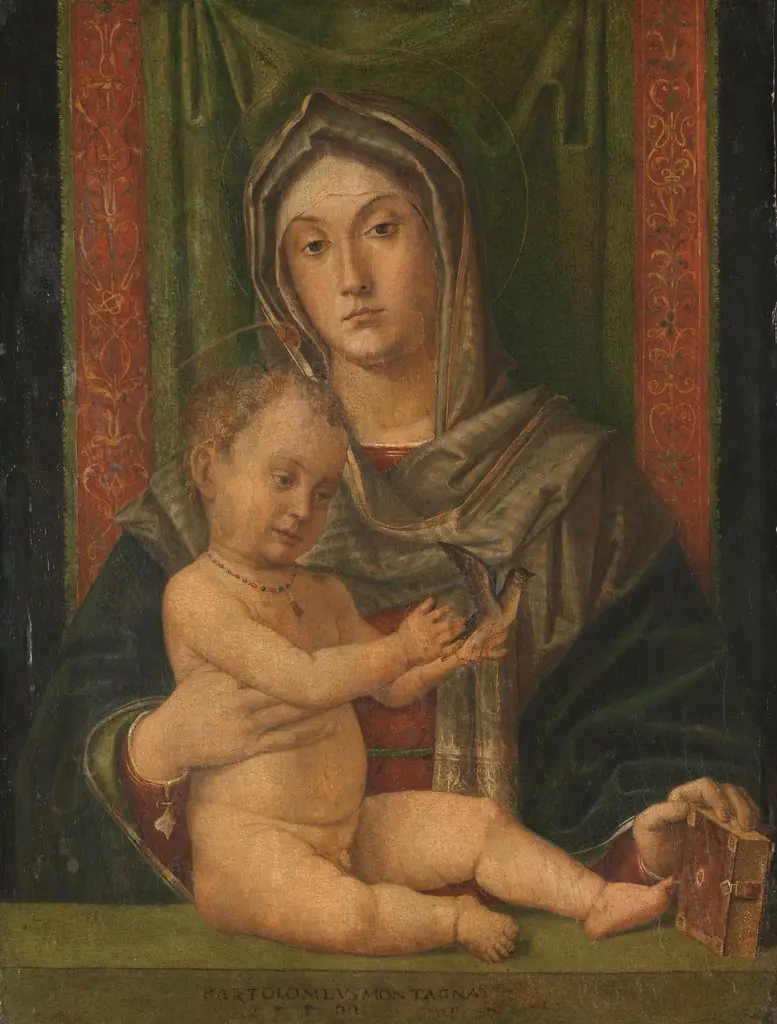
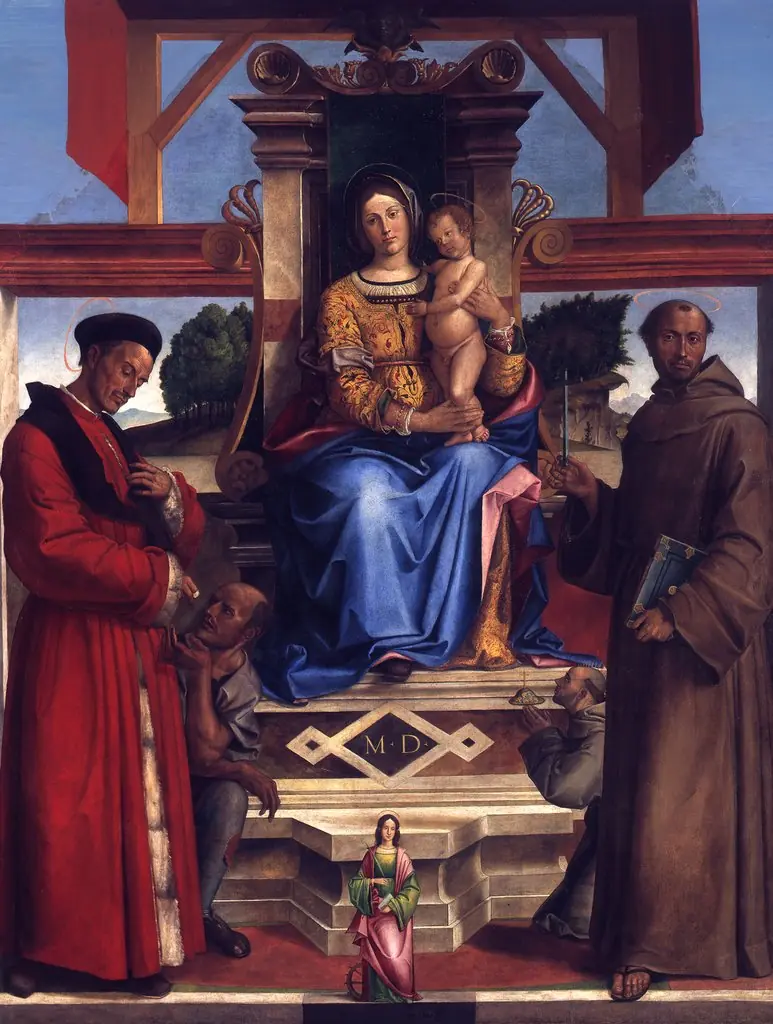
Bartolomeo Montagna was an Italian painter predominantly active in Vicenza during the late 15th century. He became known for his numerous depictions of the Madonna and Child, often incorporating distinctive architectural elements into his compositions. His artistic approach frequently showed the influence of Venetian masters, particularly Giovanni Bellini, in its use of color and light.
Legacy
Montagna's artistic lineage extended through his son, Benedetto Montagna. Benedetto became a notable engraver, further developing the family's artistic contributions. His work helped to disseminate the visual language and compositions established by his father, ensuring the continuation of their distinctive style and artistic presence into the next generation.
Own this work as a print
Artist & collection

Artist
Bartolomeo (or Bartolommeo) Montagna (UK: , US: , Italian: ; 1450?– 11 October 1523) was an Italian Renaissance painter who mainly worked in Vicenza.