Artwork
In the Dining Room
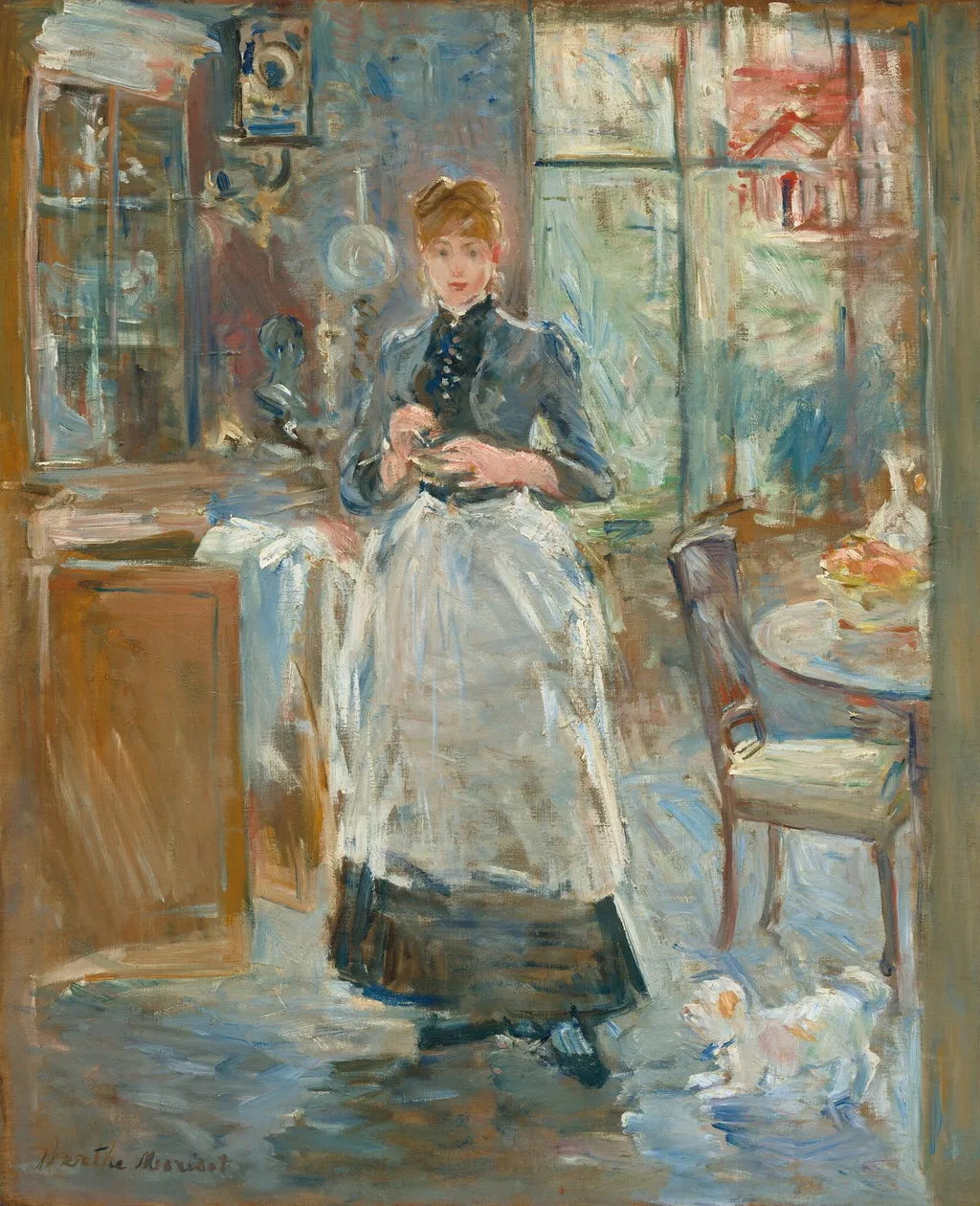
In the Dining Room is an oil painting by the Impressionist artist Berthe Morisot. It dates from 1886 and is held in the collection of the National Gallery of Art.
- Inscription
- Inscribed:lower left: Berthe Morisot
About this work
Technique & Style
The work is rendered with hasty, streaky brushstrokes that move in all directions, producing a sense of blur across several passages of the surface.
In the Dining Room is an oil-on-canvas painting executed in 1886, measuring 61.3 by 50 centimeters. The work is rendered with hasty, streaky brushstrokes that move in all directions, producing a sense of blur across several passages of the surface. This handling was more emphatic than in any of Morisot's earlier work and was singled out by contemporary critics as her "wild, streaky working method," with some reviewers calling the canvas unfinished.
The multicolored execution is built from juxtaposed tones, blues, pinks, purples, and browns in the background wall, and transparent white-green, yellow, and gray strips describing the window, applied in a bristly, gestural manner characteristic of her late period. Despite the restless facture, the domestic subject lends the composition a measure of calm, and the figure is treated with relaxed, almost unposed naturalism rather than emphatic characterization.
The handling also reflects a typically Impressionist disregard for strict perspective, with objects such as the cluttered display cabinet on the left and the fruit-laden table on the right functioning almost as an embedded still life within the genre scene.
History & Provenance
Berthe Morisot painted In the Dining Room in 1886, exhibiting it that same year at the eighth and final Impressionist exhibition. The work passed from the artist to Portier on the rue Lepic in Paris, and entered the market at the Murat sale at the Hôtel Drouot on 29 April 1899 (lot 13). It was subsequently acquired by Eugène Blot in Paris, who offered it at his own sale at the Hôtel Drouot on 10 May 1906 (lot 53).
From Blot, the painting moved to Mr. Tweed in New York, and probably by inheritance to Miss Mary W. Tweed, also in New York; it was then consigned to the Tweed sale at the American Art Association on 4 April 1929 (lot 62). The American banker and collector Chester Dale (1883–1962), New York, acquired it, and following his death it entered the National Gallery of Art, Washington, D.C., in 1963 as part of the Chester Dale bequest. A 1948 letter from the artist's daughter, Mme. Ernest Rouart, in NGA curatorial files corroborates the early ownership chain.
Context
Exhibited at the eighth and final Impressionist exhibition in 1886, In the Dining Room elicited mixed critical responses focused on Morisot's increasingly wild and streaky brushwork. While some reviewers dismissed the piece as unfinished, critic Jules-Antoine Castagnary praised the artist's extraordinary sensibility, noting her artistic feeling extended to her fingertips. This work exemplifies Morisot's distinct position within the movement; unlike her male colleagues who depicted public urban life, she, similar to Mary Cassatt, concentrated on domestic interiors.
The painting's agitated surface texture, characteristic of her late period, creates a sense of movement and complexity that contrasts with the calm of the domestic subject matter. Scholars note that Morisot often employed acquaintances as models in roles differing from their actual social status, using this stylistic approach to enhance the work's emotional charge and intrigue.
Legacy
At the eighth Impressionist exhibition in 1886 the canvas was praised for its vigorous brushwork and described as both unfinished and emotionally charged, marking a high point in Morisot's reputation among contemporaries. Critics highlighted its daring composition and the way it captured domestic intimacy with a lively palette. After changing hands through Blot, Chester Dale, and a 1963 bequest, the work entered the National Gallery of Art, where it is displayed as a key example of female Impressionist subjectivity.
Its sustained scholarly attention and inclusion in major surveys of Impressionism underscore its lasting legacy within the movement.
Overview
Berthe Morisot's 1886 oil on canvas, In the Dining Room, depicts a solitary woman within a domestic interior. This Impressionist work, characterized by its luminous quality, is housed in the collection of the National Gallery of Art in Washington, D.C. The painting captures a private moment, inviting the viewer into the scene through the subject's direct gaze, reflecting the artist's consistent engagement with everyday life.
Subject & Meaning
The painting centers on a young woman, dressed in a dark gown and a prominent white apron, standing within a sunlit dining room. Her hair is neatly styled, and she engages the viewer directly with her gaze, creating a sense of immediate connection. This portrayal of a woman in her private sphere reflects Morisot’s frequent exploration of domestic life and female experience, offering an intimate glimpse into a quiet moment.
Own this work as a print
Artist & collection
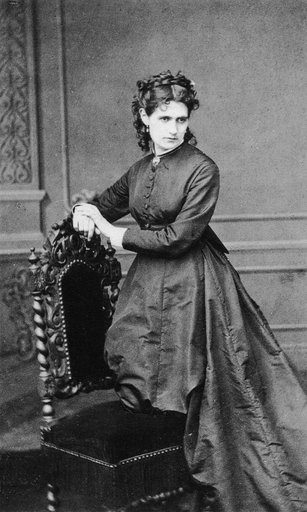
Artist
Berthe Marie Pauline Morisot was a French painter, printmaker and a member of the circle of painters in Paris who became known as the Impressionists.