Artwork
Rubens Peale with a Geranium
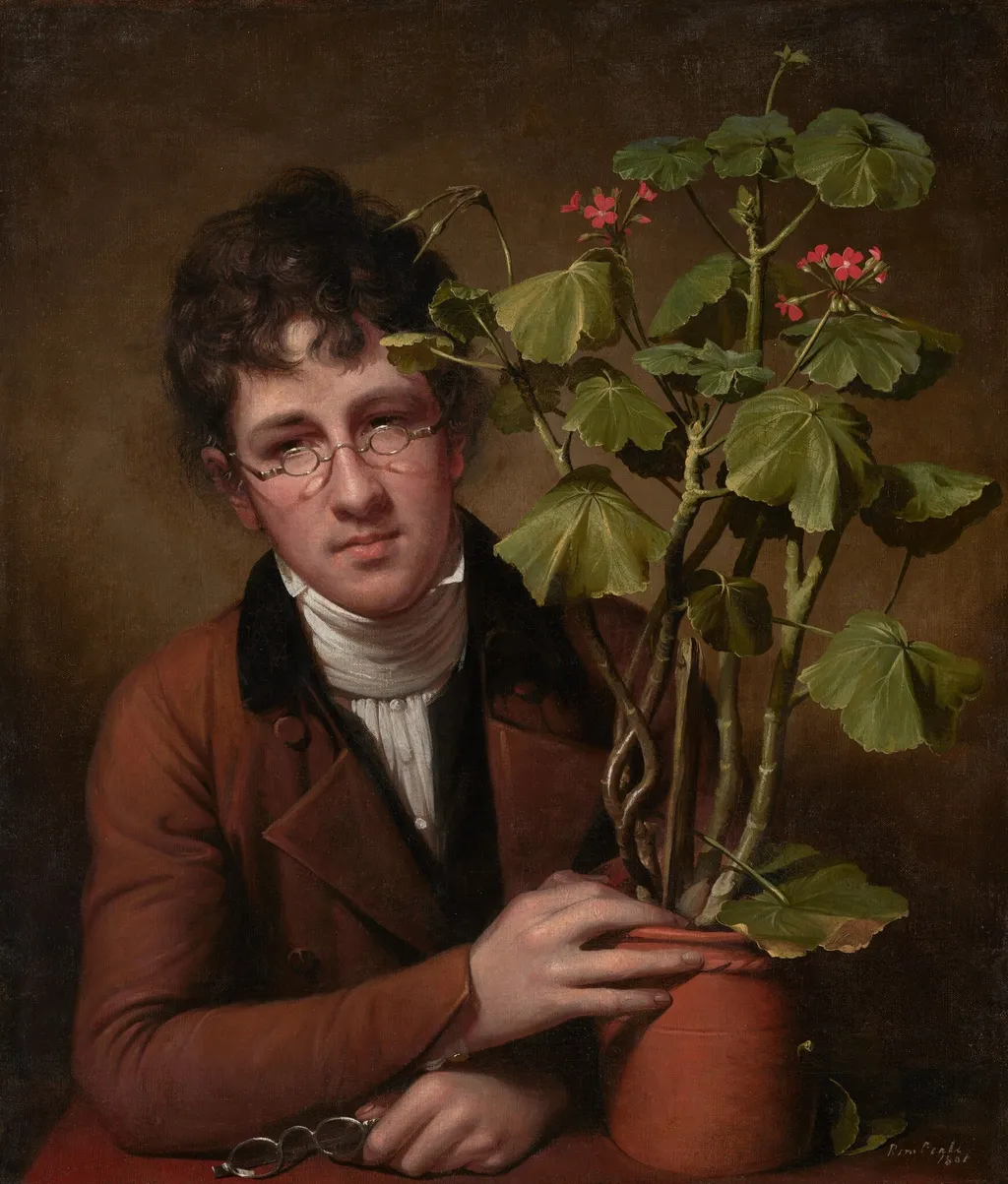
Rubens Peale with a Geranium is an oil painting by the American Impressionist artist Rembrandt Peale. It dates from 1801 and is held in the collection of the National Gallery of Art.
- Inscription
- Inscribed:lower right: Rem Peale / 1801
About this work
Subject & Meaning
Visual parallels link the subject to the plant: the "V" shape of Rubens' lapels echoes the rising stalks, while his hair curls mirror the plant's curves.
The painting depicts Rubens Peale, the artist's seventeen-year-old brother, in an informal pose that reveals his sensitive nature. A geranium, possibly Pelargonium inquinans, occupies a significant portion of the composition, competing for attention with the sitter and creating an effective double portrait. This arrangement represents an American artistic ideal favoring candor and the natural over European conventions of complexity.
Visual parallels link the subject to the plant: the "V" shape of Rubens' lapels echoes the rising stalks, while his hair curls mirror the plant's curves. The inclusion of eyeglasses, a rarity for portrait subjects of the era, further emphasizes the work's focus on naturalism and specific detail over traditional pretension.
Technique & Style
Rubens Peale with a Geranium is an oil painting on canvas, executed in 1801 when Rembrandt Peale was twenty-three. The work is handled informally: the sitter is shown in a relaxed, unstudied pose, holding a pair of glasses and resting his fingers on the lip of a terracotta pot containing a geranium, which occupies a significant portion of the composition. Stylistically, the painting echoes forms between figure and plant, the ‘V’ of the sitter’s lapels and shirt mirrors the rising stalks of the geranium, and the curls of his hair correspond to the curves of the plant’s leaves.
This departure from conventional European portraiture emphasizes candor, clarity, and naturalness over pretension and complexity, marking it as an early example of American portraiture that values direct observation.
History & Provenance
Created in 1801 by Rembrandt Peale at age 23, Rubens Peale with a Geranium depicts his 17-year-old brother. The work remained in the artist's possession before passing to James Claypoole Copper of Philadelphia. In 1854, Copper gifted the portrait to Mary Jane Peale, the sitter's daughter, initiating a multi-generational descent through the Peale family to Albert Charles Peale, Jessie Sellers Colton, and Mildred Colton Esty.
The painting was subsequently sold to collector Lawrence A. Fleischman and later acquired by Pauline E. Woolworth. On December 5, 1985, it was sold at Sotheby's in New York for $3.7 million, a record price for an American artwork at the time, before being purchased by the National Gallery of Art in Washington, D.C.
Rubens Peale with a Geranium is held in the collection of the National Gallery of Art in Washington, D.C. The museum acquired the painting in 1985 after purchasing it through Kennedy Galleries following a Sotheby's auction in New York on December 5 of that year, where it sold as lot 42. Prior to entering the national collection, the work passed through the Peale family lineage before being sold to collector Lawrence A. Fleischman and subsequently Pauline E. Woolworth. The 1985 acquisition price of $3.7 million established a new auction record for an American artwork at the time.
While the painting has been featured in exhibitions documenting the Peale family legacy, including shows at the Detroit Institute of Arts and the National Portrait Gallery, its primary institutional home remains the National Gallery of Art.
Context
Completed in 1801 when the artist was twenty-three, this portrait of his brother Rubens is hailed by the National Gallery of Art as one of the finest in American art history. Scholars value the work for its departure from traditional European portraiture, citing its informal composition and the unusual prominence of the geranium, which creates a near double-portrait emphasizing candor over pretension. Art historian Billie Follensbee has analyzed the depiction of eyewear, suggesting the glasses on the subject's face were a later overpainting, a theory supported by family correspondence despite a lack of physical evidence.
The painting's historical significance was cemented in 1985 when its acquisition by the National Gallery of Art for $3.7 million established a new auction record for an American artwork, surpassing the previous high held by Frederic Edwin Church.
Legacy
Rembrandt Peale's 1801 portrait has been described by the National Gallery of Art as "among the finest portraits in the history of American art," valued for its embodiment of an ideal in American art that favors candor over pretension and the natural over the conventional. Its 1985 acquisition by the National Gallery of Art for $3.7 million set a record for an American work of art sold at auction, surpassing Frederic Edwin Church's The Icebergs, which had sold for $2.5 million. Scholarly attention to the painting has continued, notably in Carol Eaton Soltis's 2002 study in the American Art Journal, which proposed a possible source in David Teniers the Younger, and in Robert Wilson Torchia's 1998 systematic catalogue entry for the National Gallery of Art.
Overview
This 1801 oil on canvas by American artist Rembrandt Peale depicts his younger brother, Rubens Peale. The portrait captures Rubens, then seventeen, seated calmly and holding a geranium. An early work in Rembrandt Peale's career, painted when he was twenty-three, it conveys a sense of personal connection between the siblings. The painting presents a detailed and realistic likeness of its subject within a simple interior.
Own this work as a print
Artist & collection

Artist
Rembrandt Peale (February 22, 1778 – October 3, 1860) was an American artist and museum keeper.