Artwork
Christ with a Staff
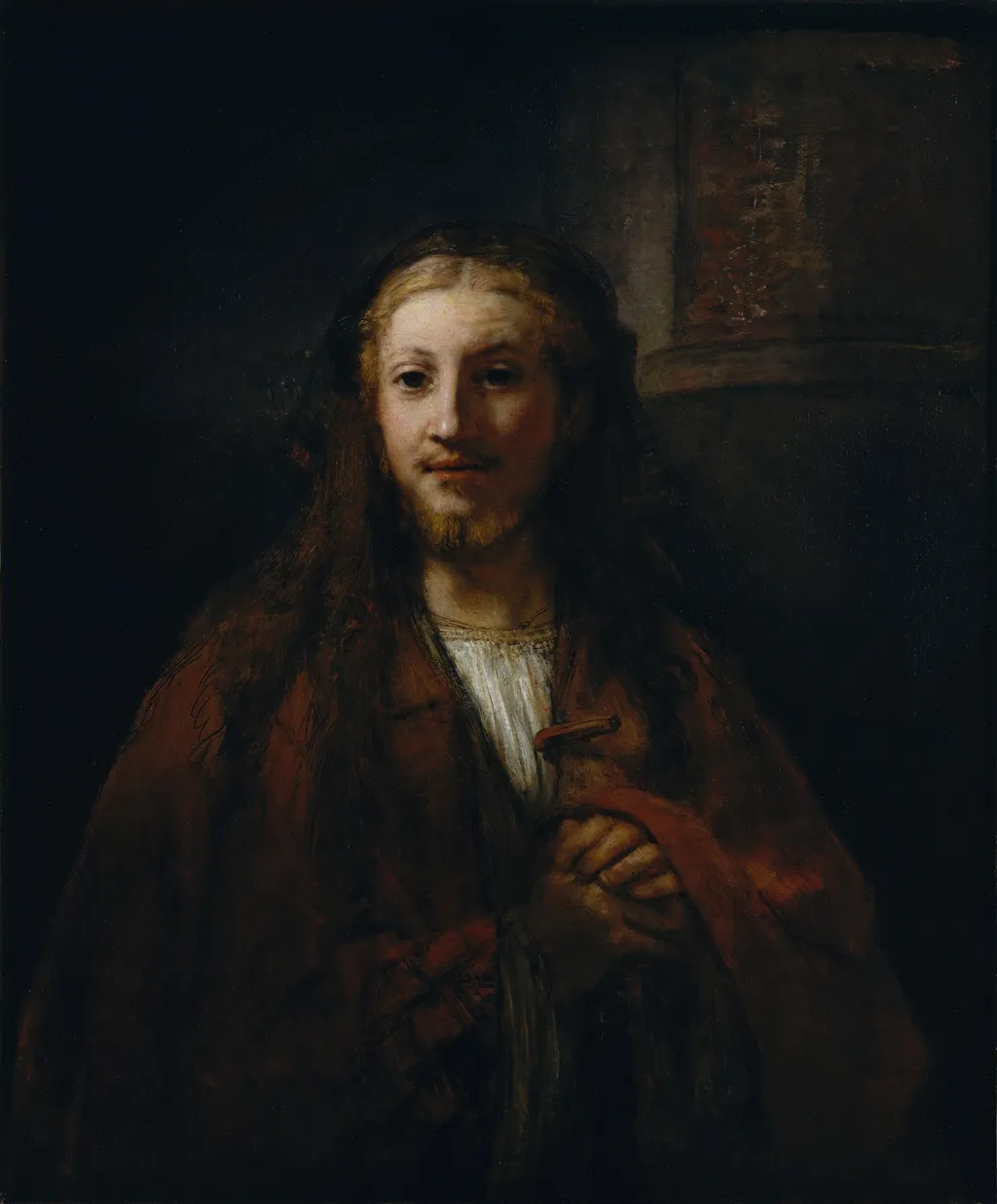
Christ with a Staff is an oil painting by the Dutch Golden Age artist Rembrandt van Rijn. It dates from 1661 and is held in the collection of the Metropolitan Museum of Art.
About this work
Subject & Meaning
The work’s Rembrandtesque style and 1661 date link it to the artist’s late period, potentially influenced by his series of apostle portraits from that year.
The painting depicts a bearded man with long hair, dressed in a brown tunic, leaning on a staff with both hands. Traditionally identified as Christ, the figure has been alternately proposed as Saint James the Less, though the absence of typical attributes such as a book or tools complicates this association. The staff, a common pilgrim’s attribute, suggests a journey or mission, possibly evoking early Christian narratives of Jesus’s travels and teachings.
The work’s Rembrandtesque style and 1661 date link it to the artist’s late period, potentially influenced by his series of apostle portraits from that year. Exhibited in 1933 as The Pilgrim, the composition emphasizes solitude and purpose, aligning with devotional traditions of representing Christ in contemplative or itinerant guise.
Technique & Style
Christ with a Staff is an oil painting on canvas, measuring 95.3 cm in height and 82.6 cm in width. Dated 1661 and signed 'Rembrandt f. / 1661' near the center right, the work depicts a bearded man in a brown robe leaning on a staff. While the signature and date suggest Rembrandt's hand, the Metropolitan Museum of Art attributes the piece to a follower, possibly his last pupil, Arent de Gelder.
The brushwork imitates Rembrandt's style from the 1660s, yet scholars note execution mannerisms distinct from the master's own. The painting is considered part of a series of apostle portraits associated with that year, though the specific identification of the figure as Christ or St. James the Less remains debated due to the atypical use of a pilgrim's staff as an attribute.
History & Provenance
The work bears the signature and date 'Rembrandt f. / 1661' on the canvas, placing its creation within the period of Rembrandt's late apostle paintings. Although traditionally attributed to the master, modern scholarship, including the Metropolitan Museum of Art, generally classifies it as the work of a follower, possibly Arent de Gelder, while some members of the Rembrandt Research Project still argue for its authenticity. The painting's documented history begins in 1836 within the collection of Christopher Bethell-Codrington.
It was sold at his estate auction in May 1843 to the dealer Christianus Johannes Nieuwenhuys and later acquired in December 1854 by Count Raczyński in Paris. Following ownership by Edward Aleksander Raczyński in Poznań, the piece was sold in 1899 to the Duveen Brothers for $150,000, who immediately resold it to Jules Bache in New York for $300,000. Bache subsequently bequeathed the painting to its current institution.
Christ with a Staff is part of the collection of the Metropolitan Museum of Art in New York, where it is accessioned as a work by a follower of Rembrandt painted circa 1661. The painting entered the museum through the bequest of Jules Bache, who acquired it from the dealer Duveen Brothers in 1930. It was first publicly shown in 1933 under the title The Pilgrim.
The work has been featured in museum catalogue entries for European paintings and in exhibitions focusing on Dutch Golden Age art.
Context
The painting’s reception has been shaped by shifting attributions. Traditionally regarded as an autograph work by Rembrandt and dated 1661, scholarly consensus since 1982 has questioned its authenticity, with the Metropolitan Museum classifying it as by a follower, possibly Rembrandt’s last pupil Arent de Gelder. Debate persists: members of the Rembrandt Research Project continue to defend the attribution, while most authors now reject it.
The picture’s style aligns with Rembrandt’s late manner, yet technical features and execution have been cited as atypical for his hand. Its iconography, depicting a bearded man with a staff, has also prompted debate over identity: traditionally read as Christ, some propose it represents St James the Less, though the absence of his usual attributes complicates this. The work’s exhibition history reflects these uncertainties; shown in 1933 as The Pilgrim, it underscores the interpretive flexibility of its iconography within Rembrandt’s circle.
Legacy
The painting's legacy is defined by its shifting attribution and its role in the study of Rembrandt's late workshop. Originally signed and dated 1661, the work was accepted as an autograph piece until 1982, when its authenticity became a subject of significant scholarly debate. Current consensus at the Metropolitan Museum of Art identifies the artist as a follower, possibly the master's final pupil, Arent de Gelder, though some members of the Rembrandt Research Project maintain its authenticity.
The work is historically linked to Rembrandt's 1661 series of apostle paintings, serving as a stylistic echo of that period. Its reputation also evolved through changing titles, having been exhibited as "The Pilgrim" in 1933 and known as "Christ" in 1854, reflecting ongoing uncertainty regarding whether the figure depicts Christ or St. James the Less.
Overview
This oil painting, titled Christ with a Staff, is attributed to an artist working in the circle of Rembrandt. Housed in the Metropolitan Museum of Art, the work has been known by several names throughout its history, including Christ in the mid-19th century and The Pilgrim when exhibited in the 1930s. The identity of the figure, and thus the precise subject, remains a point of scholarly discussion.

Own this work as a print
Artist & collection

Artist
Rembrandt Harmenszoon van Rijn, known mononymously as Rembrandt, was a Dutch Golden Age painter, printmaker, and draughtsman.