Artwork
Self-Portrait
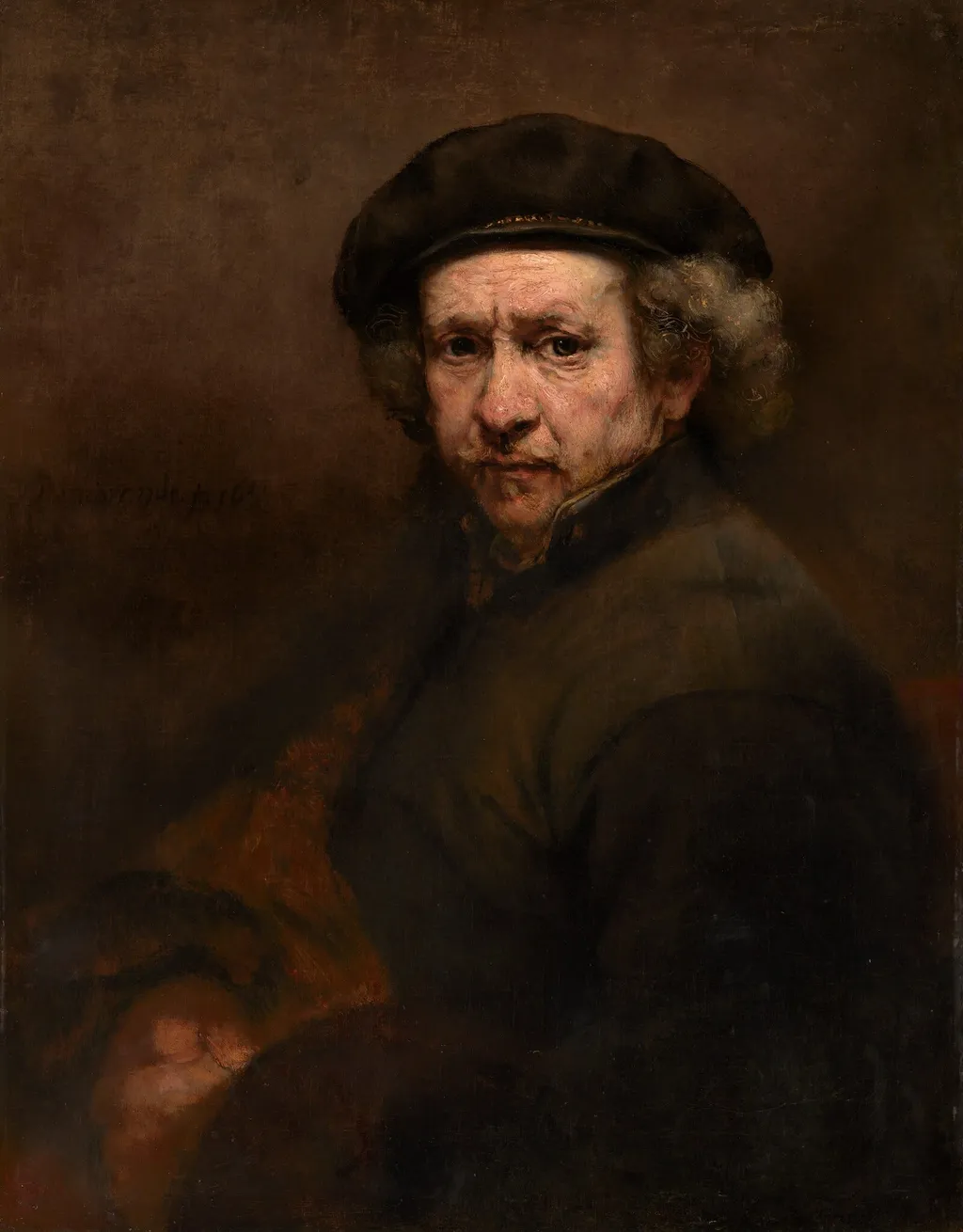
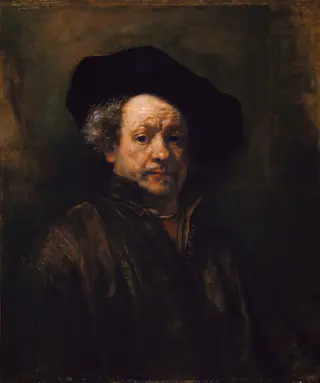
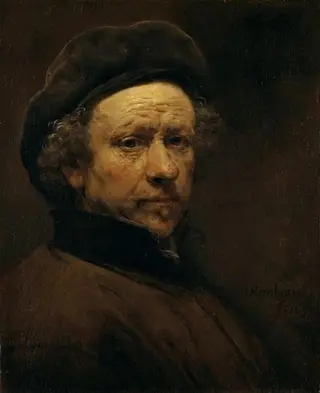
Self-Portrait is an oil painting by the Baroque artist Rembrandt van Rijn. It dates from 1659 and is held in the collection of the National Gallery of Art.
- Inscription
- Inscribed:center left: Rembrandt f. 1659
About this work
Subject & Meaning
The lighting isolates the right side of the face, emphasizing its contours and the play of light across the cheekbone.
The 1659 Self-Portrait depicts Rembrandt as an aging artist, his face mapped with wrinkles and blemishes that register both physical decline and the emotional weight of a life of creative triumphs and personal reverses. The black beret and turned-up collar frame the sitter’s features, directing attention to the luminous, tactile rendering of flesh where thick, warm impasto models the forehead, nose, and cheek while cooler green-gray underlayers appear in the temples and around the right eye. The lighting isolates the right side of the face, emphasizing its contours and the play of light across the cheekbone.
The clasped hands and the pose, turned slightly to the left, depart from the artist’s usual right-facing format and echo Raphael’s Portrait of Baldassare Castiglione, suggesting Rembrandt’s conscious reference to Renaissance tradition even as he renders his own worn physiognomy with unflinching immediacy.
Technique & Style
The painting is executed in oil on canvas, a standard support for Rembrandt’s late self‑portraits (1,2). Its handling is marked by thick, tactile pigment and expressive brushwork that van de Wetering likened to a shaving brush, with areas of dense impasto contrasted by thinner, refined touches and transparent glazes for the eye highlight (3,4). X‑radiographs reveal that the canvas was left at an intermediate stage, showing earlier thick passages subsequently worked over, indicating a less finished condition than many of his self‑portraits (3,4).
Stylistically, the work employs a restrained range of browns and grays enlivened by red accents, light from the upper right models the face, and the somber, turned‑left pose recalls Raphael’s Castiglione while conveying the artist’s physical aging and emotional experience (3,4).
History & Provenance
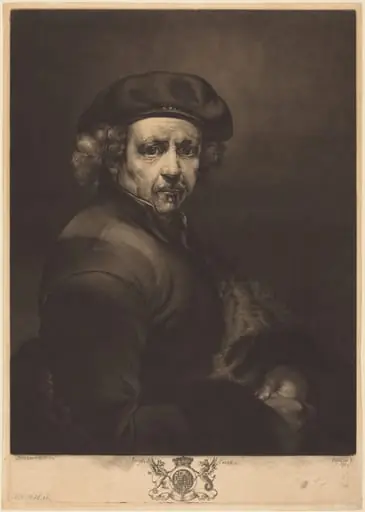
Painted by Rembrandt van Rijn in 1659, the oil-on-canvas self-portrait entered the collection of George Brudenell, 4th Earl of Cardigan (later Duke of Montagu) by 1767, as evidenced by a mezzotint dated that year. It passed by inheritance to his daughter Elizabeth, Duchess of Buccleuch, and then descended through the Dukes of Buccleuch and Queensberry to John Charles Montagu, 7th Duke of Buccleuch and 9th Duke of Queensberry. In 1928 the work was sold jointly to P. & D. Colnaghi & Co. and M. Knoedler & Co., New York, and transferred to Andrew W. Mellon in January 1929.
Mellon deeded it to the A. W. Mellon Educational and Charitable Trust on 28 December 1934, and it was gifted to the National Gallery of Art, Washington, D.C., in 1937, where it remains.
The Self‑Portrait with Beret and Turned‑Up Collar is held by the National Gallery of Art in Washington, D.C., where it forms part of the Andrew W. Mellon collection. It entered the museum in 1937 as a gift from the A. W. Mellon Educational and Charitable Trust, having previously descended through the Dukes of Buccleuch and Queensberry and been sold to Mellon in 1929. While no specific accession number is cited in the sources, the work is recorded as belonging to the Mellon gift to the NGA.
Its exhibition history includes a showing in the “Late Rembrandt” exhibition, as noted in the Wikidata entry for the painting.
Context
Painted in 1659, this self-portrait belongs to Rembrandt's late period and forms part of his prolific output of over forty self-portraits produced across his career. The work has been characterized as a self-portrayal of subtle and somber qualities, embodying "the stresses and strains of a life compounded of creative triumphs and personal and financial reverses." Its composition consciously echoes earlier works by Rembrandt, including a 1639 etching and a 1640 painted self-portrait now in the National Gallery, London, both of which reference Raphael's Portrait of Baldassare Castiglione and Titian's Man with a Quilted Sleeve.
The painting is one of only two late self-portraits, alongside Self-Portrait as Zeuxis, in which Rembrandt turns to the left, revealing more of the right side of his face. It derives from the same period as an identically titled, more finished canvas in the National Gallery of Scotland. Rembrandt scholar Ernst van de Wetering has commented on the work's expressive brushwork, noting that "the paint seems to have been applied, as it were, with a shaving brush." The painting was included in the exhibition "Late Rembrandt."
Legacy
Since its acquisition by the National Gallery of Art in Washington, D.C., in 1937, the 1659 Self-Portrait has been recognized as a profound depiction of the artist's later life, embodying the 'stresses and strains' of his creative triumphs alongside personal and financial reverses. The work's reputation rests on its unique, somber qualities and its expressive, unfinished brushwork, which researcher Ernst van de Wetering noted appears applied with a 'shaving brush.' Despite initial questions regarding its attribution due to this freedom of execution, the painting is now celebrated for its textural vibrancy and atmospheric illusionism.
Its legacy is further cemented by its inclusion in major exhibitions, such as Late Rembrandt, where it stands as a pivotal example of Rembrandt's mature style and his intentional deviation from standard self-portrait conventions.
Overview
Rembrandt van Rijn's 1659 oil on canvas, titled Self-Portrait with Beret and Turned-Up Collar, is one of more than forty self-portraits created by the Dutch master. This painting presents a contemplative and understated depiction of the artist. It is often regarded as reflecting the complexities of his life, marked by both artistic achievements and personal difficulties. The work offers a direct, yet nuanced, engagement with the viewer.
Own this work as a print
Artist & collection

Artist
Rembrandt Harmenszoon van Rijn, known mononymously as Rembrandt, was a Dutch Golden Age painter, printmaker, and draughtsman.