Artwork
Jeremiah Lamenting the Destruction of Jerusalem
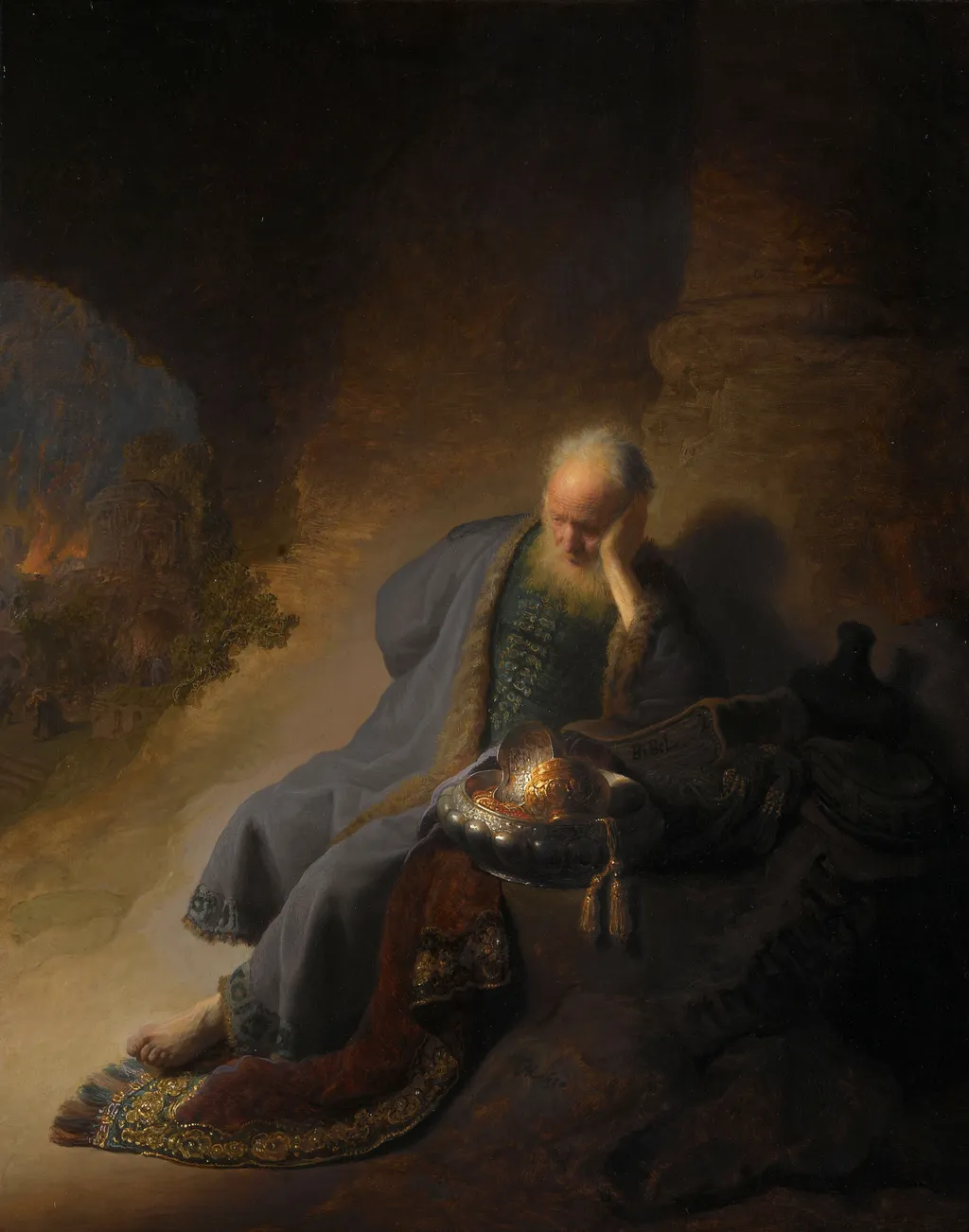
Jeremiah Lamenting the Destruction of Jerusalem is an oil painting by the Dutch Golden Age artist Rembrandt van Rijn. It dates from 1630 and is held in the collection of the Rijksmuseum. Created in 1630, this oil painting by Rembrandt belongs to his early Leiden period.
About this work
Subject & Meaning
A small figure clutching his eyes represents the blinded King Zedekiah, grounding the work in the specific historical trauma of the Jewish exile.
The painting depicts the prophet Jeremiah mourning the destruction of Jerusalem in 586 BCE, a scene synthesized from biblical accounts in the Books of Jeremiah and Lamentations. The central figure, modeled after Rembrandt’s father, sits in a melancholic pose with his elbow on a book inscribed "BiBeL," symbolizing deep sorrow and the weight of prophecy. Beside him lie golden vessels and a silver bowl, interpreted as gifts from Nebusaradan upon Jeremiah’s release, alongside a bottle referencing the prophet’s warning that God would break Jerusalem like a potter’s vessel.
In the background, the burning city and fleeing figures illustrate the Babylonian siege, while a winged figure holding a torch suggests divine agency in the destruction. A small figure clutching his eyes represents the blinded King Zedekiah, grounding the work in the specific historical trauma of the Jewish exile.
Technique & Style
Created in 1630 during Rembrandt's Leiden period, Jeremiah Lamenting the Destruction of Jerusalem is an oil painting executed on an oak panel sourced from trees felled after 1624 in the northern Netherlands. The work measures 58.3 by 46.6 centimeters. Rembrandt employed a refined technique for the central figure, rendering the prophet's wrinkled forehead and fur-lined mantle with precise detail, while the background destruction of Jerusalem is depicted using loose, sketchy brushstrokes in thin layers of brown and yellow paint.
The artist utilized the impasto method to highlight specific elements, such as the velvet cloth with its embroidered border and the gleaming golden vessels, often scratching into the wet paint with a knife or the blunt end of a brush. A dramatic chiaroscuro effect divides the composition diagonally, contrasting the illuminated, melancholic prophet with the darker, fiery ruins in the distance.
History & Provenance
Painted in 1630 during Rembrandt's Leiden period, the work was executed in oil on an oak panel sourced from a tree felled after 1624 in the northern Netherlands. The earliest documented owner is Jacob Alewijn (1714–1761) of Amsterdam, in whose possession the painting was recorded by 1761. It passed by inheritance that same year to Margaretha Helena Graafland (1720–1766), and on 10 June 1767 was acquired by Fouquet through an anonymous sale at the Amsterdam auction house J. Posthumus and H. de Winter.
By 1768 the painting had entered the collection of Carl Philip César (1725–1795) in Berlin, and on 1 July 1778 it was purchased by Alexander Alexandrovich Golovkin (1732–1781) in Paris. No later than 1793 it was held by Alexander Sergeievich Stroganoff (1733–1811) in Saint Petersburg under the title Le philosophe en méditation. It descended through the Stroganoff family to Natalia Pavlovna (1796–1872), Sergei Grigorievich Stroganoff (1794–1882), and Sergei Alexandrovich Stroganoff (1852–1923).
In 1922 Herman Rasch of Stockholm bought it for 300,000 francs, and in 1939 the Rijksmuseum in Amsterdam acquired it from Rasch for 150,000 guilds.
The painting has been held in the collection of the Rijksmuseum in Amsterdam since 1939, when it was acquired from the Swedish owner Herman Rasch for 150,000 guilds, with support from the Vereniging Rembrandt. Earlier owners recorded in the provenance include Jacob Alewijn (by 1761), Margaretha Helena Graafland (1761), Fouquet (acquired 10 June 1767 at the Amsterdam auction house J. Posthumus and H. de Winter), Carl Philip César (by 1768, Berlin), Alexander Alexandrovich Golovkin (acquired 1 July 1778), and members of the Stroganoff family, Alexander Sergeievich Stroganoff (by 1793, under the title Le philosophe en méditation), Natalia Pavlovna and Sergei Grigorievich Stroganoff, and Sergei Alexandrovich Stroganoff, from whom Herman Rasch purchased the work in 1922 for 300,000 francs.
No specific exhibition history beyond its acquisition by the Rijksmuseum is documented in the provided sources.
Context
Painted in 1630 during Rembrandt's Leiden period, Jeremiah Lamenting the Destruction of Jerusalem is widely regarded as one of the finest achievements of his early career. The Dutch source describes it as "een van de allerbeste werkstukken uit Rembrandts late Leidse jaren," and the English-language overview calls it "one of Rembrandt's few early masterpieces." At only 24 years old, Rembrandt demonstrated a precocious mastery in conveying emotion through posture, gesture, and facial expression, an approach the German-language scholarship identifies as the highest achievement of 17th-century psychologically refined art.
The work's identification was long uncertain: until the late nineteenth century it was variously interpreted as Lot fleeing Sodom, Anchises at burning Troy, or simply a philosopher in a grotto. In 1897, Wilhelm von Bode and Cornelis Hofstede de Groot established the correct subject as Jeremiah mourning the fall of Jerusalem in 586 BCE. Scholarly analysis has linked its diagonal composition to the Italian Baroque, particularly Guido Reni's Saints Peter and Paul, situating the painting within broader European artistic currents while exemplifying Rembrandt's distinctive handling of light, impasto, and tronie-like facial expressiveness.
Legacy
Since the late nineteenth century, Rembrandt’s Jeremiah Lamenting the Destruction of Jerusalem has been recognized as a signal early masterpiece from his Leiden period, praised for its psychological intensity and technical ambition.
Critics have consistently ranked it among Rembrandt’s most accomplished early works, emphasizing its emotional depth and innovative compositional structure. Early modern viewers sometimes misidentified the subject as Lot or a generic philosopher, but Wilhelm von Bode and Cornelis Hofstede de Groot’s attribution to Jeremiah in 1897 established the painting’s correct iconography within Rembrandt’s oeuvre.
Overview
Created in 1630, this oil painting by Rembrandt belongs to his early Leiden period. It portrays a solitary, elderly figure seated against a dark, indistinct backdrop, his attention drawn to an open book and a glowing object in a metal bowl. The composition is dominated by stark contrasts of light and shadow, giving the scene a solemn, contemplative atmosphere.
Own this work as a print
Artist & collection

Artist
Rembrandt Harmenszoon van Rijn, known mononymously as Rembrandt, was a Dutch Golden Age painter, printmaker, and draughtsman.