Artwork
The Denial of Saint Peter
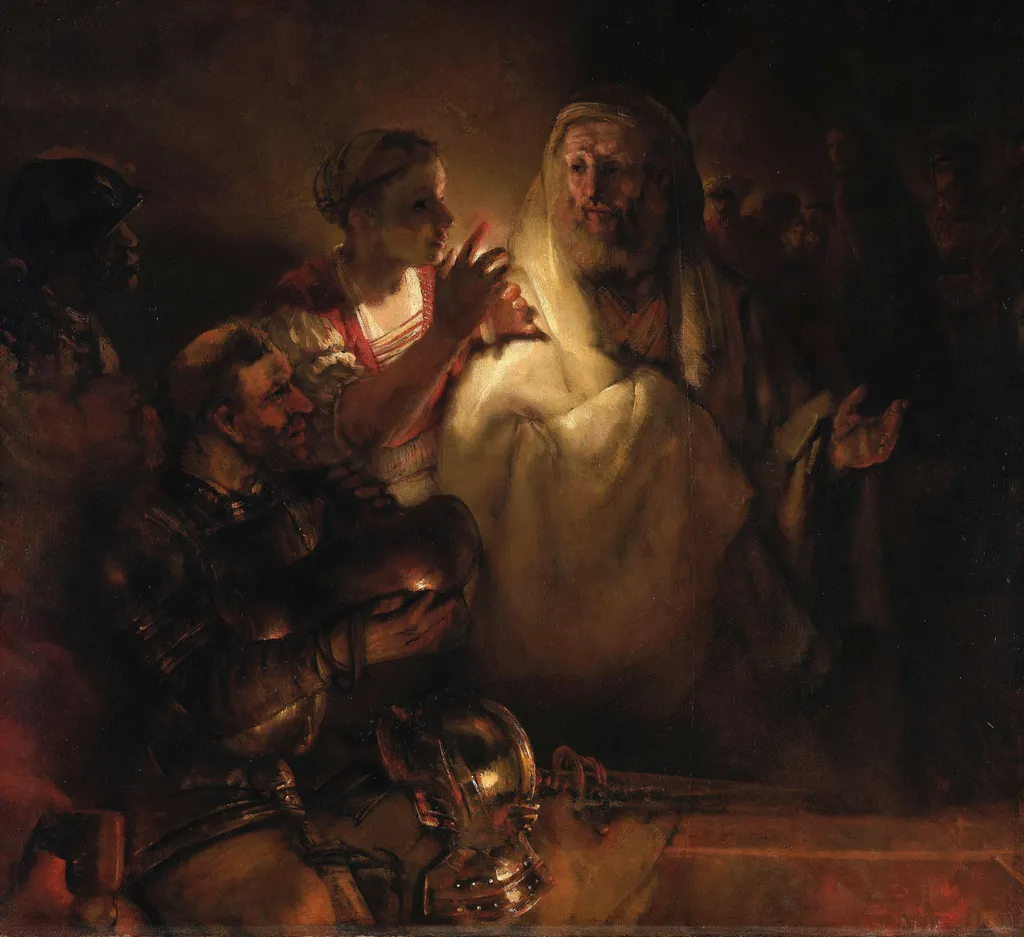
The Denial of Saint Peter is an oil painting by the Baroque artist Rembrandt van Rijn. It dates from 1660 and is held in the collection of the Rijksmuseum.
About this work
Subject & Meaning
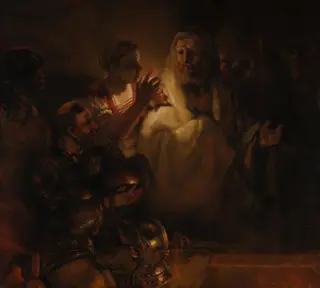
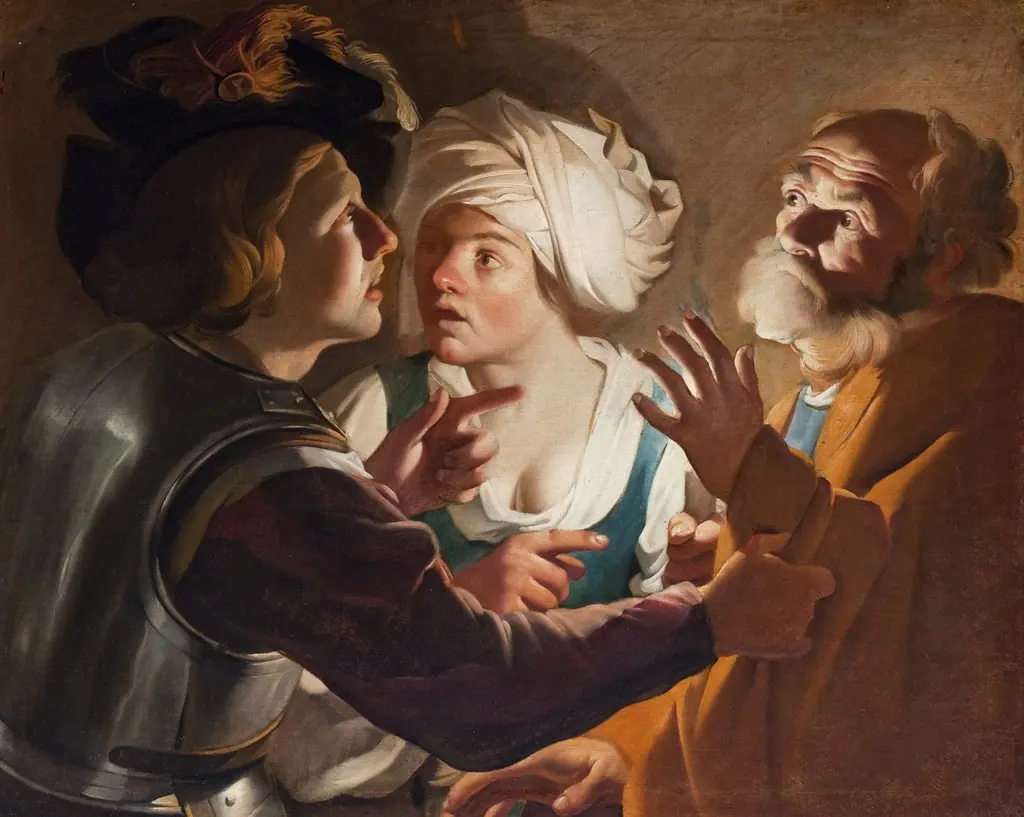
In the composition Peter, clothed in white, raises his hand in denial while two armed guards watch; Christ is shown in the background, led away bound.
The Denial of Saint Peter portrays the biblical moment when the apostle Peter repudiates knowledge of Jesus before a servant girl, as recounted in the Passion narratives. In the composition Peter, clothed in white, raises his hand in denial while two armed guards watch; Christ is shown in the background, led away bound. The work is signed and dated “Rembrandt 1660” and measures 154 × 169 cm (oil on canvas).
Its iconography draws on foreign prints, notably engravings after Gerard Seghers, and the scene emphasizes the tension between denial and divine knowledge through dramatic lighting and gesture. The painting’s provenance traces from Dutch collectors through Catherine II of Russia to the Hermitage, where it remained until its clandestine 1933 acquisition by the Rijksmuseum.
Technique & Style
The Denial of Saint Peter is an oil painting on canvas measuring 154 × 169 cm, signed and dated "REMBRANDT 1660" at the lower right. Stylistically it belongs to the Dutch Golden Age and the Baroque movement.
Light plays a central formal role in the composition. A glow from an unseen source illuminates the faces of Peter and the servant woman beside him, sharpening their expressions, and catches on the armor of the guards in the foreground. In the background, figures emerge only partially from the darkness, with Christ's face glimpsed as he glances back.
Rembrandt's treatment of the theme is thought to derive substantially from prints after works by the Flemish painter Gerard Seghers, specifically engravings by Schelte a Bolswert and Giovanni Antonio de Paoli, since Rembrandt never traveled to Italy.
History & Provenance
Signed and dated by the artist in the lower right corner, this canvas was completed in 1660. The work may have originally belonged to the Amsterdam merchant Marten Davidsz van Ceulen, appearing in his post-mortem inventory of March 24, 1687. By the mid-18th century, it entered the collection of Marc-René de Voyer d'Argenson in Paris, who likely sold it to Claude-Alexandre de Villeneuve, Comte de Vence, around 1759 or 1760.
Following Villeneuve's death, the painting was auctioned for 500 livres to an unknown buyer before entering the collection of Sylvain-Raphaël de Baudouin by 1780.
In 1781, Baudouin sold the piece along with 118 other artworks via Melchior Grimm to Catherine II of Russia, after which it resided in the Hermitage Museum in St. Petersburg. The Soviet government secretly sold the painting in 1933 through dealers Colnaghi, Knoedler, and Matthiesen. Supported by the Vereniging Rembrandt, the Rijksmuseum in Amsterdam acquired the work on July 10, 1933.
The Denial of Saint Peter has been held in the Rijksmuseum in Amsterdam since 10 July 1933, where it remains part of the permanent collection under its accession. Prior to this, the painting was part of the Hermitage Museum in Saint Petersburg, having entered its collection in 1781 when acquired by Catherine II of Russia alongside 118 other artworks.
The work’s exhibition history is primarily tied to its institutional holdings. After its secret sale by the Soviet government in 1933, facilitated by dealers Colnaghi, Knoedler, and Matthiesen, it was acquired by the Rijksmuseum with support from the Vereniging Rembrandt. No major temporary exhibitions are documented in the provided sources.
Context
The painting The Denial of Saint Peter (1660) is situated within the Dutch Golden Age and Baroque traditions, reflecting Rembrandt's engagement with biblical narratives without direct Italian experience, as noted in scholarly analysis of his reliance on prints after foreign works such as those by Gerard Seghers.
The work's provenance traces a complex path from Dutch collectors like Marten Davidsz van Ceulen to French aristocrats including Marc-René de Voyer d'Argenson, then to Catherine II of Russia via sale in 1781, before its clandestine acquisition by the Rijksmuseum in 1933 through Soviet-era channels.
The subject draws from New Testament accounts of Peter's denial during Christ's trial, rendered with characteristic chiaroscuro emphasizing Peter's gesture of denial and the surrounding figures' tension, as described across multilingual sources documenting its iconography and composition.
Overview
The Denial of Saint Peter is a 1660 painting by Rembrandt, measuring 154 cm × 169 cm, executed on canvas and now housed in the Rijksmuseum, Amsterdam. Signed and dated 'Rembrandt 1660', it captures a pivotal moment from the Passion of Jesus.
Own this work as a print
Artist & collection

Artist
Rembrandt Harmenszoon van Rijn, known mononymously as Rembrandt, was a Dutch Golden Age painter, printmaker, and draughtsman.