Artwork
The Return of the Prodigal Son
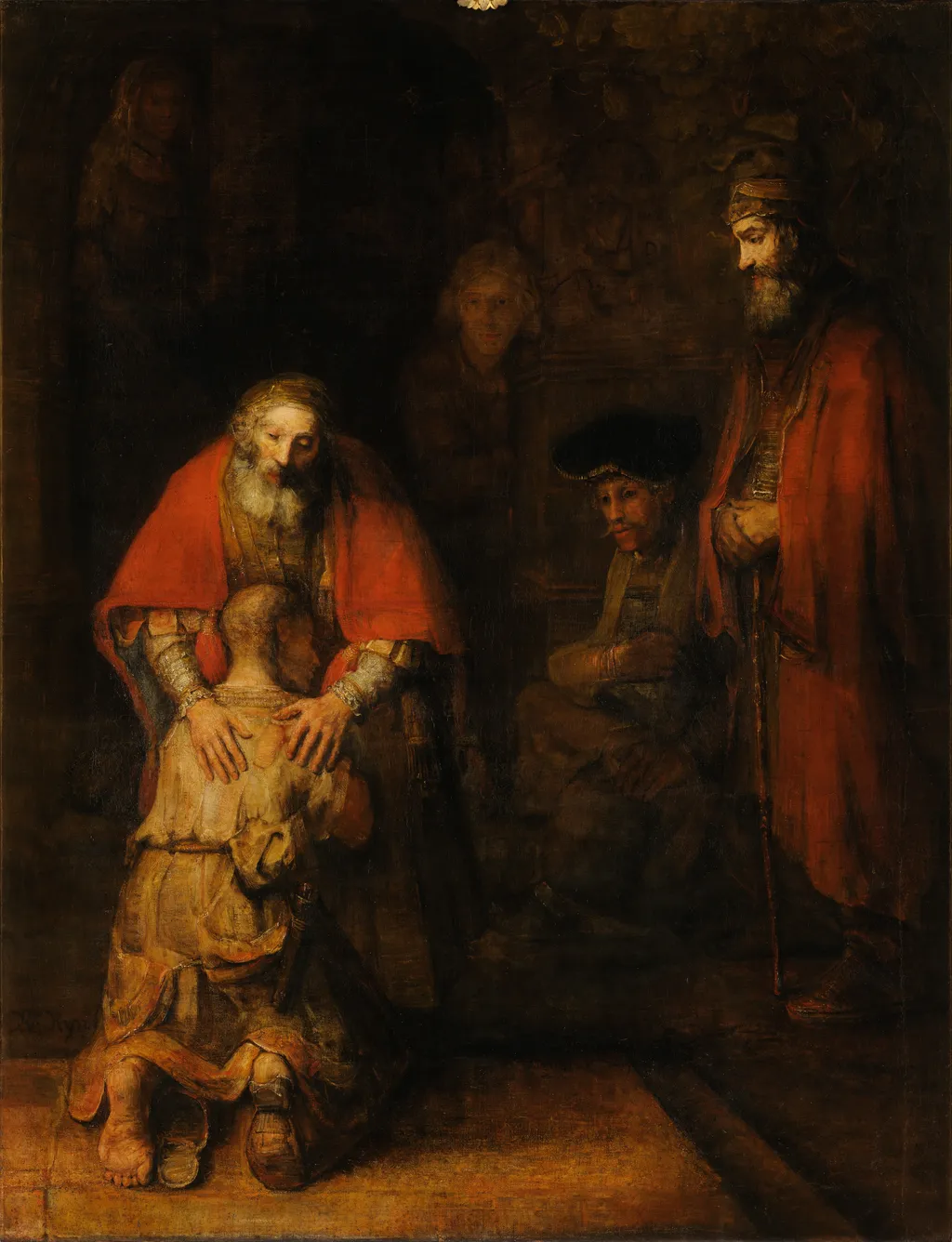
The Return of the Prodigal Son is an oil painting by the Dutch Golden Age artist Rembrandt van Rijn. It dates from 1668 and is held in the collection of the Hermitage Museum.
About this work
Subject & Meaning
Iconographically, the scene emphasizes the son's wretched state through tattered clothing and worn, bare feet, contrasting with the father's tender embrace.
The work illustrates the Parable of the Prodigal Son from Luke 15, depicting the moment a destitute son kneels in repentance before his father after squandering his inheritance. Iconographically, the scene emphasizes the son's wretched state through tattered clothing and worn, bare feet, contrasting with the father's tender embrace. The father's hands carry profound symbolism: the larger, masculine left hand rests on the son's shoulder, while the softer, receptive right hand suggests maternal care, representing a union of divine compassion.
To the right stands the elder brother, his crossed hands and judgmental posture embodying resentment and the difficulty of forgiving. Art historians interpret the painting as a spiritual testament on mercy, forgiveness, and homecoming, where the father's gesture signifies God's unconditional love. The inclusion of shadowy onlookers, possibly the mother or estate advisors, frames the central act of reconciliation within a broader human context of suffering and redemption.
Technique & Style
Executed circa 1668, this monumental work is an oil painting on canvas measuring 262 by 205 centimeters. As one of Rembrandt's final creations, the piece exemplifies his late style through a simplified composition that eschews external drama for profound psychological intensity. The artist employs a masterful handling of chiaroscuro, utilizing a light source from the left to illuminate the central figures against a predominantly dark background, thereby enhancing the spiritual atmosphere.
Formal qualities include the tender, dual-natured gesture of the father's hands, one masculine and firm, the other soft and receptive, contrasted with the son's worn shoes and tattered clothing which signify his arduous journey. The painting lacks artificial halos, relying instead on the interplay of light, shadow, and expressive body language to convey themes of mercy and homecoming with extraordinary solemnity.
History & Provenance
The Return of the Prodigal Son was painted by Rembrandt in Amsterdam, with the Hermitage Museum dating its creation to circa 1668 and the Wikidata entry recording inception dates of 1665 to 1668. The Dutch Wikipedia notes that when the Hermitage exhibited the work in the 2015 show Late Rembrandt, a broader date range of circa 1666–1669 was applied. It is regarded as one of Rembrandt's final works, likely completed within two years of his death in 1669, and is the largest painting he produced in his late years.
The canvas, measuring 262 by 205 centimeters, entered the Hermitage collection in 1766 when it was acquired by Catherine the Great, and it has since been displayed in the museum's Room 254, a gallery devoted exclusively to Rembrandt.
The Return of the Prodigal Son is permanently held by the State Hermitage Museum in St. Petersburg, Russia, where it resides in Room 254, a gallery dedicated to Rembrandt. The museum acquired the painting in 1766 through the purchase by Catherine the Great. While the Hermitage generally dates the work to circa 1668, the 2014–2015 exhibition "Late Rembrandt" proposed a creation window between 1666 and 1669.
The painting was a central feature of this specific exhibition, which traveled to the Hermitage. Prior to its acquisition, the work's provenance is not detailed in the provided sources, but its long-term residence in the Hermitage collection is well-documented since the late 18th century.
Context
Critical reception of Rembrandt’s The Return of the Prodigal Son emphasizes its spiritual intensity and psychological depth. Scholars such as Rosenberg describe the work as monumental, noting its unparalleled evocation of mercy and its capacity to convey a moment that stretches into eternity. Contemporary commentators, including Kenneth Clark and H. W. Janson, regard it as the apex of Rembrandt’s late style, highlighting the tender silence and the convergence of paternal forgiveness with human frailty.
The painting’s placement in the Hermitage Museum since its acquisition by Catherine the Great situates it within the broader narrative of 17th‑century Dutch biblical art. Its complex iconography, discussed in Dutch and French encyclopedias‑5), reflects Rembrandt’s lifelong engagement with the parable, linking his personal hardships to a universal theme of homecoming.
Legacy
The Return of the Prodigal Son is widely regarded as Rembrandt's spiritual testament and a pinnacle of Western art. Art historian Kenneth Clark suggested that viewers of the original might forgive claiming it as the greatest painting ever created. Scholars describe the work as monumental, noting its unparalleled evocation of religious mood and human sympathy that surpasses other Baroque artists.
H. W. Janson characterized it as the Dutch master's most moving and quietest painting, capturing a moment of eternal tenderness. The work's profound impact is evidenced by the 1992 book The Return of the Prodigal Son: A Story of Homecoming by Henri Nouwen, who was deeply moved after contemplating the piece at the Hermitage Museum in 1986. Nouwen used the painting as a framework to explore themes of forgiveness and the parable's relevance to Rembrandt's own life.
The painting is also celebrated as an extraordinary visual realization of paternal love and forgiveness within the history of art.
Overview
Rembrandt's The Return of the Prodigal Son is an oil painting housed in the Hermitage Museum in St. Petersburg. It represents one of the artist's final creations, likely completed shortly before his death in 1669. The work depicts a pivotal moment from the biblical parable, focusing on themes of repentance and paternal forgiveness. Its profound emotional depth and masterful execution have earned it significant acclaim in art history.
Own this work as a print
Artist & collection

Artist
Rembrandt Harmenszoon van Rijn, known mononymously as Rembrandt, was a Dutch Golden Age painter, printmaker, and draughtsman.