Artwork
Abraham Francen
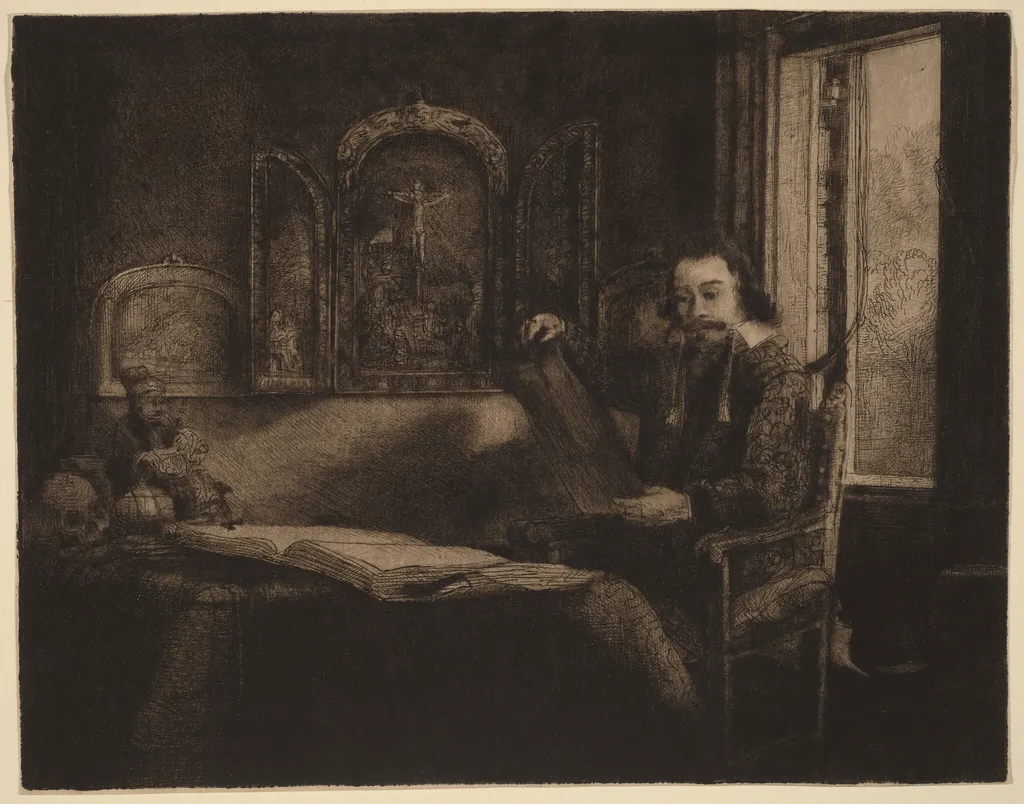
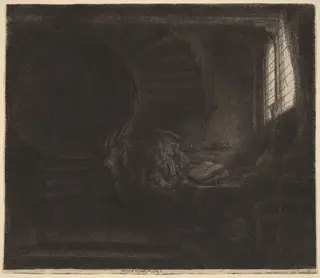
Abraham Francen is an ink print by the Baroque artist Rembrandt van Rijn. It dates from 1657 and is held in the collection of the National Gallery of Art.
About this work
Overview
Abraham Francen, executed by Rembrandt van Rijn in 1657, is a masterful etching combining drypoint and burin on Japan paper.
Abraham Francen, executed by Rembrandt van Rijn in 1657, is a masterful etching combining drypoint and burin on Japan paper. The work depicts the artist's apothecary friend, Abraham Francen, seated at a cluttered desk within a dimly lit interior. Francen holds a sheet of paper, his gaze directed outward, while the surrounding space is densely populated with scholarly and domestic objects, including a globe, books, and various vessels.
A prominent crucifix hangs on the wall behind him, positioned between two smaller framed paintings, establishing a distinct spiritual atmosphere within the domestic setting. Heavy curtains frame a window to the right, modulating the light that falls across the scene. Rembrandt employs his characteristic technique of varying line density and rich burin work to create deep shadows and textured surfaces, emphasizing the tactile quality of the paper and the wood.
This portrait is significant as one of the few known likenesses of Francen, who served as the artist's supplier of materials and confidant during Rembrandt's later years in Amsterdam. The composition reflects the artist's mature interest in the intersection of the intellectual, the material, and the spiritual, capturing a moment of quiet contemplation rather than a formal state portrait.
Subject & Meaning
The central figure, a man holding a sheet of paper, appears absorbed in study or contemplation. Behind him, a prominent crucifix dominates the space, flanked by two smaller framed pictures, suggesting a setting that intertwines scholarly activity with religious devotion.
Technique & Style
Rembrandt employed fine, intersecting lines to render deep shadows and the texture of fabric folds, while the drypoint technique adds a velvety quality to the darker areas. The bright crucifix is achieved through careful manipulation of the burin, creating a focal point that contrasts with the surrounding gloom.
History & Provenance
The work is catalogued as an etching from the later period of Rembrandt’s career, when he frequently combined multiple printmaking methods. It remains part of the artist’s extensive oeuvre of prints that explore chiaroscuro and intimate interior scenes.
Own this work as a print
Artist & collection

Artist
Rembrandt Harmenszoon van Rijn, known mononymously as Rembrandt, was a Dutch Golden Age painter, printmaker, and draughtsman.