Artwork
Abraham Francen
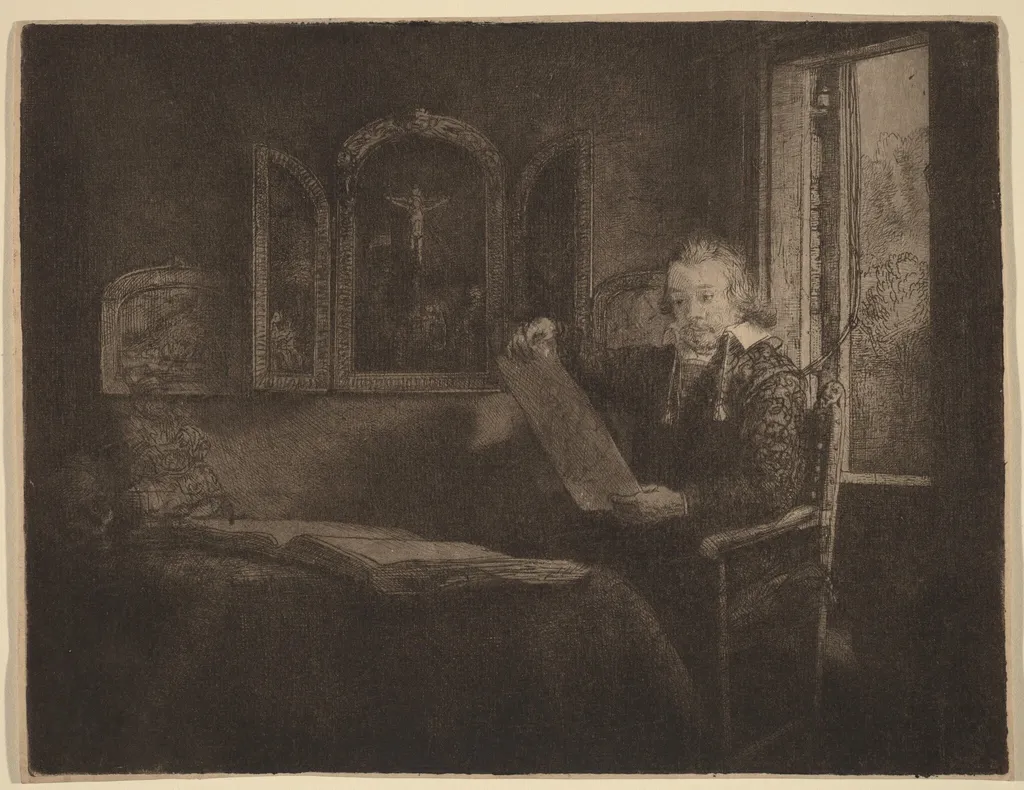
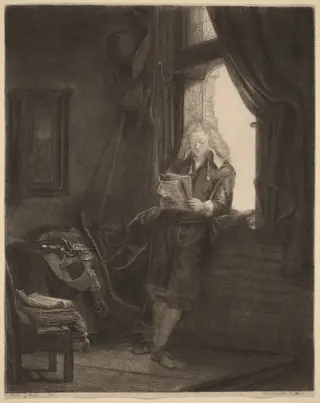
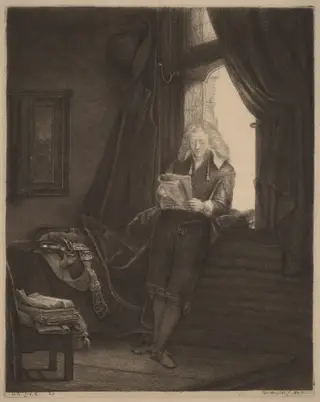
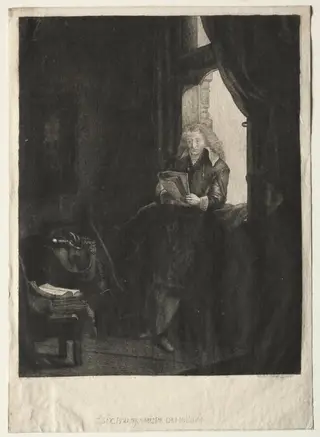
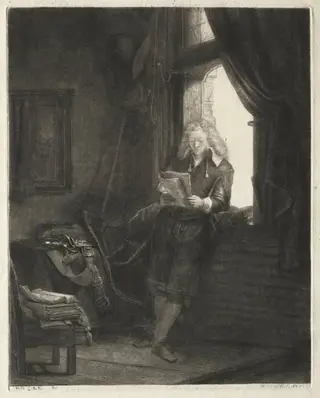
Abraham Francen is an ink print by the Baroque artist Rembrandt van Rijn. It dates from 1657 and is held in the collection of the National Gallery of Art.
About this work
Overview
This portrait exemplifies Rembrandt's late-period interest in capturing the psychological presence of his subjects through intimate, unidealized representation.
Abraham Francen, created by Rembrandt van Rijn in 1657, is a masterful print executed in etching, drypoint, and burin. The work depicts the artist's apothecary friend, Abraham Francen, seated in a dimly lit interior. Francen is shown in a relaxed, informal pose, with one leg crossed over the arm of his chair and his body draped in a loose robe, suggesting a moment of rest or deep contemplation.
The composition is defined by Rembrandt's characteristic use of chiaroscuro, where strong contrasts between light and shadow model the figure and define the spatial depth. Behind the sitter, three framed pictures hang on the wall; the central image clearly depicts a crucifixion scene, while the flanking frames remain less distinct. This portrait exemplifies Rembrandt's late-period interest in capturing the psychological presence of his subjects through intimate, unidealized representation.
Rather than a formal state portrait, the work conveys a sense of quiet domesticity and intellectual engagement. It stands as a significant example of Rembrandt's technical virtuosity in combining multiple printmaking techniques to achieve rich tonal variations and textural complexity.
Subject & Meaning
The central figure appears absorbed in contemplation, his loose robe and thoughtful expression suggesting a moment of private reflection. The presence of the crucifixion panel may allude to spiritual or moral considerations, inviting viewers to contemplate the relationship between the individual’s inner world and the larger religious narrative implied by the background imagery.
Technique & Style
Rembrandt employs a layered approach, integrating traditional etching with drypoint and burin incisions to achieve a rich tonal range. The rough, scratched textures of the robe, chair, and wall hangings contrast with the softer, illuminated areas on the face and picture frames, creating depth through chiaroscuro and emphasizing the tactile quality of the printed surface.
History & Provenance
The work belongs to Rembrandt’s late period, when he frequently explored intimate, interior scenes using mixed printmaking methods. Though specific ownership records are scarce, the piece has been documented in several 19th‑century collections of Dutch prints, confirming its attribution to Rembrandt and its circulation among connoisseurs of his graphic oeuvre.
Own this work as a print
Artist & collection

Artist
Rembrandt Harmenszoon van Rijn, known mononymously as Rembrandt, was a Dutch Golden Age painter, printmaker, and draughtsman.