Artwork
Jan Uytenbogaert
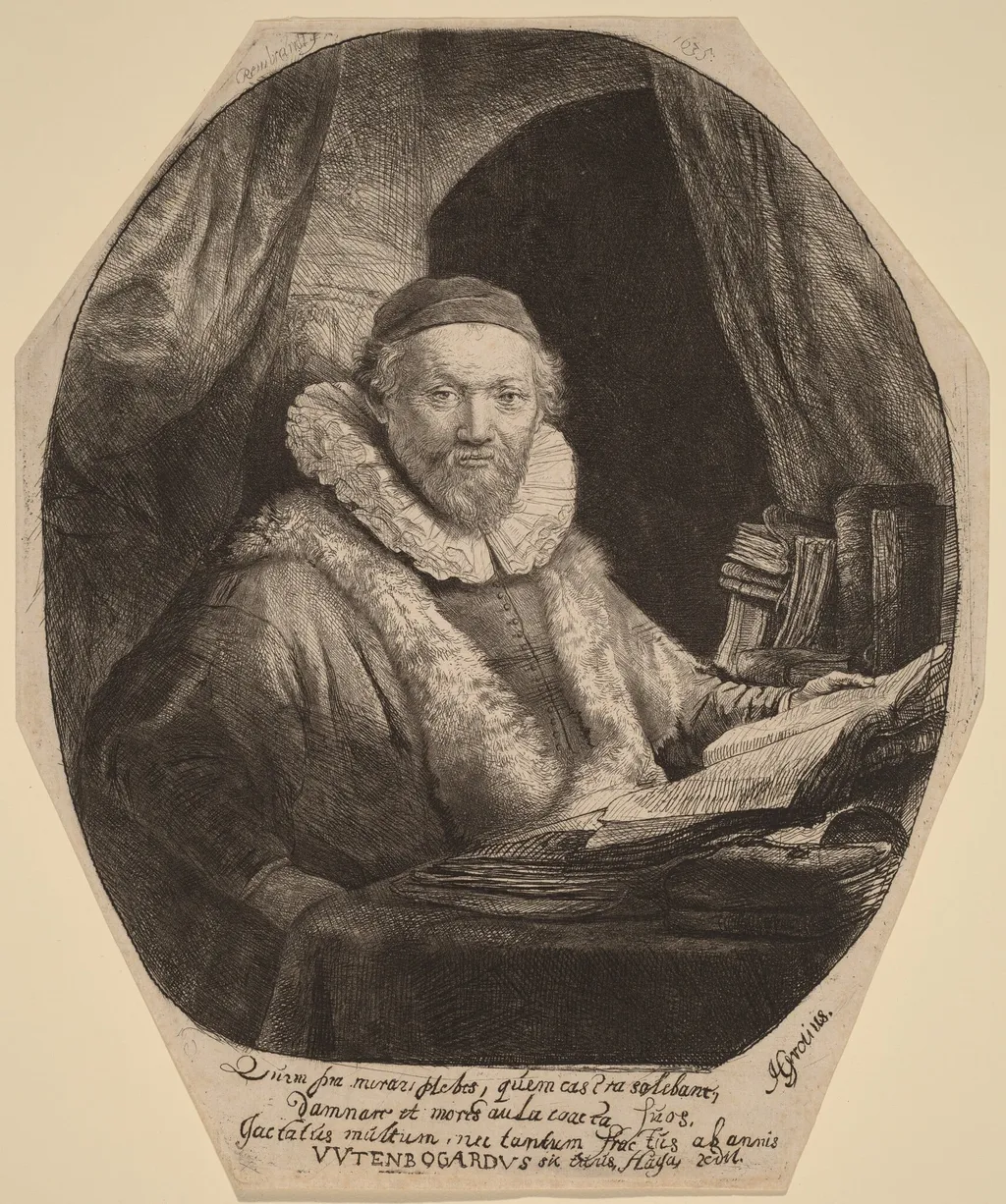
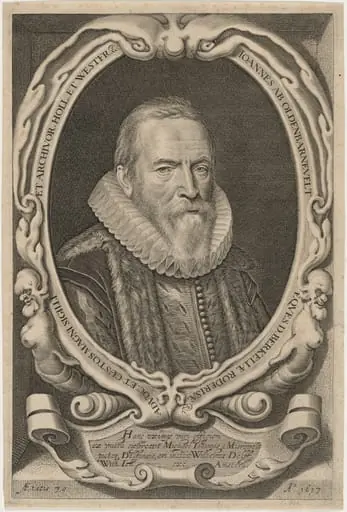
Jan Uytenbogaert is an ink print by the Baroque artist Rembrandt van Rijn. It dates from 1635 and is held in the collection of the National Gallery of Art.
About this work
Overview
Rembrandt employs a combination of fine etched lines and the deeper, richer tones of burin work to model the textures of the fur and the softness of the skin.
Jan Uytenbogaert is a 1635 etching and burin by Rembrandt van Rijn, depicting the Amsterdam goldsmith and art collector of the same name. The portrait presents the sitter in a three-quarter view, seated against a dark, unadorned background that isolates his figure. Uytenbogaert is shown as an older man with a full beard and curly hair, dressed in a heavy fur-lined coat and a wide, flat collar typical of the period.
His posture is contemplative; he rests his chin on his right hand while his left hand holds a small object, likely a ring or a key, resting on the arm of his chair. Rembrandt employs a combination of fine etched lines and the deeper, richer tones of burin work to model the textures of the fur and the softness of the skin. This work is significant as a rare instance where Rembrandt utilized the burin to enhance the tonal range of an etching, demonstrating his technical experimentation during his early Amsterdam period.
The portrait captures the dignity and intellectual presence of a prominent citizen, reflecting Rembrandt's growing reputation for psychological depth in portraiture.
Subject & Meaning
The portrait depicts an older man with a full beard, curly hair, and a contemplative expression. He rests his chin on one hand while the other grasps a small object, possibly a key or ring, suggesting personal significance or status. The serious, thoughtful demeanor invites speculation about the sitter’s identity and role.
Technique & Style
Rembrandt employed a combination of etching and burin work, using delicate lines to model facial wrinkles and the plush fur collar. Cross‑hatching creates subtle tonal gradations, while the stark contrast between light and shadow heightens the three‑dimensional effect. The print exemplifies the artist’s mastery of line to convey texture and mood.
History & Provenance
The print belongs to Rembrandt’s early period, when he produced numerous portrait etchings for the Dutch market. Though specific ownership records are limited, the work has been documented in several catalogues of Rembrandt’s prints and is held in public collections that specialize in 17th‑century graphic art.
Own this work as a print
Artist & collection

Artist
Rembrandt Harmenszoon van Rijn, known mononymously as Rembrandt, was a Dutch Golden Age painter, printmaker, and draughtsman.