Artwork
The Descent from the Cross
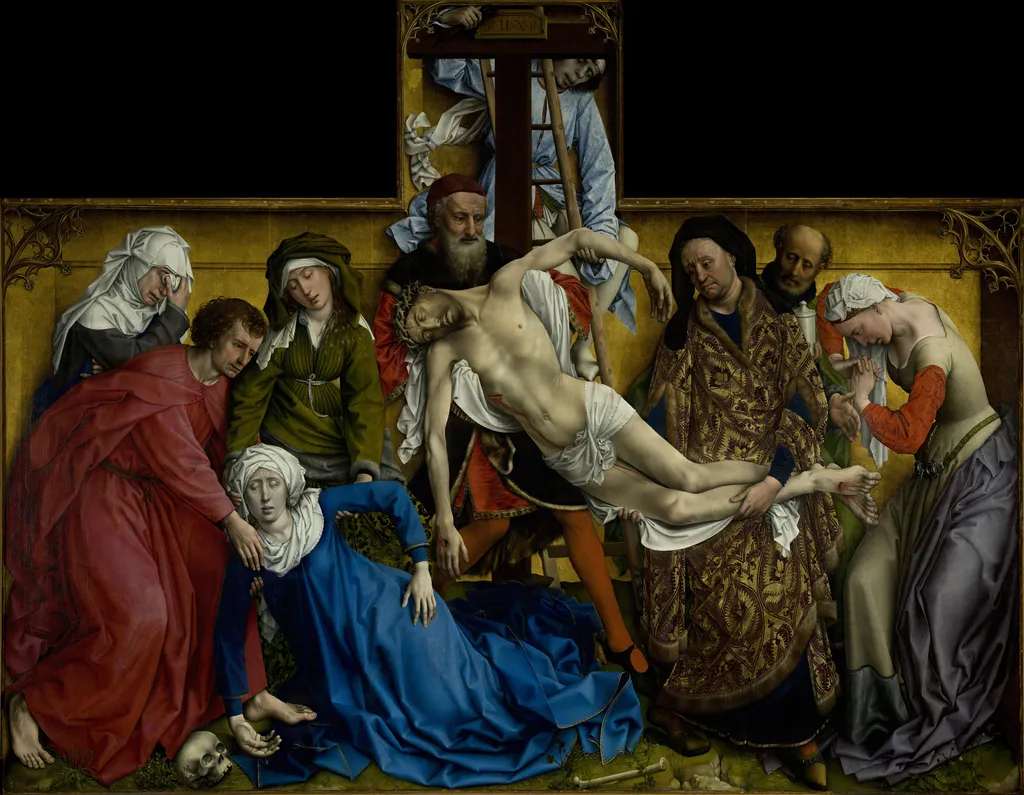
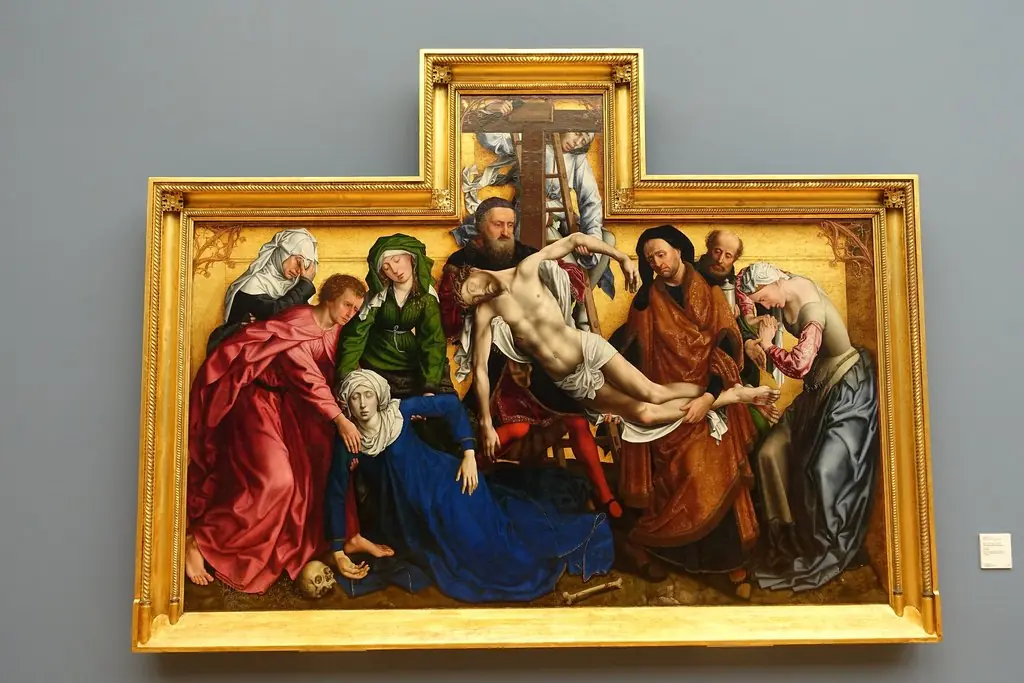
The Descent from the Cross is an oil painting by the Northern Renaissance artist Rogier van der Weyden. It dates from 1440 and is held in the collection of the Museo del Prado.
About this work
Subject & Meaning
Despite the violent nature of the event, figures are dressed in immaculate robes to emphasize spiritual purity over physical gore.
The work depicts the moment Christ's lifeless body is lowered from the cross, supported by Joseph of Arimathea and Nicodemus, while mourners including Mary Magdalene, John the Evangelist, and three women including Mary of Clopas and Mary Salome react with grief. A defining iconographic innovation is the 'Swoon of the Virgin,' where Mary collapses in a pose mirroring her son's, a visual theology reflecting the belief that she shared in his suffering and death. The composition deliberately arranges Christ's body in a T-shape resembling a crossbow, symbolizing the relaxation of a bow after releasing its arrow, a metaphor for the Passion commissioned by the Leuven crossbowmen guild.
Despite the violent nature of the event, figures are dressed in immaculate robes to emphasize spiritual purity over physical gore. The painting synthesizes the narrative of deposition with lamentation and foreshadows the entombment, inviting viewers to personally identify with the emotional intensity of the scene.
Technique & Style
Executed in oil paint on a panel support, the work measures approximately 204.5 by 261.5 centimeters and is constructed from eleven planks of Baltic oak. The painting remains in exceptionally good condition, having undergone its most recent restoration in 1992 and 1993. Stylistically, the composition reflects the influence of Robert Campin, characterized by hard, sculpted surfaces and vivid primary colors, particularly reds, whites, and blues.
The figures are rendered with a polychrome relief quality, appearing as three-dimensional sculptures within a shallow, gold architectural niche. The handling of space is complex, compressing five distinct levels of depth into a restricted area to heighten emotional intensity. Notably, despite the violent subject, the figures wear immaculate garments, and Christ's body displays only the stigmata, avoiding graphic blood to emphasize spiritual devotion rather than naturalistic gore.
The arrangement of Christ's body mimics the T-shape of a crossbow, a formal device linking the work to its original patrons.
History & Provenance
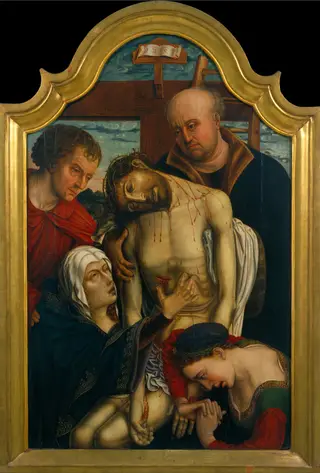
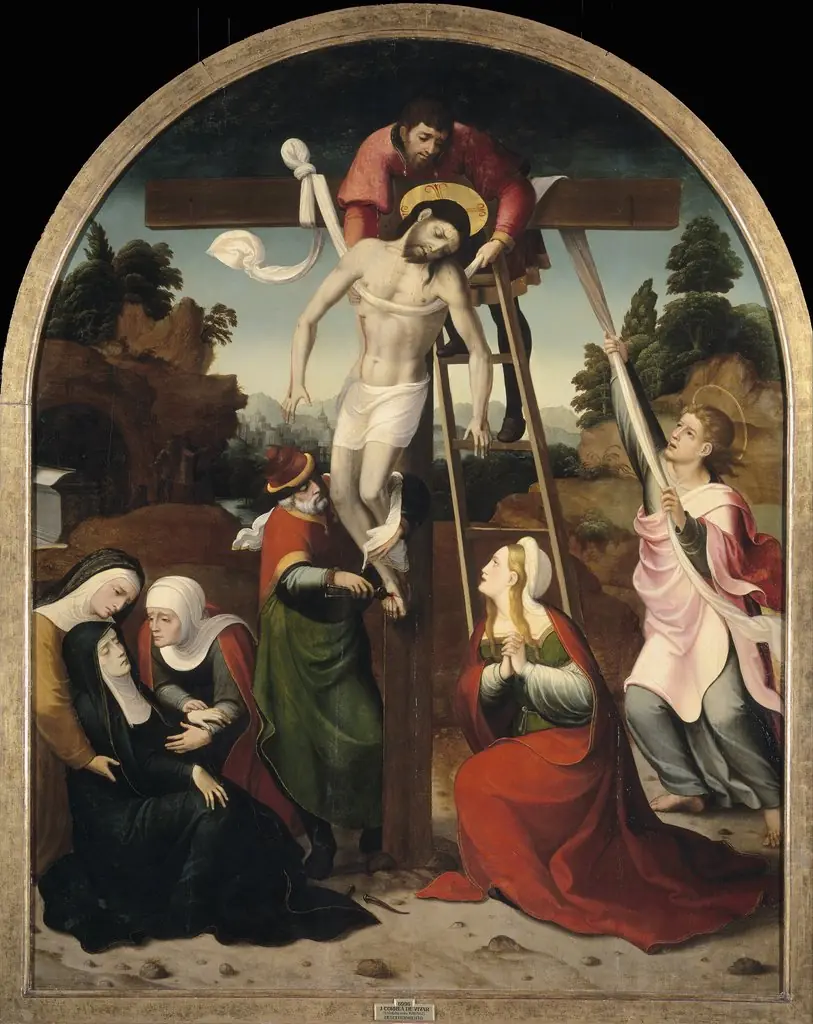
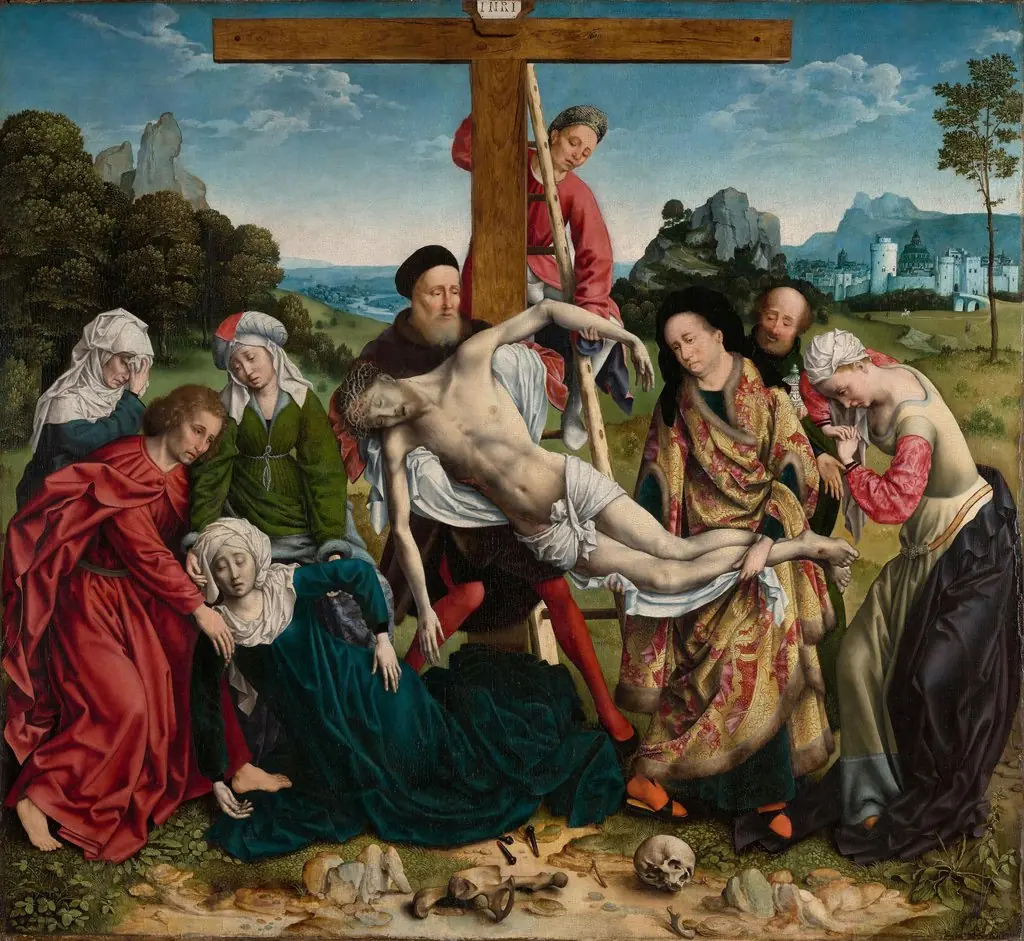
The Descent from the Cross was commissioned by the Greater Guild of Crossbowmen (Schutterij) of Leuven as the central panel of a triptych for the high altar of their chapel, Onze-Lieve-Vrouw-van-Ginderbuiten (Notre-Dame-hors-les-Murs), where it was installed by at least 1443. Most art historians date the painting to around 1435, shortly after van der Weyden completed his apprenticeship with Robert Campin, though Dirk de Vos has argued for a date closer to 1443. The work's fame was immediate: the Leuven family Edelheere commissioned a reduced copy of the central panel for their chapel in Sint-Pieterskerke by 1443, and Michiel Coxcie produced another copy between 1440 and 1448.
Around 1548, Mary of Hungary acquired the painting from the crossbowmen's guild in exchange for an organ valued at 1,500 florins (or 500 guilders, per the Dutch source) and a copy by her court painter Coxcie. She installed it in the chapel of her new palace at Binche, where it was documented by Vicente Álvarez in 1551. After French troops burned Binche in 1554, her nephew Philip II acquired the painting in 1555 and had it moved to Spain, first to the hunting lodge at El Pardo and then, as of 1574, to the monastery of El Escorial.
During the Spanish Civil War the panel was evacuated to Valencia and then Geneva, returning in 1939 to the Museo del Prado, where it has since remained. A restoration campaign was carried out in 1992–1993.
The Descent from the Cross is held in the Museo del Prado in Madrid, Spain, where it is cataloged under inventory number 2825. Originally commissioned for the Chapel of Our-Lady-Outside in Leuven, the painting was acquired around 1548 by Mary of Hungary in exchange for an organ and a copy by Michiel Coxcie. It subsequently entered the collection of Philip II of Spain, who installed it at the Royal Monastery of San Lorenzo de El Escorial in 1574, having previously housed it at the Palace of El Pardo.
During the Spanish Civil War, the work was evacuated to Valencia in 1936 and later exhibited at the Musée d'Art et d'Histoire in Geneva in 1939. Upon its return to Spain later that year, it was formally incorporated into the Prado's permanent collection.
Context
Art historians have described The Descent from the Cross as arguably the most influential Netherlandish painting of Christ's crucifixion, widely copied and adapted in the two centuries following its completion. Erwin Panofsky singled out its emotional intensity, writing that the painted tear "epitomizes that which Italians most admired in Early Flemish painting: pictorial brilliance and sentiment." The work is considered van der Weyden's self-conscious bid for international renown, produced shortly after completing his apprenticeship with Robert Campin, whose influence is visible in its hard sculpted surfaces and vivid primary palette.
Its depiction of the swooning Virgin, paralleling Christ's pose, was a novelty in Early Netherlandish art and shaped later Passion imagery. A 1565 engraving by Cornelis Cort, published by Hieronymus Cock with the inscription "Rogerij Belgae inventum," constitutes the earliest printed reference to van der Weyden by name. Attribution has occasionally been contested: Felix Thürlemann, following Mojmír Frinta, has argued the panel is a late work by Robert Campin rather than by van der Weyden, though most scholars, including Dirk de Vos, maintain the traditional attribution.
Legacy
Art historians regard The Descent from the Cross as arguably the most influential Netherlandish painting of the crucifixion, serving as a benchmark for depicting emotion in religious art for centuries. Its impact was immediate; within years of its completion, the Leuven Edelheere family commissioned a copy in 1443, and Mary of Hungary later acquired the original in exchange for an organ and a replica by Michiel Coxcie. The composition's depiction of the Virgin Mary's swoon became a definitive model for the 'spasimo' motif, inspiring widespread adaptation over the following two centuries.
Critical reception has remained high since the sixteenth century, when Vicente Álvarez described it as the most beautiful painting in the world. Erwin Panofsky later highlighted the work's emotional resonance, specifically noting the 'painted tear' as an epitome of Flemish sentiment admired by Italians. The painting's legacy includes numerous copies, such as those by Coxcie, and an early engraving by Cornelis Cort in 1565.
Overview
Rogier van der Weyden's oil painting, The Descent from the Cross, created around 1435, is a significant early work by the Flemish artist. Now housed in the Museo del Prado, Madrid, the panel depicts the solemn moment when the crucified Christ is taken down from the cross. His lifeless form is supported by figures such as Joseph of Arimathea and Nicodemus, surrounded by grieving mourners. This painting quickly garnered renown, establishing van der Weyden's reputation.
Own this work as a print
Artist & collection
Artist
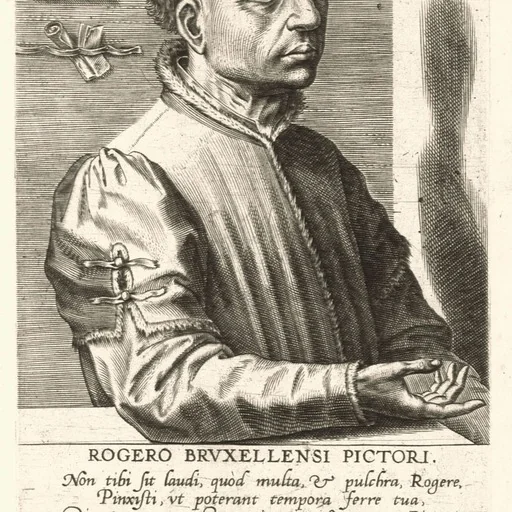
Rogier van der Weyden (Dutch:; 1399 or 1400 – 18 June 1464), initially known as Roger de la Pasture (French: ), was an early Netherlandish painter whose surviving works consist mainly of religious triptychs,…