Artwork
Saint George and the Dragon
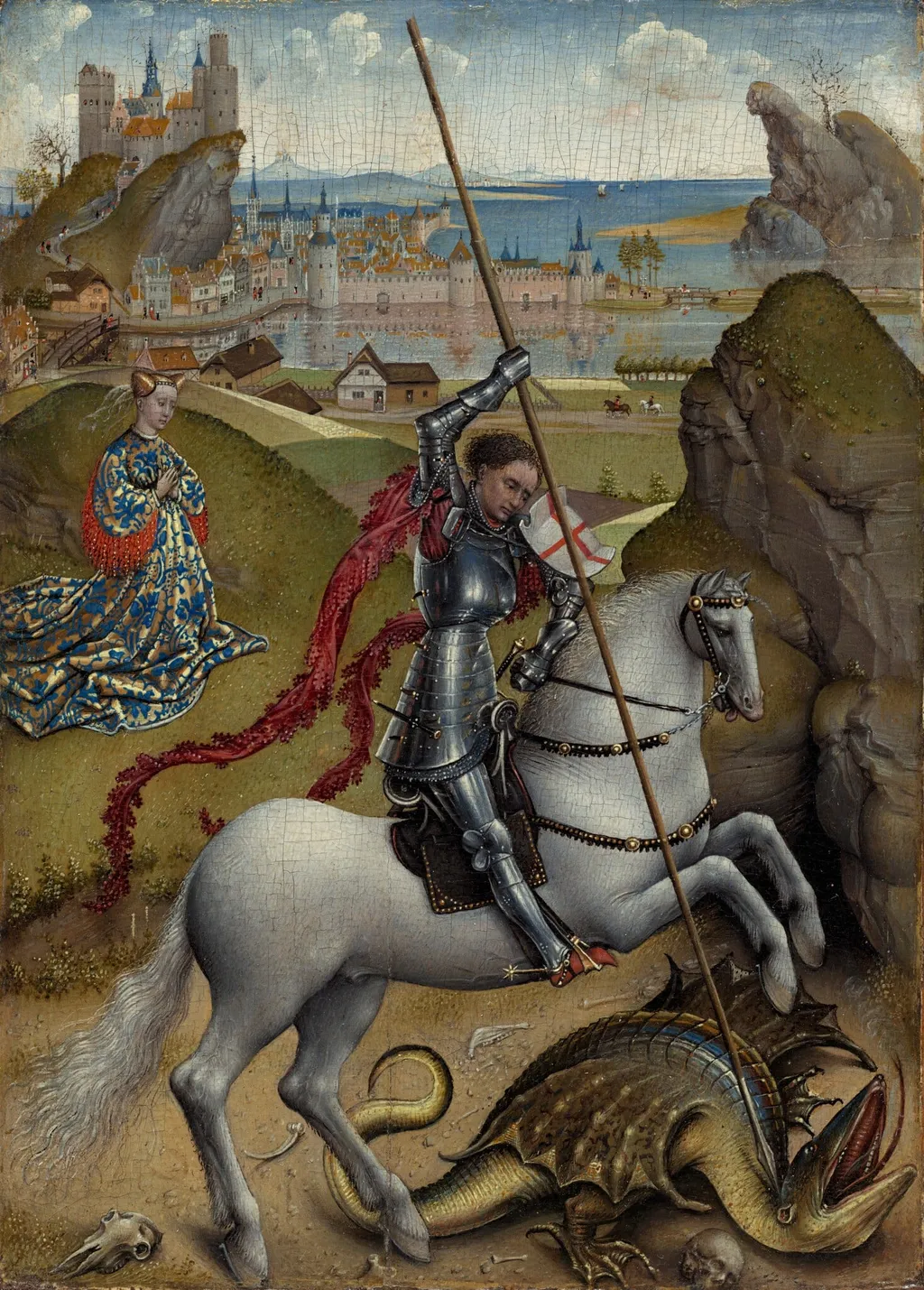
Saint George and the Dragon is an oil painting by the Northern Renaissance artist Rogier van der Weyden. It dates from 1434 and is held in the collection of the National Gallery of Art.
About this work
Saint George, on a white horse, drives his spear into a dragon beneath a dark sky, its red wings and spiked back curling around the horse's legs. A small princess waits safely behind him. Rogier van der Weyden built the depth with thin, translucent oil layers, so the scales seem lit from within. Painted 1434.
Subject & Meaning
Infrared analysis reveals an underdrawing that prepared the knight, horse, dragon and town, while the princess appears to have been added later.
The painting shows the Christian martyr Saint George, identified as a Roman soldier from Cappadocia, thrusting a lance into a dragon while Princess Cleodolinda kneels in prayer; the dragon is depicted pinned rather than slain outright. Van der Weyden places the scene within an imagined contemporary Belgian walled town, complete with a castle on a cliff, water, and tiny figures, a setting that blends realistic detail with fantastical elements. The black armor of Saint George reflects chivalric ideals, and the composition may have been part of a now‑separated diptych, as suggested by technical study of the panel’s structure.
Infrared analysis reveals an underdrawing that prepared the knight, horse, dragon and town, while the princess appears to have been added later.
Technique & Style
Saint George and the Dragon is executed in oil on a small wooden panel measuring 14.3 by 10.5 centimetres, set into a slightly larger 15.2 by 11.8 centimetre board, with both mounted on a third panel. Infrared reflectogram analysis reveals a small crack running from the bottom of the panel through the horse's foremost rear hoof, the dragon's tail, and to the horse's flank. A pen underdrawing underlies the composition, in which the knight, horse, dragon, town walls, and spires are all present; the princess appears to have been added later, placed against a hill already painted, with a thicker paint layer visible behind her head.
The work was built up in successive layers, achieving a degree of detail that John Oliver Hand argues required a magnification device. Stylistically, the painting blends Early Netherlandish realism with fantasy, notably in the fantastical cliff beneath the castle, and shows Jan van Eyck's influence in its handling of light and reflections, particularly on Saint George's black armour, while the background cliffs, town, and water recall Robert Campin's compositions.
History & Provenance
Saint George and the Dragon is dated to circa 1432–1435, painted in oil on a small wooden panel by Rogier van der Weyden. The earliest documented owner is possibly the Polish Grudna-Grudzinski family of Poznan, identified through a coat-of-arms seal on the panel's reverse; the painting may have reached Saint Petersburg via Joanna of that house, who married Grand Duke Constantine in 1820. By 1902 the work was with General de Plaoutine in Saint Petersburg, later moving with him to Nice by 1917 and London by 1920.
In 1923 Lady Evelyn Mason, a cousin of Plaoutine's wife, purchased it. After Mason's death in 1944 it passed by inheritance to her daughter, Mrs. L.A. Impey, of Chilland, Hitchin Abbas near Winchester. The panel was then sold at Sotheby's, London, on 16 March 1966 (lot 1), and acquired by the National Gallery of Art.
The painting is currently held in the collection of the National Gallery of Art in Washington, D.C. Its acquisition followed a sale at Sotheby's in London on March 16, 1966, where it was purchased by the museum after previously belonging to Mrs. L.A. Impey of Winchester. Prior to this, the work passed through the collections of Lady Evelyn Mason in London and General de Plaoutine, who owned it in Saint Petersburg by 1902 and exhibited it in London in 1920. Early records suggest a possible association with the Grudna-Grudzinski family of Poznan, potentially linking the panel to Saint Petersburg via a marital connection to the Russian Grand Duke Constantine. The piece was documented in the General de Plaoutine collection as early as 1902.
Context
Saint George and the Dragon holds a notable place within Early Netherlandish painting, attributed to Rogier van der Weyden and dated to circa 1432–1435. The work reflects the movement's characteristic blend of realism and fantasy, combining a meticulously observed contemporary Belgian townscape with an imagined cliff supporting a distant castle. Scholarship has traced multiple influences on the panel: Robert Campin's impact is visible in the background cliffs, town, and water, drawn from compositions such as his Nativity, while the optical reflections on Saint George's black armour, the dragon, and the water reveal Jan van Eyck's influence.
The composition also borrows motifs from International Gothic manuscript illuminations of the legend, including works by the Boucicaut Master and images in the Belles Heures. The painting's attribution has historically been debated, having been assigned at various times to the van Eyck brothers, to Campin, or to an anonymous follower, before Hulin de Loo established van der Weyden's authorship, an attribution generally accepted though occasionally qualified by scholars such as John Oliver Hand.
Overview
Rogier van der Weyden's Saint George and the Dragon, painted around 1432-35, is a small oil-on-panel work. Housed at the National Gallery of Art in Washington D.C., this painting depicts the legendary Christian saint in his iconic battle. It exemplifies the detailed execution characteristic of Early Netherlandish art, presenting a blend of narrative action and meticulous observation within a compact format.
Own this work as a print
Artist & collection
Artist
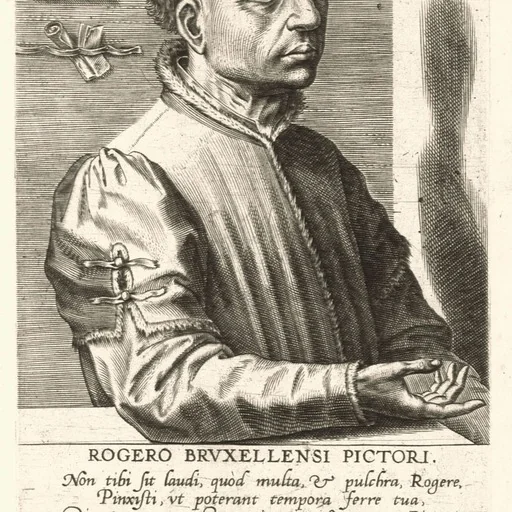
Rogier van der Weyden (Dutch:; 1399 or 1400 – 18 June 1464), initially known as Roger de la Pasture (French: ), was an early Netherlandish painter whose surviving works consist mainly of religious triptychs,…