Artwork
Saint Luke Drawing the Virgin
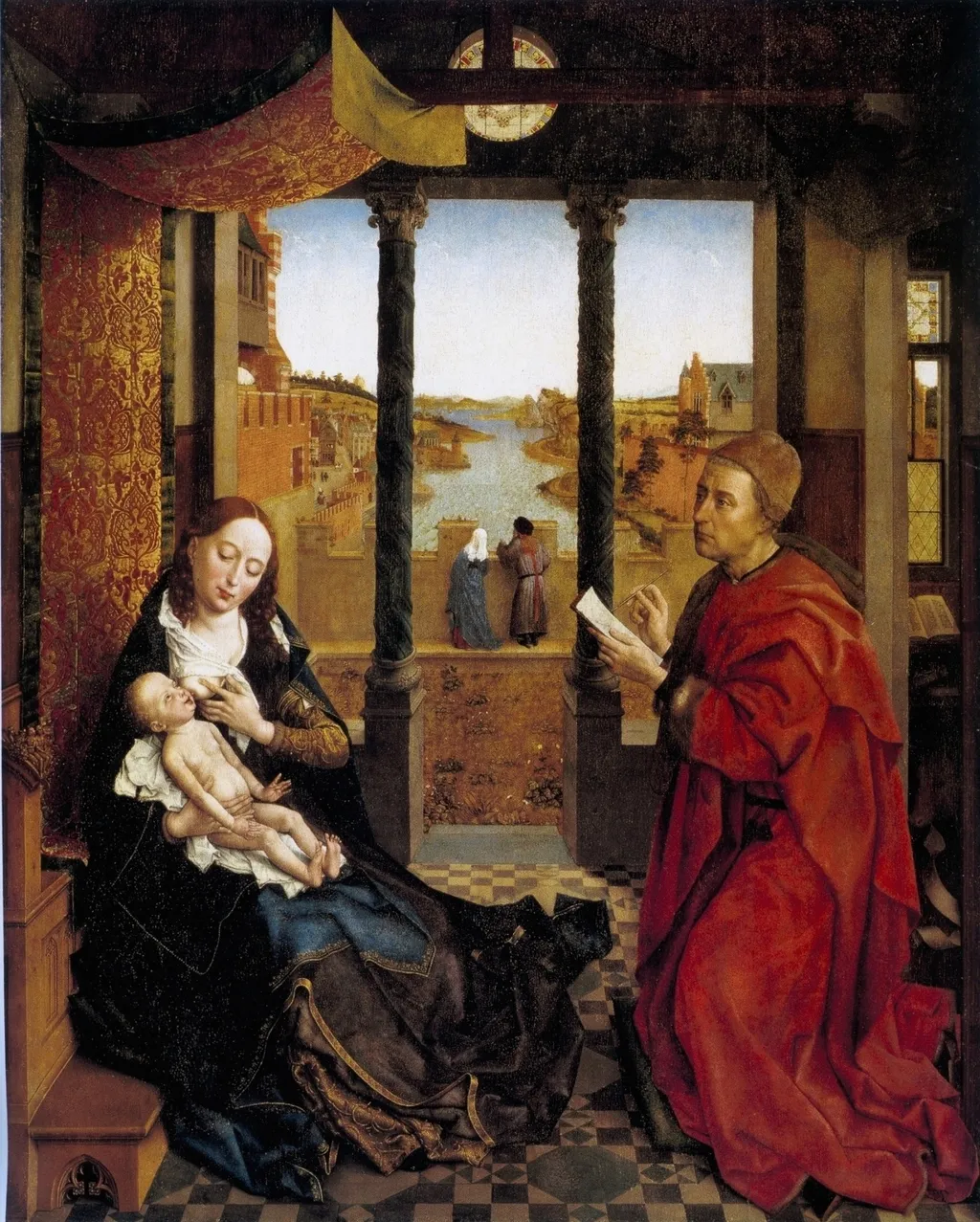
Saint Luke Drawing the Virgin is an oil painting by the Northern Renaissance artist Rogier van der Weyden. It is held in the collection of the Museum of Fine Arts Boston. Created in the mid‑15th century, this panel painting measures roughly three meters across and is executed in oil on oak.
About this work
Subject & Meaning
Symbolic elements include Adam and Eve carved on Mary’s throne arm, the ox (Luke’s attribute) at the right edge, and an open book representing his Gospel.
The painting shows Saint Luke, patron saint of artists, depicted as a male figure seated on a green cushion, focused on sketching the Virgin Mary nursing the Child Jesus. Mary sits under a brocade canopy, her dress richly detailed with blue and violet fabrics, embodying the Maria Lactans motif that emphasizes her maternal role in the redemption of humanity. Luke’s hands hover before him, holding a silverpoint underdrawing, symbolizing artistic creation and divine inspiration.
The composition merges earthly and divine realms: a closed garden (hortus conclusus) represents contemplation and Mary’s purity, while the distant city and river suggest the active world beyond. Symbolic elements include Adam and Eve carved on Mary’s throne arm, the ox (Luke’s attribute) at the right edge, and an open book representing his Gospel. The setting, a bourgeois interior opening to a courtyard, reflects 15th-century realism, and Luke’s positioning, possibly a self-portrait, underscores the artist’s role as a divine intermediary.
The work’s historical significance lies in its fusion of technical mastery with spiritual narrative, influencing later artists like Hugo van der Goes and the Master of the Legend of Saint Ursula.
Technique & Style
Executed in oil on oak, the panel (137.5 × 110.8 cm) rests on a chalk ground bound with glue and is composed of four oak planks dated to c. 1410. The palette centers on lead white, charcoal black, ultramarine, lead-tin yellow, verdigris, and red lake, with discoloration evident in once-green passages now brown. Mary is seated under a brocade cloth of honour that has darkened from red-brown to greenish, wearing an embroidered dress lined with fur and a light veil; her layered blues are heightened with lapis lazuli and lead white.
Luke kneels on a green cushion, holding a silverpoint drawing of the Virgin and Child, his face accepted as van der Weyden’s self-portrait.
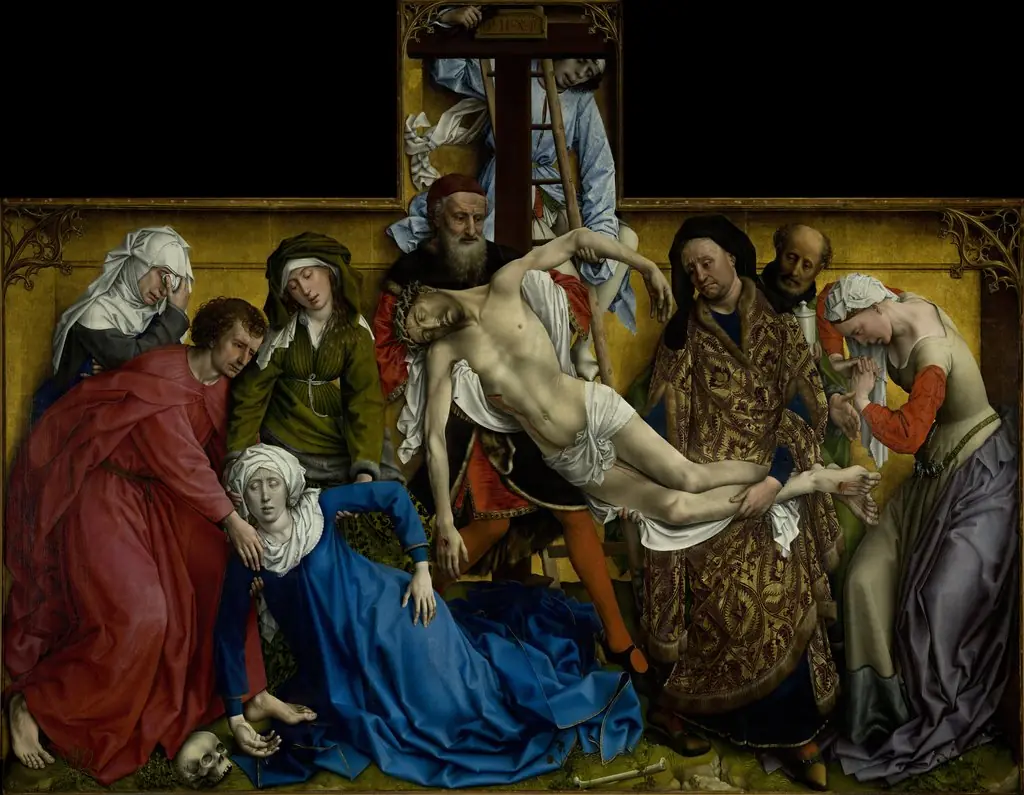
The composition divides into three spatial zones: the intimate interior with the nursing Madonna, a central hortus conclusus and bridge, and a distant view of Tournai with its cathedral on the Scheldt. Illusionistic carvings of the Fall of Man adorn the throne’s arms, while Luke’s symbol, the ox, appears beside a scroll. The figures exhibit a monumental solidity indebted to van der Weyden’s Descent from the Cross, tempered by van Eyckian clair-obscur and warm coloration, with Luke’s red mantle contrasting Mary’s cool blues.
History & Provenance
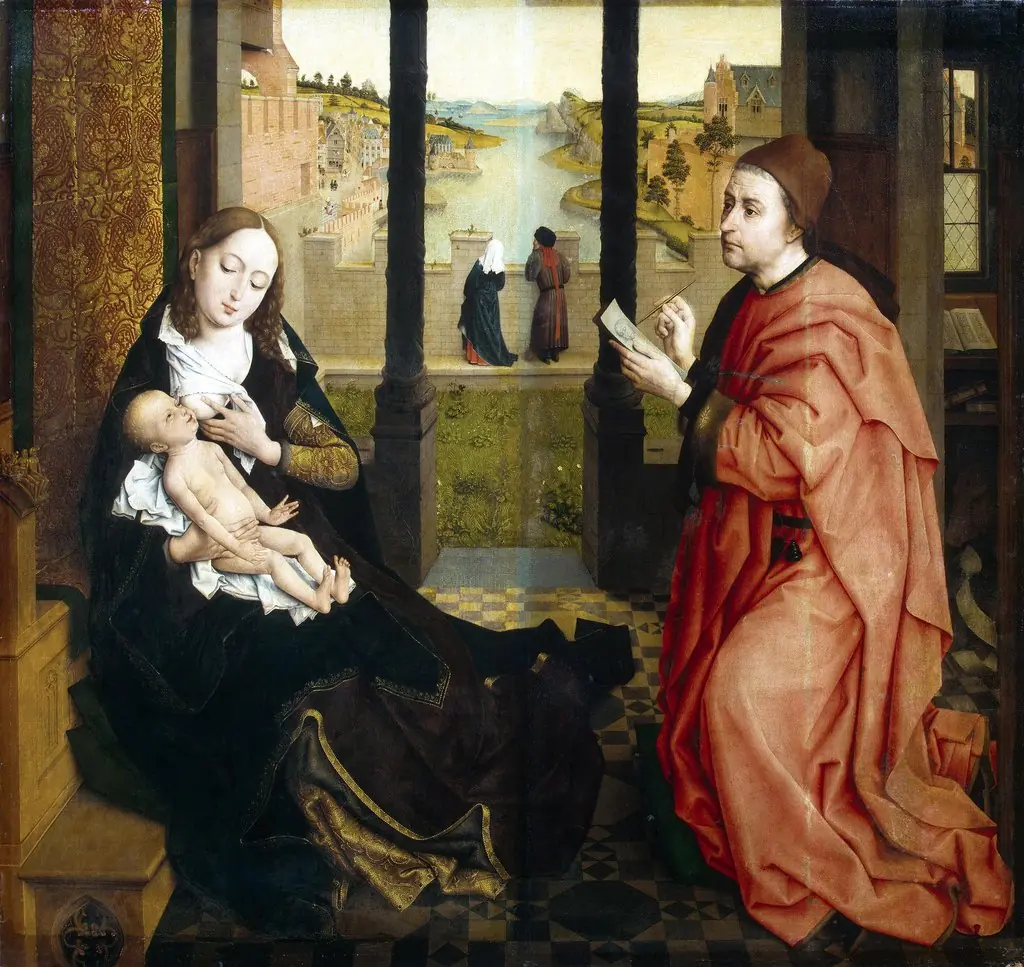
Executed between 1435 and 1440, this panel was likely commissioned by the Brussels painters' guild for their chapel in the Church of St. Michael and St. Gudula, potentially marking Rogier van der Weyden's appointment as city painter. While early twentieth-century scholars debated whether the Boston version was a copy, infrared reflectography later confirmed its status as the original through unique underdrawings absent in contemporary versions held in Munich, St. Petersburg, and Bruges.
Little is documented regarding the work's ownership prior to the nineteenth century. It appeared in 1835 within the collection of Infante Sebastián Gabriel of Spain, who misattributed it to Lucas van Leyden. The painting was subsequently sold at auction in New York in 1889 and donated to the Museum of Fine Arts, Boston, in 1893 by Henry Lee Higginson and his wife. The panel has undergone significant restoration, including a major cleaning in 1932, to address considerable surface damage.
Context
Widely considered one of the most influential works of Early Netherlandish painting, this panel merges earthly and divine realms to elevate the status of artistic creativity in fifteenth-century society. Art historians generally agree the work was commissioned by the Brussels painters' guild for their chapel, likely celebrating van der Weyden's 1436 appointment as city painter. The composition closely follows Jan van Eyck's Madonna of Chancellor Rolin but reverses the figure positioning and employs a warmer palette, while depicting the Virgin as a nursing mother rather than in the traditional Byzantine style.
Although early twentieth-century scholars debated whether the Boston version was a copy, infrared reflectography later revealed unique underdrawings confirming it as the original. The painting's significance is underscored by its numerous high-quality copies produced by contemporaries and later masters, including Hugo van der Goes, which disseminated its innovative iconography throughout Europe.
Legacy
The Boston panel became widely influential, generating near copies by the Master of the Legend of Saint Ursula and Hugo van der Goes, and three high-quality versions survive in the Hermitage, the Alte Pinakothek, and the Groeningemuseum. The Dutch-language encyclopedia describes it as one of the most important and influential paintings of the Flemish Primitives, while the Museum of Fine Arts, Boston, characterizes it as among the most significant Northern European paintings in the United States. The work's significance rests on both its design and its merging of earthly and divine realms: by placing a painter in the same space as the Madonna and showing him in the act of portrayal, Van der Weyden foregrounded the role of artistic creativity in fifteenth-century society.
The painting also established a compositional model that later Netherlandish artists adapted, including Dierick Bouts, Jan Mabuse, Maarten van Heemskerck, and Marten de Vos, and it was exhibited at the Exposition des primatifs flamands à Bruges. The Boston museum organized a 1989 exhibition centered on the work, titled "Art in Context: Rogier van der Weyden's Saint Luke Drawing the Virgin."
Overview
Created in the mid‑15th century, this panel painting measures roughly three meters across and is executed in oil on oak. It is traditionally linked to Rogier van der Weyden, a leading figure of Early Netherlandish art. The work resides in the Museum of Fine Arts in Boston and depicts a devotional scene that merges portraiture with symbolic narrative.
Own this work as a print
Artist & collection
Artist
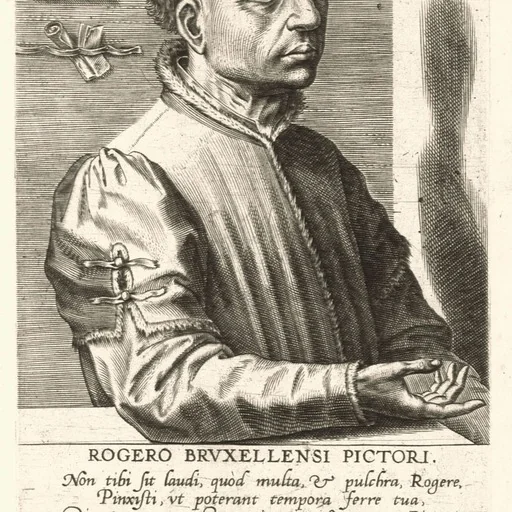
Rogier van der Weyden (Dutch:; 1399 or 1400 – 18 June 1464), initially known as Roger de la Pasture (French: ), was an early Netherlandish painter whose surviving works consist mainly of religious triptychs,…