Artwork
Coronation of the Virgin
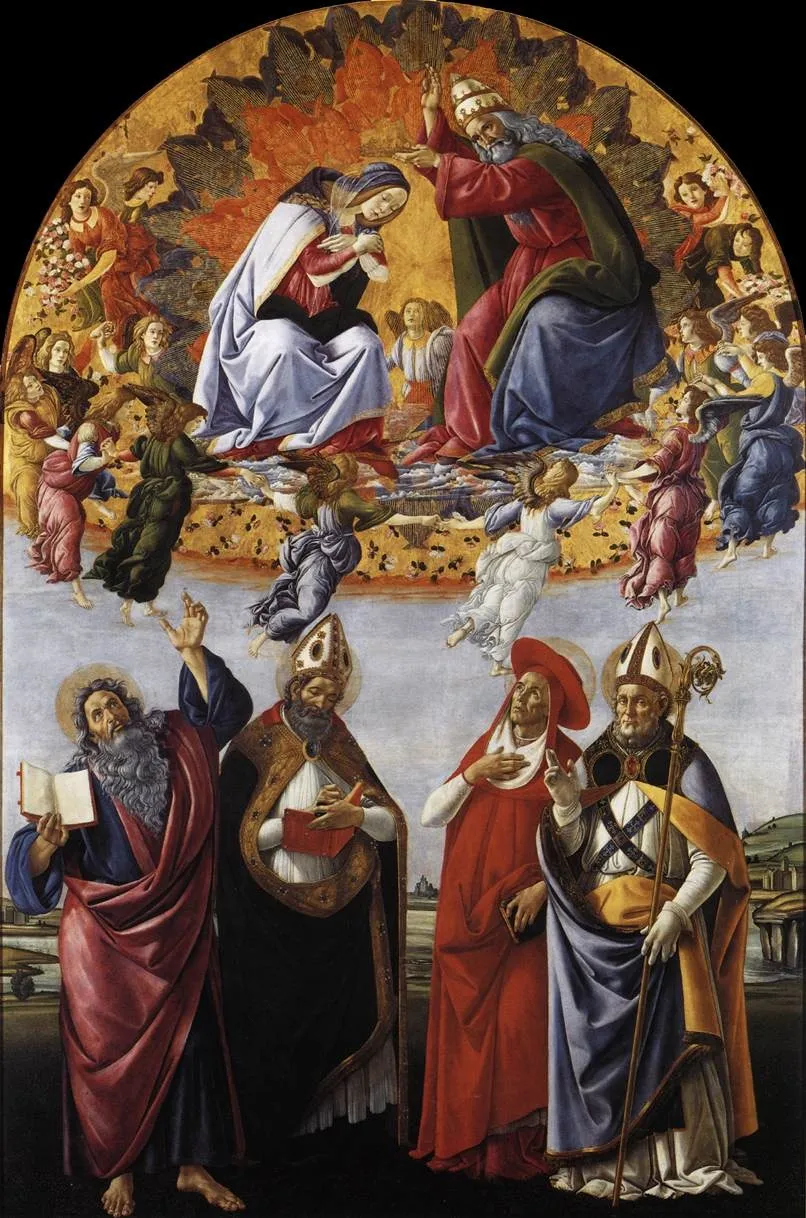
Coronation of the Virgin is a tempera painting by the Early Renaissance artist Sandro Botticelli. It dates from 1494 and is held in the collection of the Uffizi Gallery.
About this work
Subject & Meaning
The painting depicts the Coronation of the Virgin Mary as a heavenly event presided over by God the Father crowning Mary, surrounded by angels and saints.
The painting depicts the Coronation of the Virgin Mary as a heavenly event presided over by God the Father crowning Mary, surrounded by angels and saints. The upper register shows a celestial coronation on a gold background, with God the Father placing a crown on Mary while blessing her, flanked by cherubim and seraphim in a circular arrangement of about sixteen angels. Below, four saints, John the Evangelist, Augustine, Jerome, and Eligius, stand in a terrestrial landscape, each reacting to the heavenly scene.
John points upward with his right hand, holding an open book; Augustine records the event; Jerome rests his hand on his heart in awe; and Eligius offers a benediction toward the viewer. The four saints are identified by their attributes: John with a book, Augustine as a Church Father, Jerome in cardinal robes, and Eligius as a bishop and patron of goldsmiths. The predella beneath contains five narrative scenes from the lives of these saints, including John on Patmos, Augustine in his cell, the Annunciation, Jerome in penance, and the miracle of Eligius with a possessed horse.
The work symbolizes the Assumption of Mary into heaven and reflects Botticelli’s late spiritual turn influenced by the preacher Savonarola, marking a shift from earlier profane subjects to intense religious iconography. The upper and lower registers are contrasted through a golden celestial space above and a subdued, rocky landscape below, emphasizing the divine over the earthly.
Technique & Style
The Coronation of the Virgin is executed in tempera on panel, measuring 378 cm in height and 258 cm in width.
The composition is divided into two stacked registers. The upper register, set against a burnished gold ground, depicts the celestial Coronation: God the Father crowns the kneeling Virgin Mary while blessing her, surrounded by concentric rings of seraphim and cherubim and a rotating ring of twelve visible angels who scatter white and red roses. The lower register presents four standing saints, John the Evangelist, Augustine, Jerome, and Eligius, before a simplified, lake-strewn landscape under a cool, grey-blue sky.
Figure modeling is emphatically plastic, with voluminous drapery carved by sharp chiaroscuro; the angels’ swirling garments and tossed hair heighten rhythmic movement. The handling balances hieratic symmetry with expressive asymmetry, particularly in the saints’ individualized gestures and gazes, which range from John’s sweeping indication of the divine event to Eligius’s direct blessing of the viewer.
Conservation history records structural instability in the wood support with lifting and flaking, addressed by a major restoration in 1990 at the Opificio delle Pietre Dure that stabilized the panel and consolidated the pictorial surface.
History & Provenance
Commissioned by the Arte degli Orafi (Goldsmiths' Guild) for the Chapel of Sant'Alò in the basilica of San Marco, Florence, this altarpiece was executed between 1488 and 1490. The work gained early renown, cited by Albertini in 1510 and later by Vasari. Following structural renovations to the basilica by Giambologna, the chapel was ceded to Alessandro Brandolini in 1596, prompting the painting's relocation to the convent chapter house; the original frame was likely lost during this transfer and replaced with a carving from Santa Maria dei Battilani.
Napoleonic suppressions in 1808 led to the panel's transfer to the Galleria dell'Accademia for student study, where it underwent restoration in 1830. Reorganized into state collections in 1919, it moved to the Uffizi Gallery, receiving further conservation in 1921 and a comprehensive structural stabilization in 1990 to address wood panel deformation.
The Coronation of the Virgin (also called Pala di San Marco) is held in the Uffizi Gallery in Florence, where it has been displayed since its transfer from the convent of San Marco following Napoleonic suppressions in 1808. The work was originally commissioned around 1488–1490 by the Arte degli Orafi for the chapel of Sant'Alò in the Basilica of San Marco, Florence. It remained in that location until the chapel was reassigned in 1596 after the church's restructuring by Giambologna, after which the altarpiece was moved to the convent chapter.
Subsequent transfers occurred during the 19th century, including a move to the Galleria dell'Accademia in 1808 and later to the Uffizi in 1919, where it has been exhibited continuously. The painting underwent restoration in 1830, 1921, and a comprehensive capillary restoration completed in 1990 by the Opificio delle Pietre Dure.
Context
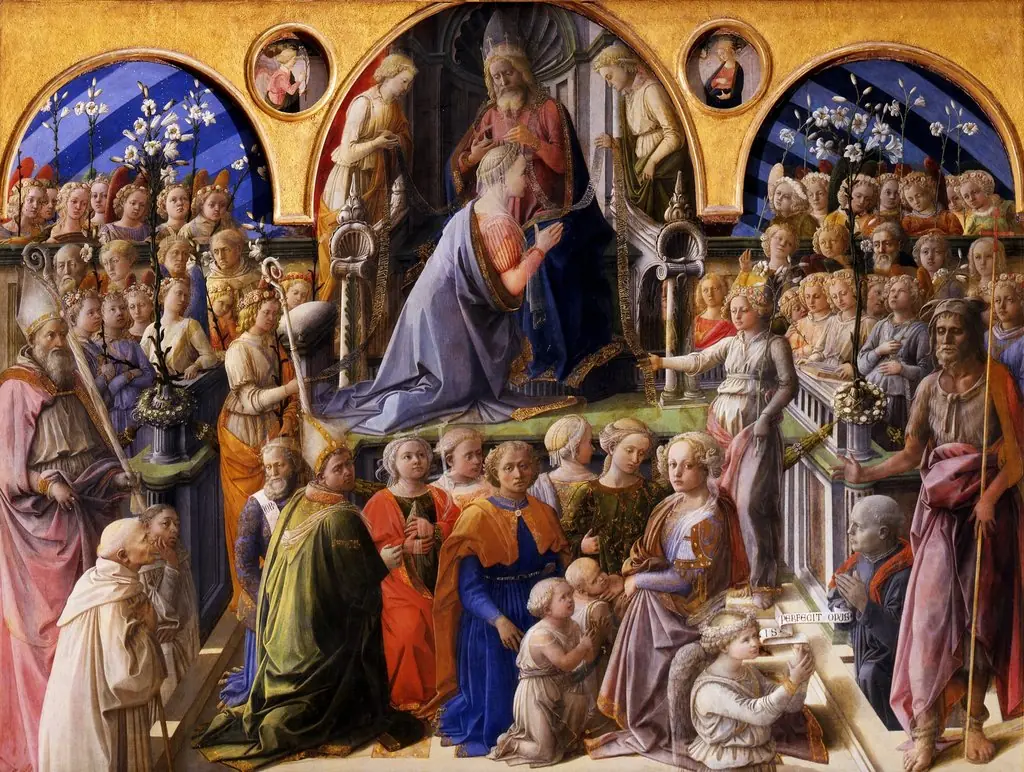
Painted for the chapel of Sant'Elò in the Dominican church of San Marco in Florence on commission from the Arte degli Orafi, the altarpiece acquired considerable fame in the late fifteenth and early sixteenth centuries, being cited by Albertini, Antonio Billi, the Anonimo Magliabechiano, and Vasari in both editions of the Vite. The Coronation of the Virgin is regarded as one of the best-known examples of the "mystical crisis" that overtook Botticelli with the arrival of Girolamo Savonarola in Florence, prompting him to abandon profane subjects and to revive the style of the earlier Florentine masters such as Fra Angelico, whose Coronation scene appears to have served as a model. The heightened expressiveness of the saints, the dramatic chiaroscuro, and the freer arrangement of figures are seen as signs of a stylistic shift that would develop further into the sixteenth century.
The prominence given to Saint John the Evangelist has been linked to Savonarola's apocalyptic preaching, which shortly afterward contributed to the expulsion of the Medici in 1494.
Legacy
The altarpiece achieved immediate renown, cited by early chroniclers including Albertini (1510), Antonio Billi, the Anonimo Magliabechiano, and Vasari in both editions of his Lives. Art historians identify the work as a defining example of Botticelli's late "mystical crisis," triggered by the sermons of Savonarola, which prompted the artist to abandon profane subjects and revive archaic stylistic elements reminiscent of Fra Angelico. The painting's expressive intensity and departure from fifteenth-century rationality are viewed as precursors to sixteenth-century compositional freedom.
Its legacy includes the survival of two preparatory drawings and two workshop copies featuring added donors, currently held in New York and Basel. Following centuries of relocation within Florence and restorations in 1830, 1921, and 1990, the panel remains a central holding of the Uffizi Gallery.
Overview
Created in 1494, this tempera panel by Sandro Botticelli portrays the coronation of the Virgin Mary. The composition is dense with figures, each adorned in richly colored robes and halos, set against a luminous backdrop. Central to the scene is Mary seated on an ornate golden throne, receiving a crown from a robed figure, while angels and saints observe the rite.
Artist & collection
Artist
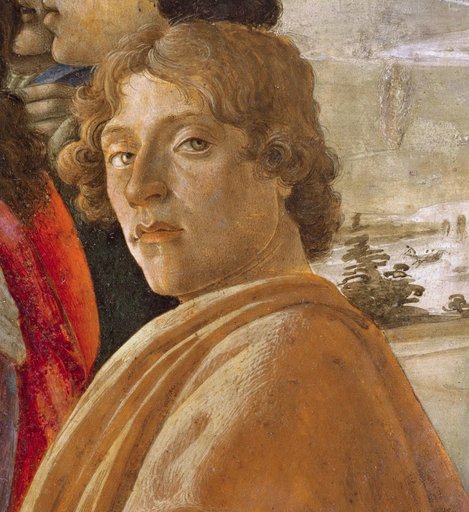
Alessandro di Mariano di Vanni Filipepi, better known as Sandro Botticelli or simply Botticelli, was an Italian painter of the Early Renaissance.

 Annunciation
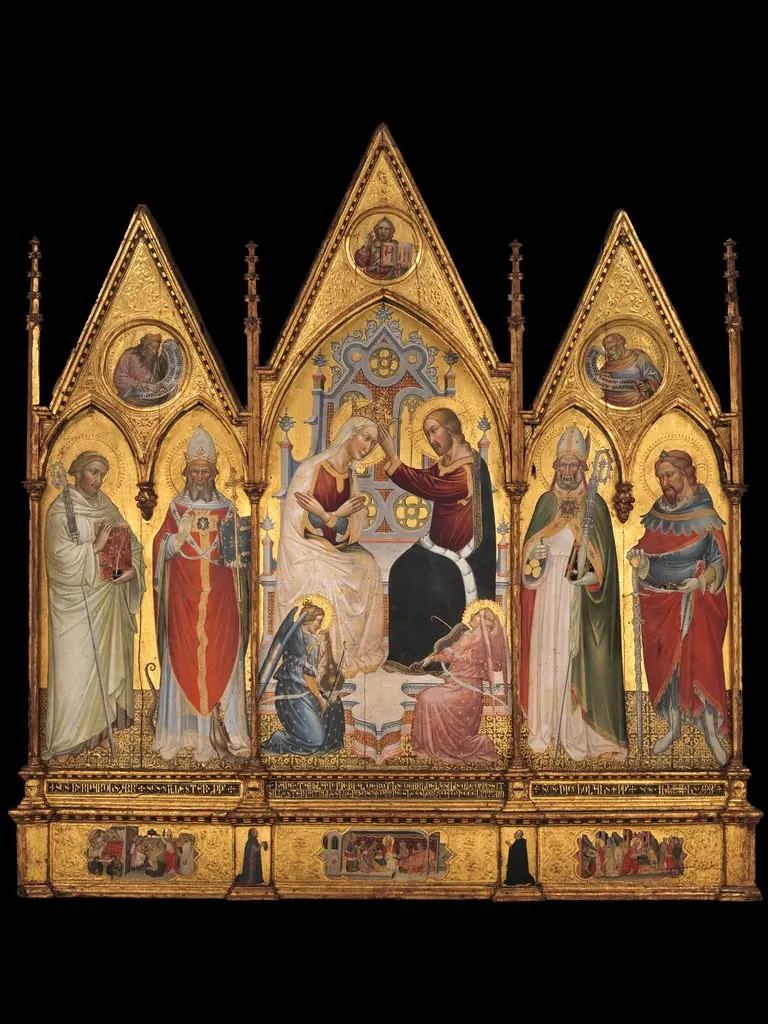 The Coronation of the Virgin, and Saints
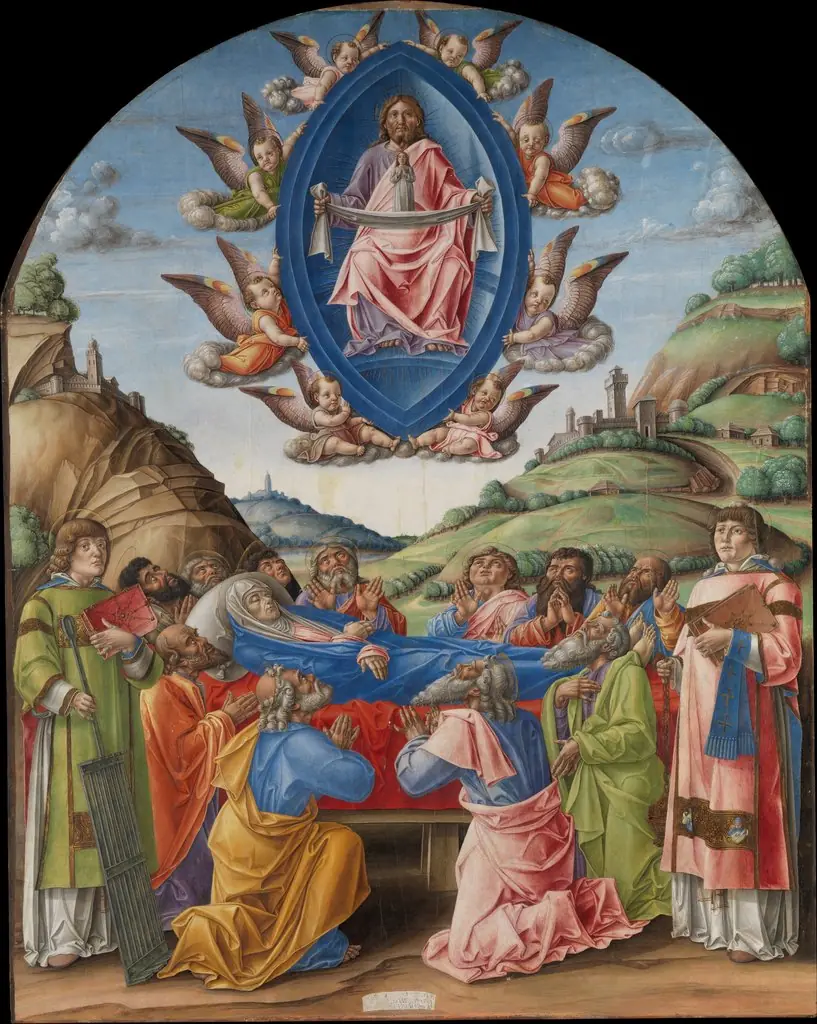 The Death of the Virgin
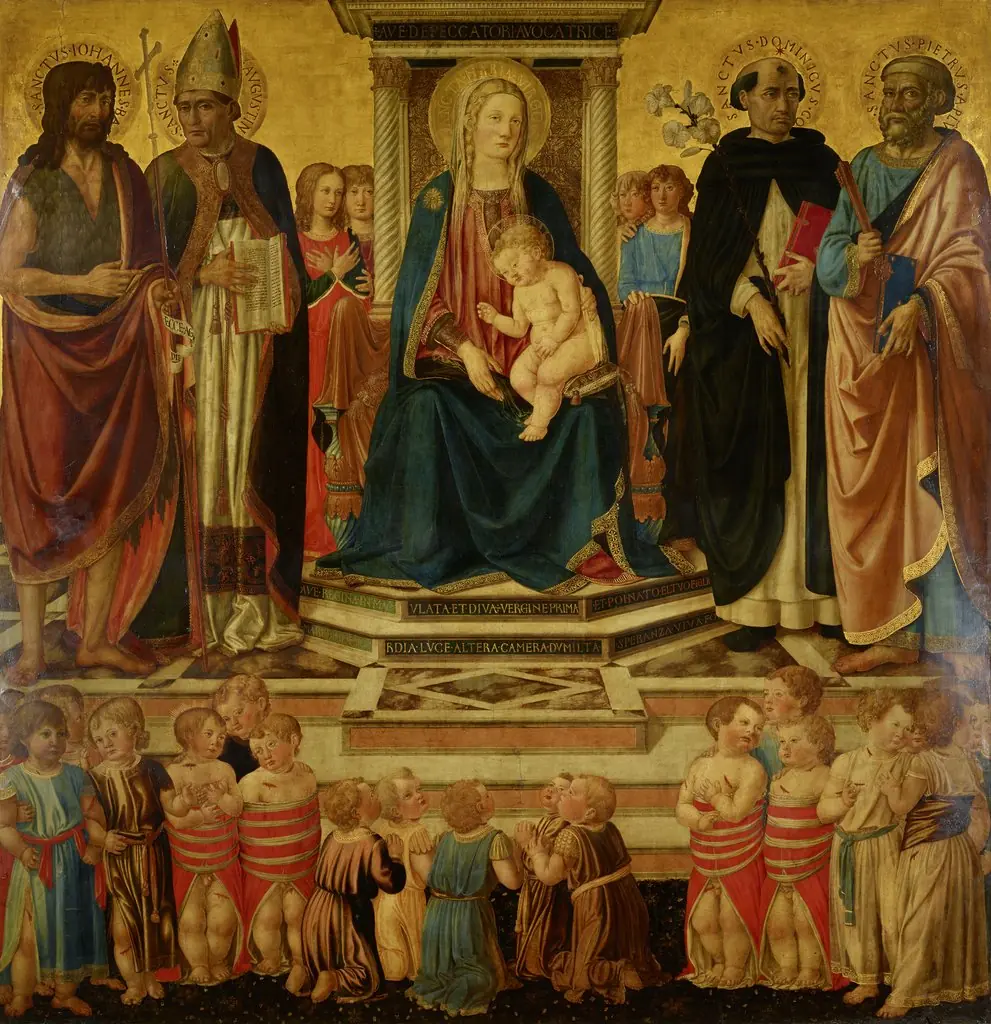 The Virgin and Blessing Child Enthroned with Sts. John, Augustine, Dominic, Peter and Victims of the bethemitic Child Murder
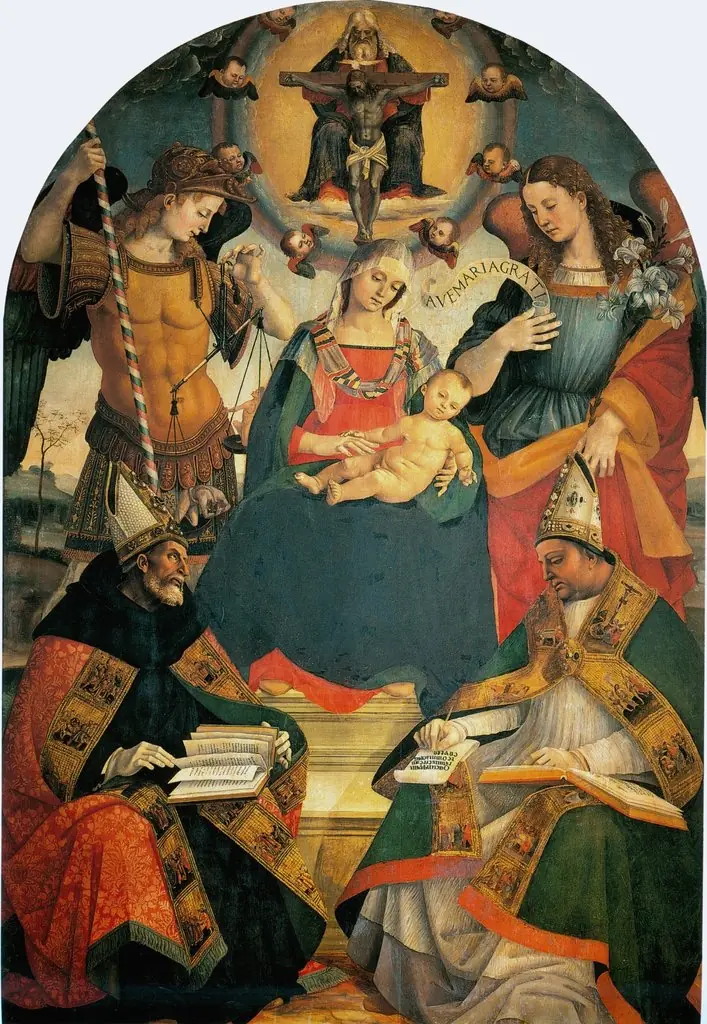 Trinity, the Virgin, and Two Saints
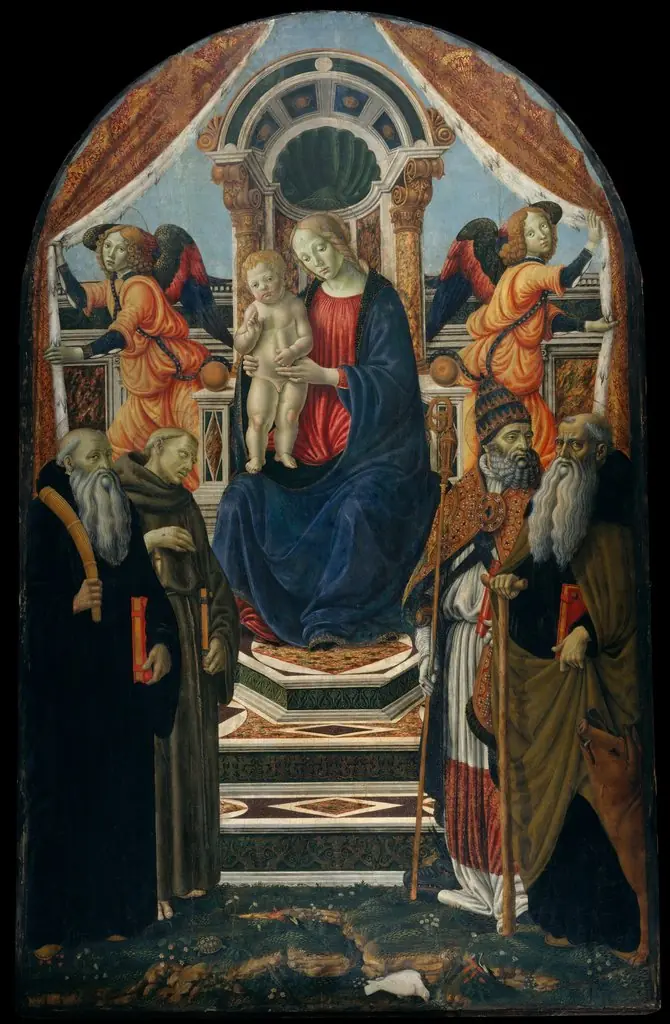 Madonna and Child Enthroned with Saints and Angels
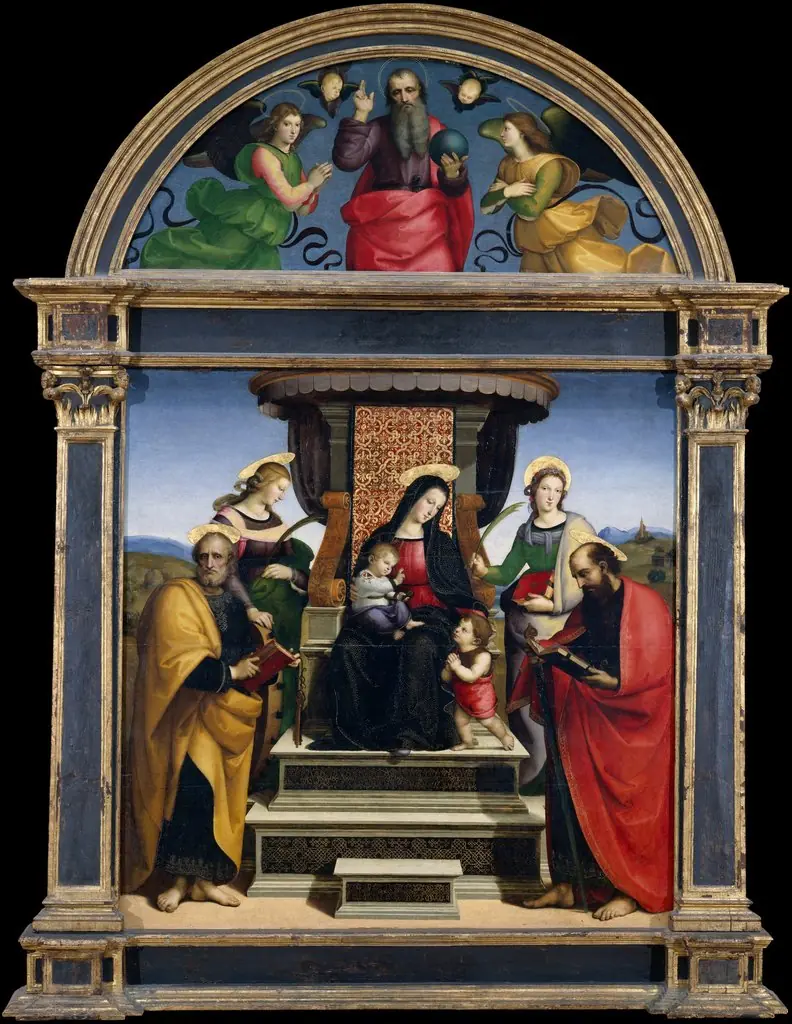 Madonna and Child Enthroned with Saints
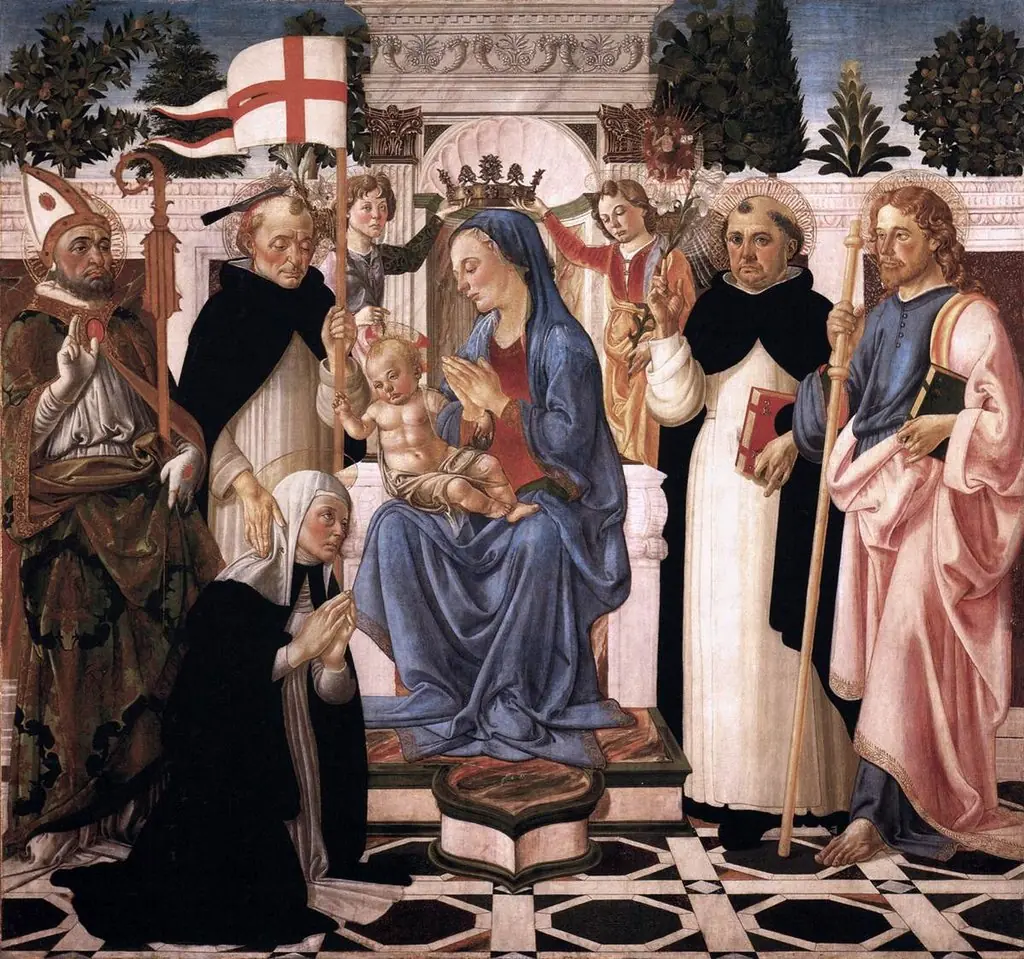 Madonna and Child with Five Saints and Two Angels
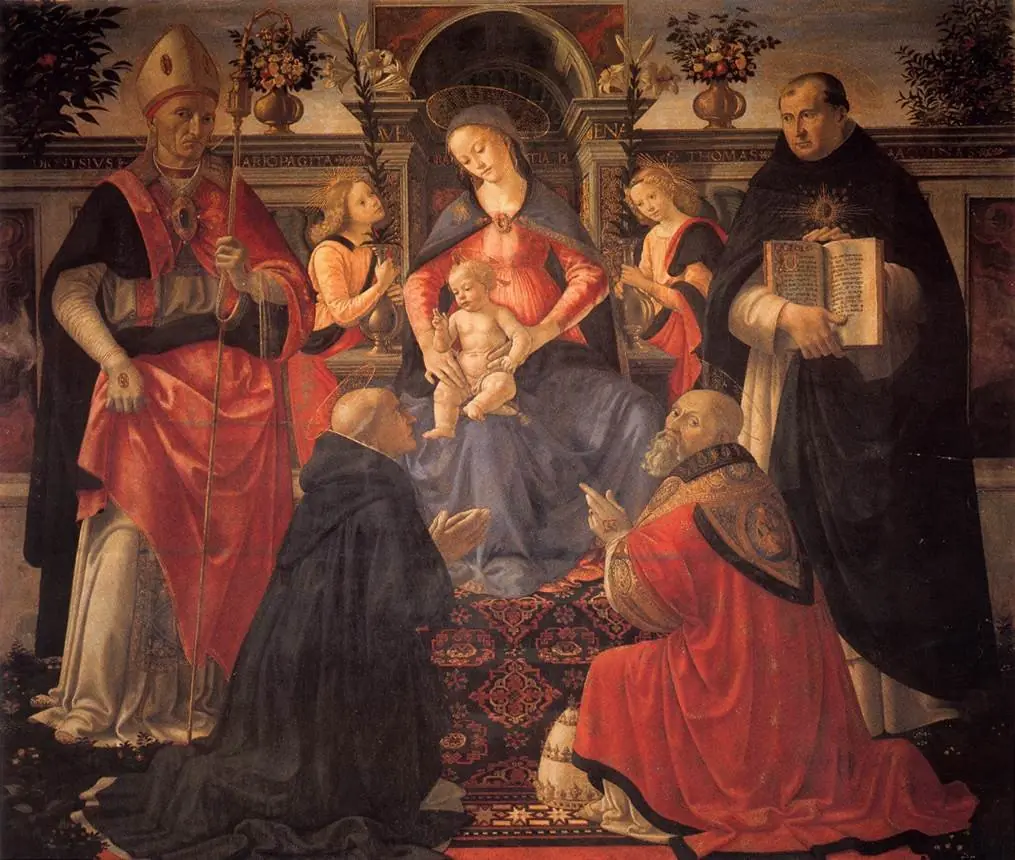 Madonna and Child Enthroned between Angels and Saints
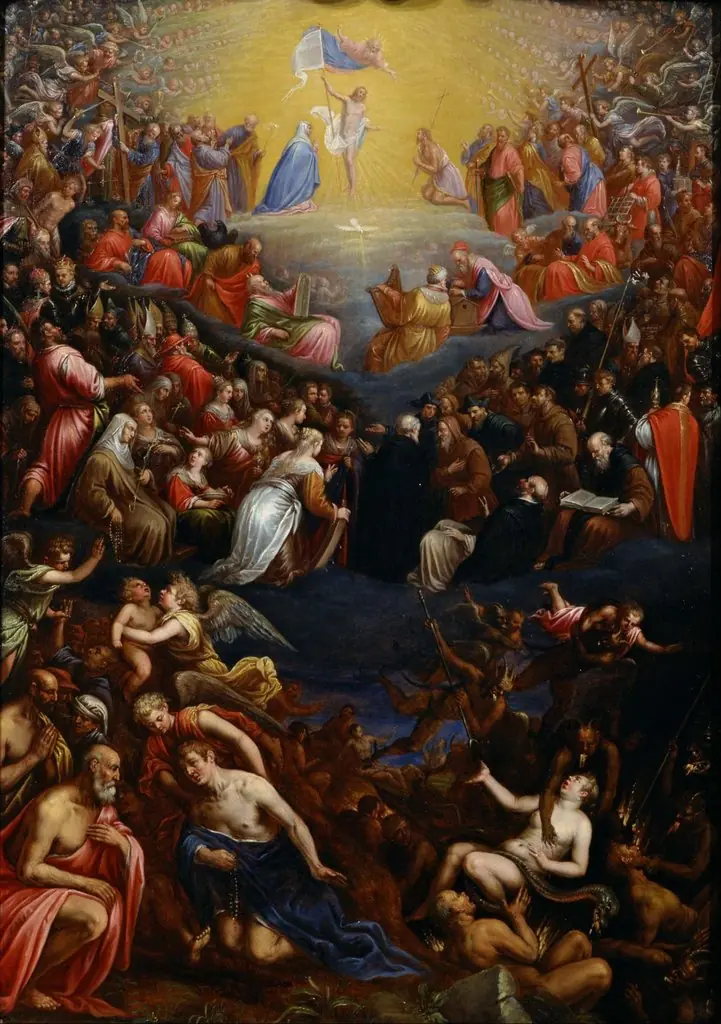 The Last Judgement