Artwork
Cain Kills His Brother Abel
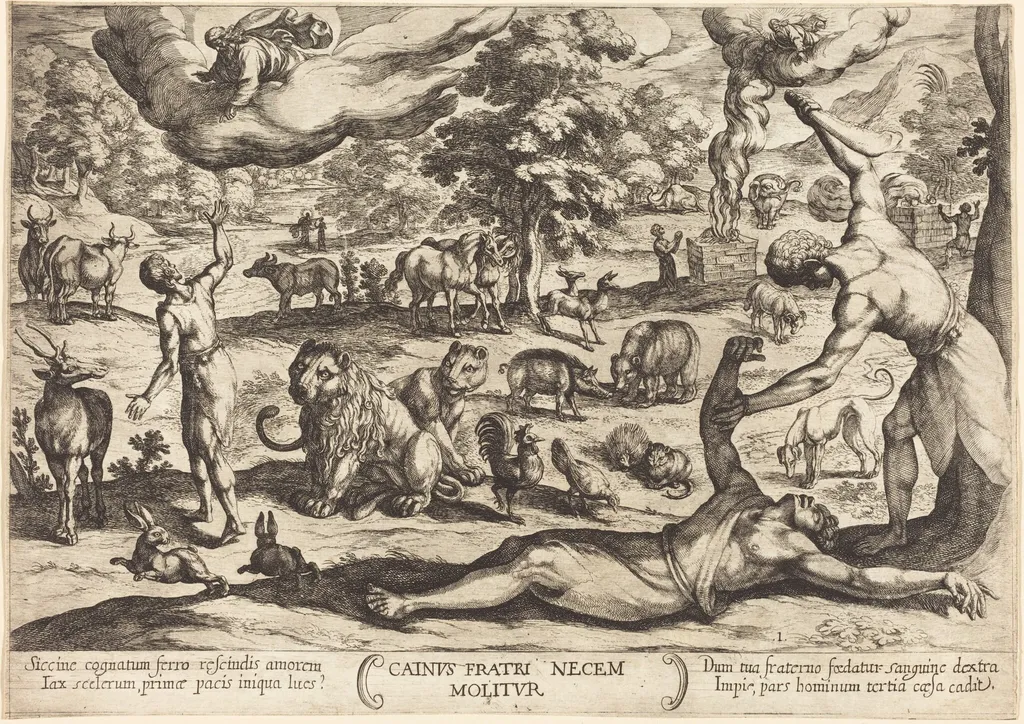
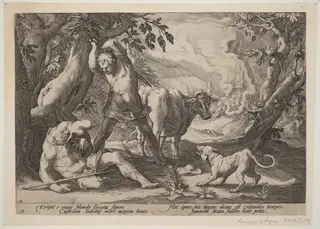
Cain Kills His Brother Abel is an ink print by the Baroque artist Antonio Tempesta. It dates from 1613 and is held in the collection of the National Gallery of Art.
About this work
Overview
This print, executed in fine linear strokes, captures a moment of violent rupture from the Book of Genesis with clarity and emotional restraint.
Antonio Tempesta created this 1613 etching as part of a series illustrating biblical stories. An Italian artist active in Rome during the transition from Mannerism to Baroque, Tempesta was known for his detailed engravings of historical and mythological scenes. This print, executed in fine linear strokes, captures a moment of violent rupture from the Book of Genesis with clarity and emotional restraint.
Subject & Meaning
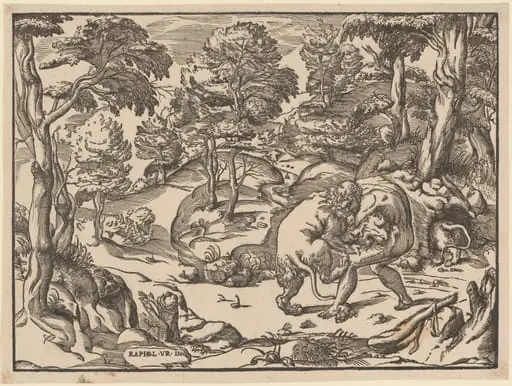
The scene depicts Cain murdering his brother Abel, the first recorded act of fratricide in the Bible. Cain stands over Abel’s fallen form, his posture conveying force and finality. The surrounding animals, cattle, sheep, and birds, observe silently, suggesting nature’s witness to human sin.
Distant figures, one near a fire and another on a hill, imply isolation and divine detachment, reinforcing the moral gravity of the act.
Technique & Style
Tempesta employed etching to achieve sharp, controlled lines that define form and movement without heavy shading. The composition relies on rhythmic contours and layered detail, typical of Northern European print traditions adapted in Rome. Background elements are rendered with precision but kept subordinate to the central figures, emphasizing narrative clarity over atmospheric depth.
History & Provenance
Created in 1613, the etching was likely produced for a broader European audience familiar with biblical iconography. Tempesta’s prints circulated widely through print shops in Rome and Antwerp, reflecting the transnational trade in engraved images. While no specific early ownership records are documented, the work aligns with the period’s demand for religious subjects in print form.
Context
Tempesta worked during a time when printmaking served both devotional and educational purposes. His style merged Italian compositional rigor with Flemish attention to detail, appealing to collectors across Catholic Europe. The depiction of Cain and Abel resonated in Counter-Reformation contexts, where moral lessons from scripture were actively promoted through visual media.
Legacy
Tempesta’s etchings influenced later generations of printmakers through their narrative precision and technical discipline. Though less celebrated than his contemporaries, his work contributed to the dissemination of biblical imagery in early 17th-century Europe. This print remains a documented example of how religious themes were translated into accessible graphic forms during a period of artistic transition.
Own this work as a print
Artist & collection
Artist
Antonio Tempesta, also called il Tempestino (1555 – 5 August 1630), was an Italian painter and engraver, whose art acted as a point of connection between Baroque Rome and the culture of Antwerp.