Artwork
Mount Kurama Mandala: Bishamonten Triad (Kuramayama mandara: Bishamonten sanzonzō)
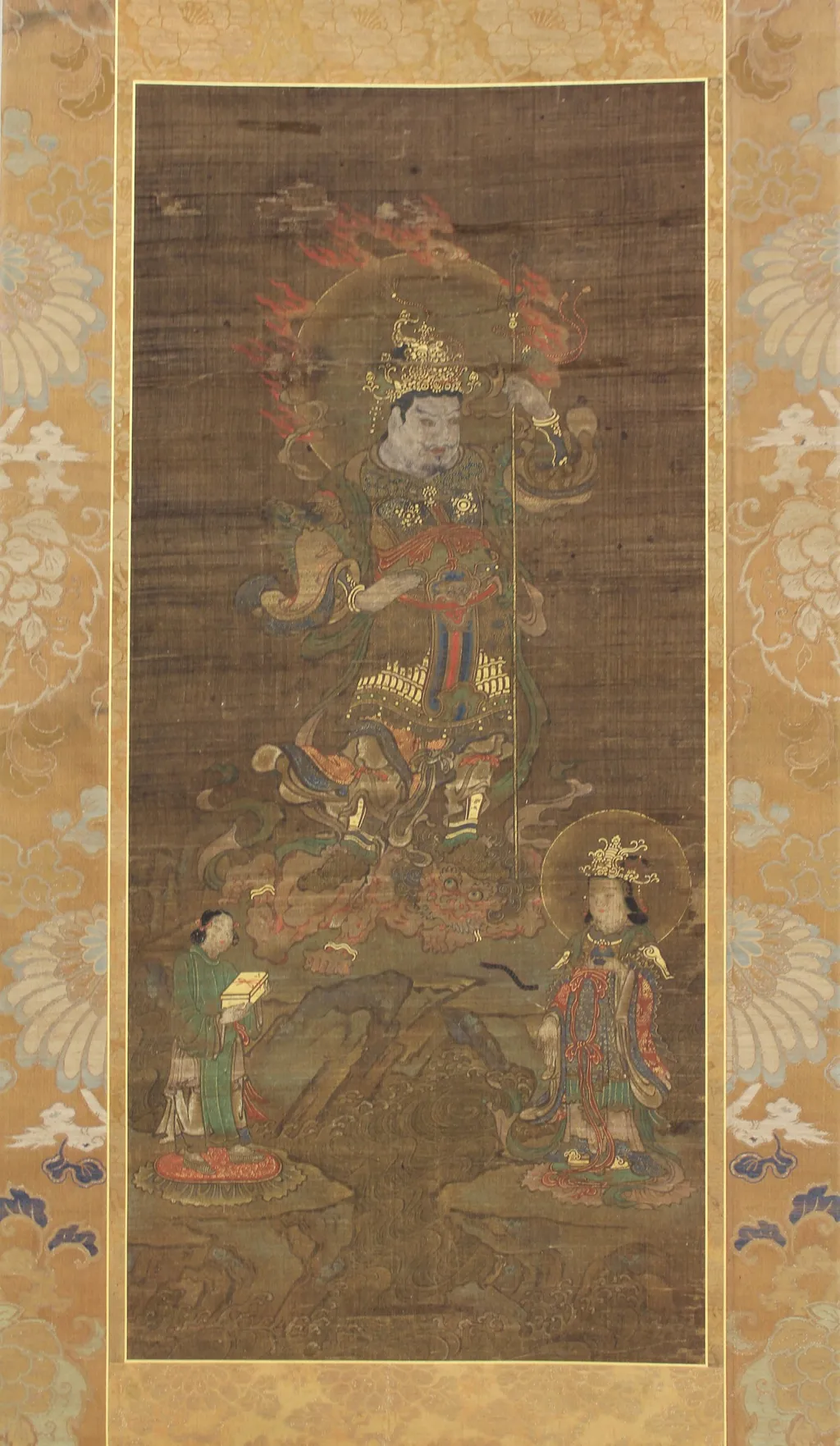
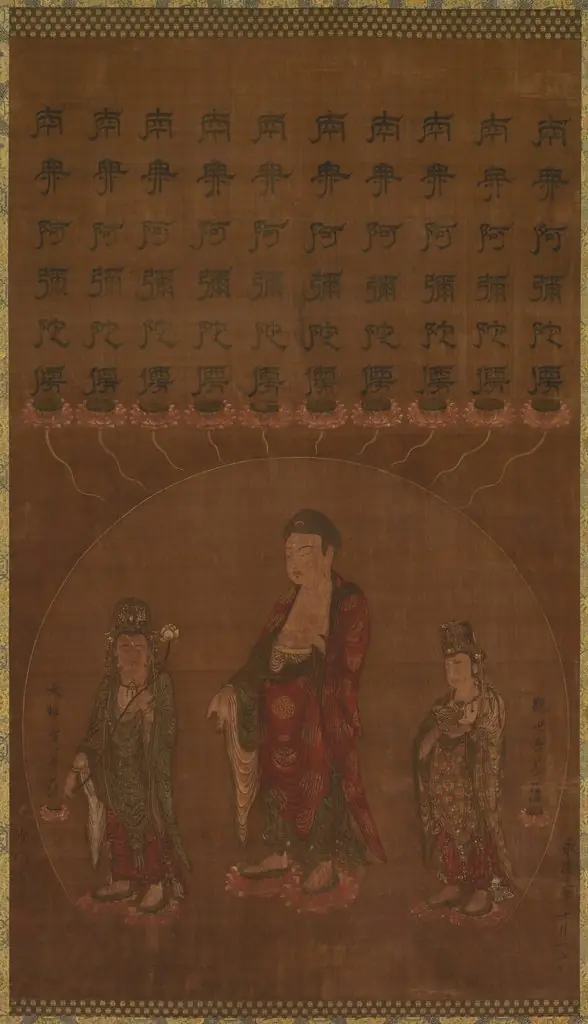
Mount Kurama Mandala: Bishamonten Triad (Kuramayama mandara: Bishamonten sanzonzō) is an unspecified painting. It dates from 1494 and is held in the collection of the Metropolitan Museum of Art. The work depicts a trio of figures suspended above a craggy terrain.
About this work
Subject & Meaning
The work depicts the Bishamonten Triad, a grouping centered on the Buddhist deity Bishamonten, also known as the Guardian of the North.
The work depicts the Bishamonten Triad, a grouping centered on the Buddhist deity Bishamonten, also known as the Guardian of the North. As a mandala associated with Mount Kurama, the painting functions as a visual representation of the sacred geography and divine hierarchy specific to that mountain cult. The triad structure typically presents the central deity flanked by attendant figures, embodying the protective and martial attributes of Bishamonten within a ritual context.
Created in 1486, the composition serves as a devotional object that maps the spiritual landscape of Mount Kurama, linking the earthly realm with the celestial abode of the deity.
History & Provenance
Created in 1486 in Japan, this painting is attributed to an unidentified artist. The work, titled Mount Kurama Mandala: Bishamonten Triad, entered the collection of the Metropolitan Museum of Art, where it is currently held. While the specific circumstances of its commission and the details of its ownership chain prior to its museum acquisition are not documented in the available records, its date of inception is firmly established as 1486.
Overview
The work depicts a trio of figures suspended above a craggy terrain. A dominant central figure, crowned in gold and clad in armor, grasps a spear and a luminous jewel, while two diminutive companions, one in green robes, the other in red and gold, stand below, gazing upward. Dark, swirling clouds dominate the background, and the composition is framed by an ornamental border.
Technique & Style
Rendered in a flat, decorative manner, the painting employs bold coloration and defined outlines characteristic of Japanese religious iconography. The use of contrasting hues, gold, red, green, and dark background tones, creates a striking visual hierarchy that emphasizes the central deity.
Context
Such mandala compositions were used in devotional settings, serving as visual focal points for meditation on protective deities. The inclusion of a decorative border and stylized clouds reflects conventions of Japanese Buddhist art from the period in which the piece was produced.
Artist & collection

 Amitābha Triad
 Bishamonten, the Guardian of the North, with his Retinue
 Shakyamuni with two attendants
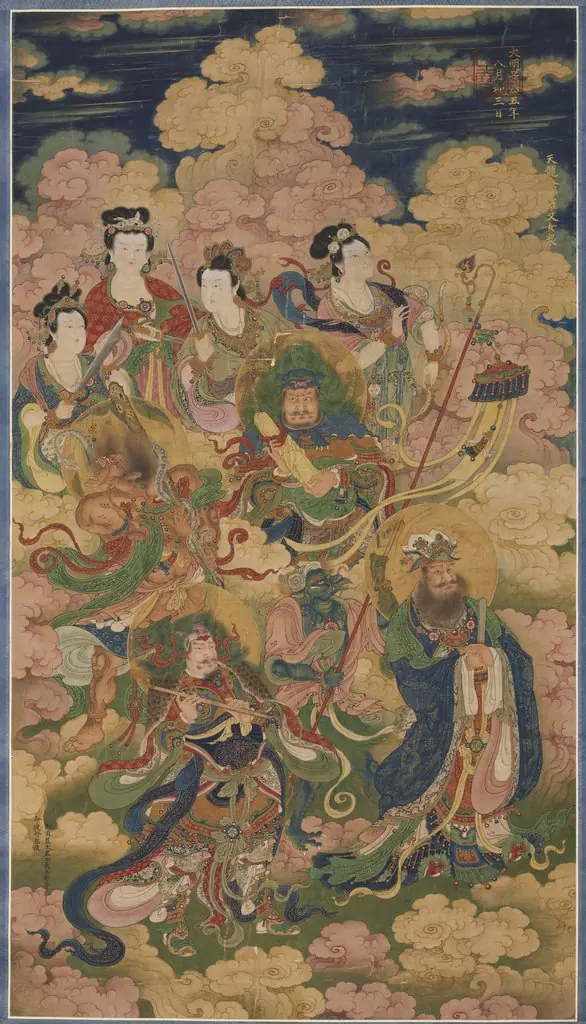 The Eight Hosts of Deva, Naga, and Yakshi
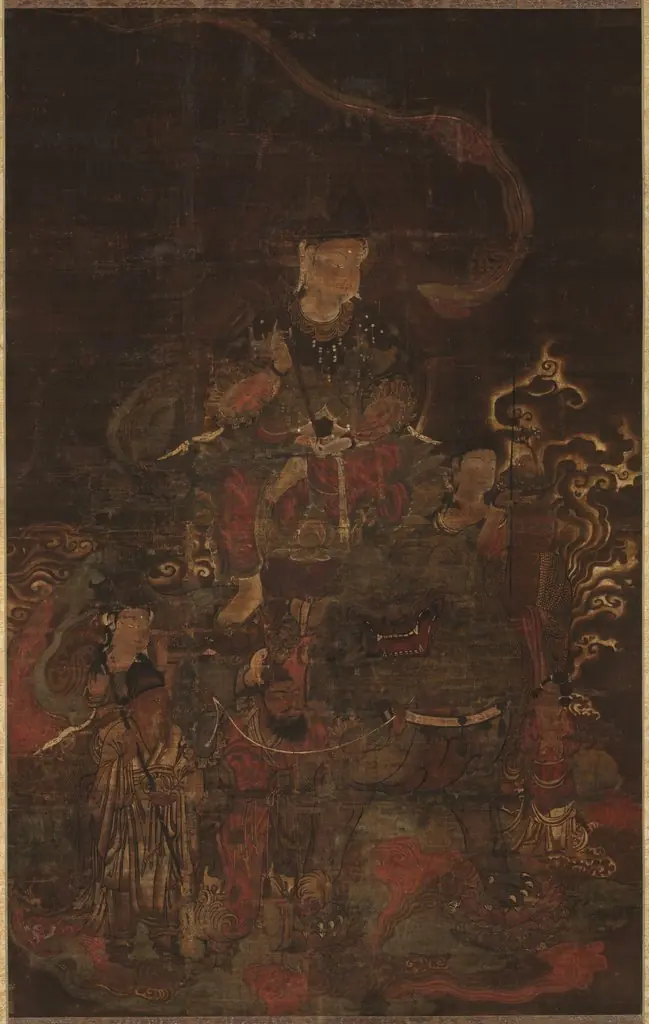 Monju Riding Lion with Attendants
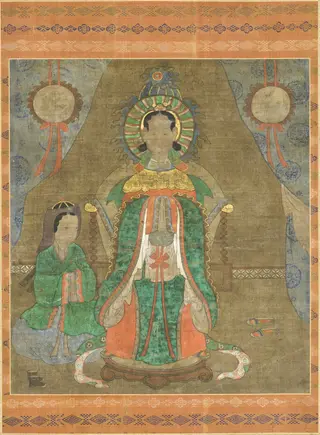 Spirit of a Noble Woman (Probably Princess Pari) and Attendant
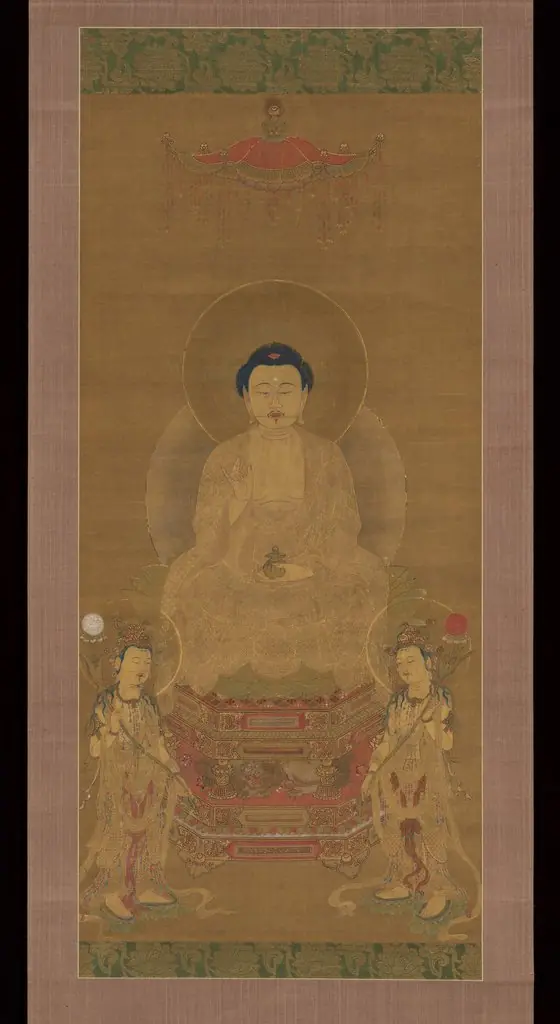 Triad of the Medicine Master Buddha Yakushi (Bhaisajya Buddha)
 Buddha Amitābha with Two Attending Bodhisattvas