Artwork
Print Collection
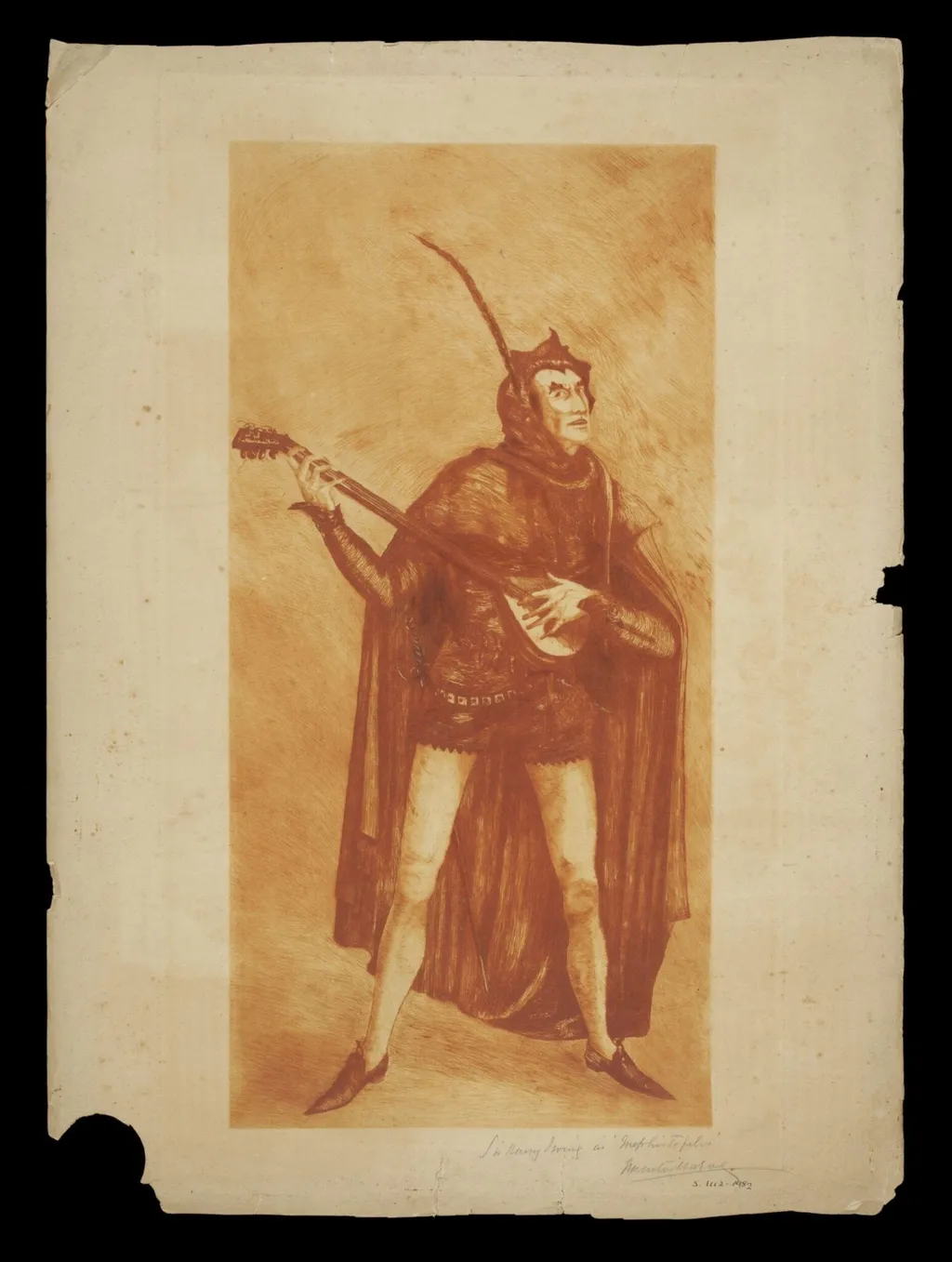
Print Collection is a print by Unknown. It dates from 1900 and is held in the collection of the Victoria and Albert Museum. This sepia-toned etching captures Henry Irving in the role of Mephistopheles from Goethe’s Faust.
About this work
Overview
This sepia-toned etching captures Henry Irving in the role of Mephistopheles from Goethe’s Faust. Created as a theatrical portrait, it translates the actor’s stage presence into a printed image using fine, hand-carved lines. The composition emphasizes dramatic contrast and psychological intensity, typical of 19th-century theatrical portraiture.
Subject & Meaning
Irving portrays Mephistopheles, the demonic figure who tempts Faust, embodying menace and intellect. The horns, flowing beard, and crimson cloak align with traditional iconography of the devil, while his piercing gaze breaks the fourth wall, implicating the viewer in the character’s seductive power. The image reflects Victorian fascination with moral ambiguity and the theatrical sublime.
Technique & Style
The image is rendered in a detailed etching technique, with hatched and cross-hatched lines modeling the actor’s angular features and textured costume. The sepia ink enhances the somber, atmospheric tone. The artist’s precision in capturing facial contours and fabric folds demonstrates a commitment to realism, even within a stylized theatrical context.
History & Provenance
The print originates from the late 19th century, during Irving’s peak fame as a leading actor at London’s Lyceum Theatre. It was likely produced to commemorate his acclaimed performance in Faust, circulating among theatre enthusiasts and collectors. The Victoria and Albert Museum holds related materials documenting this era of British theatrical culture.
Context
Irving’s portrayal of Mephistopheles was part of a broader trend in Victorian theatre that elevated Shakespearean and literary roles into grand, psychologically complex spectacles. His performances were widely documented through prints and photographs, reflecting the growing intersection of theatre and visual media as tools of cultural memory.
Legacy
This print endures as a record of Irving’s influential stage persona and the era’s visual documentation of performance. It contributes to the study of how actors were mythologized through imagery, bridging live theatre and the printed image in an age before photography dominated theatrical archives.
Artist & collection