Artwork
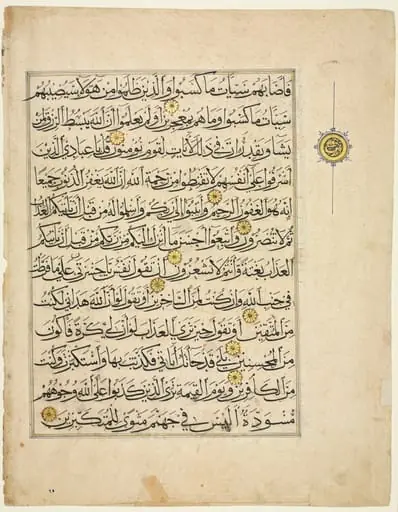
Qur'an Manuscript Folio. Left Folio of a Bifolio (verso)
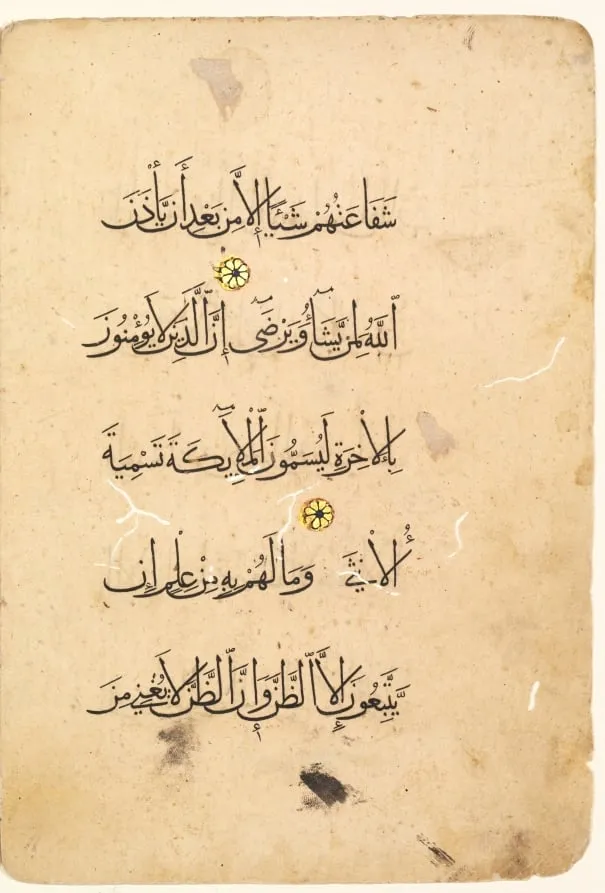
Qur'an Manuscript Folio. Left Folio of a Bifolio (verso) is a drawing by Unknown. It dates from 1400 and is held in the collection of the Cleveland Museum of Art. This folio is part of a handwritten Qur’an manuscript, likely produced during the Mamluk Sultanate period.
- Accession no.
- 1933.473.2.b
- Credit line
- Edward L. Whittemore Fund
About this work
Overview
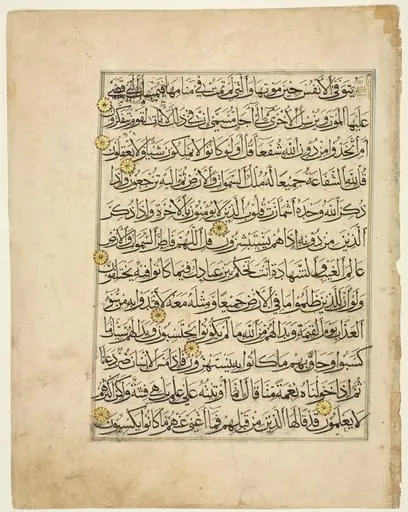
Decorative golden circular motifs, each with star-like centers, are placed between lines, serving as visual markers for textual divisions.
This folio is part of a handwritten Qur’an manuscript, likely produced during the Mamluk Sultanate period. The verso side features densely arranged black Arabic script in horizontal lines, meticulously copied onto aged paper showing signs of wear, faint staining, and minor tears. Decorative golden circular motifs, each with star-like centers, are placed between lines, serving as visual markers for textual divisions.
Subject & Meaning
The text contains verses from the Qur’an, written in a clear, legible hand for liturgical or devotional use. The golden circles function as verse separators, aiding recitation and structural navigation. Their placement reflects a tradition of integrating aesthetic elements into sacred texts, enhancing spiritual focus without altering the sanctity of the words.
Technique & Style
The script is executed in a standardized cursive hand, typical of Mamluk-era Qur’anic copying. Ink is applied with precision, and the gold dots are applied using metallic pigment, likely applied with a fine brush or stylus. The paper, though worn, retains its structural integrity, suggesting high-quality materials and careful handling over centuries.
History & Provenance
This folio was likely part of a larger manuscript produced in a royal or elite scriptorium under Mamluk patronage. Its survival indicates it was preserved in a religious or scholarly context, possibly in a mosque, madrasa, or private collection. The wear and stains suggest regular use in ritual recitation before being separated and archived.
Context
During the Mamluk Sultanate, Qur’an manuscripts were central to religious life and artistic expression. Commissioned by rulers and elites, these texts combined calligraphic excellence with subtle ornamentation. The use of gold markers aligned with broader Islamic traditions of honoring sacred text through refined craftsmanship and restrained decoration.
Legacy
This folio exemplifies the enduring practice of Islamic book arts, where textual fidelity and visual harmony coexisted. Its survival offers insight into medieval scribal methods and devotional habits. Today, such fragments serve as material witnesses to the transmission of religious knowledge and the cultural value placed on handwritten scripture.
![Qur'an Manuscript Folio (recto; verso) [Right side of Bifolio]](https://artifactworldgallery.com/img/unknown--qur-an-manuscript-folio-recto-verso-right-side-of-bifolio--0873974e1864806f-w320.webp)
Artist & collection