Artwork
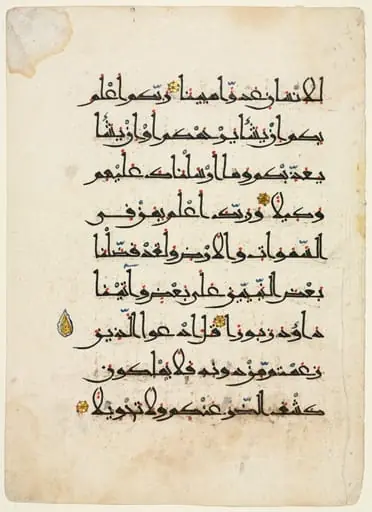
Folio from a Qur'an (recto)
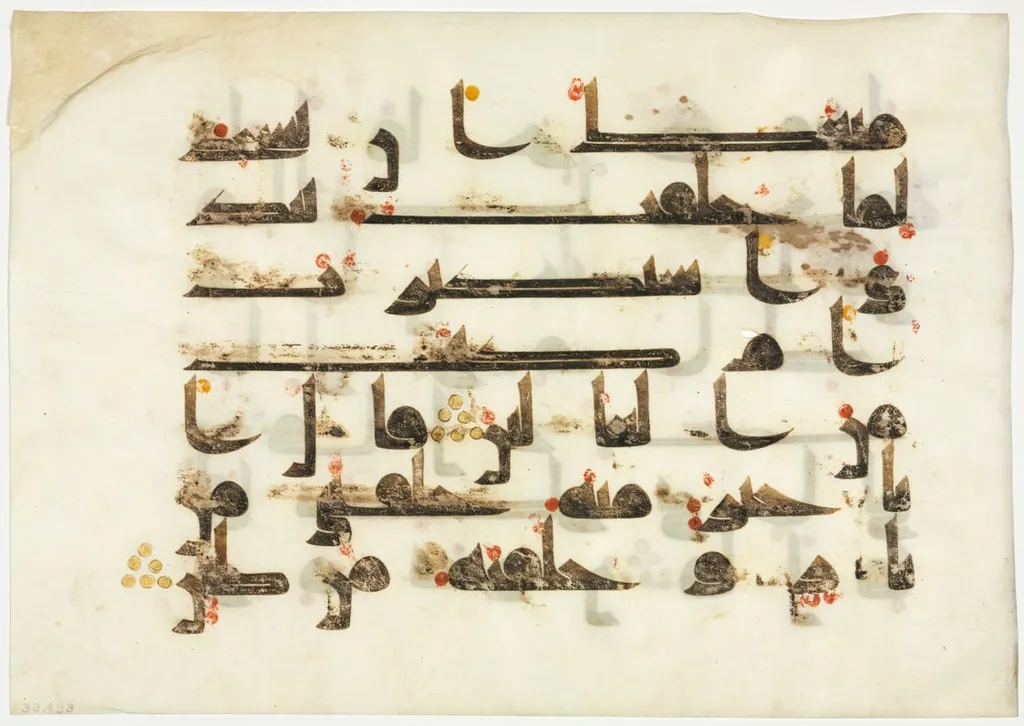
Folio from a Qur'an (recto) is a drawing by Unknown. It dates from 850 and is held in the collection of the Cleveland Museum of Art.
- Accession no.
- 1933.493.a
- Credit line
- Edward L. Whittemore Fund
About this work
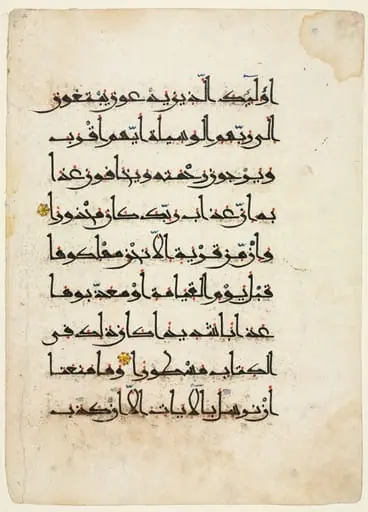
You see a single page from an old Qur’an, filled with tall, angular Arabic letters in black ink on cream-colored parchment.
You see a single page from an old Qur’an, filled with tall, angular Arabic letters in black ink on cream-colored parchment.
This page uses Kufic script, the earliest style of Arabic calligraphy. The letters are spaced wide apart, giving the words room to breathe. Muslims believe the Qur’an holds God’s exact words, so scribes treated the text with great care.
To see more pages like this, look up the subject Abbasid period (750–1258).
Overview
This folio is part of an early Qur'anic manuscript, produced during the Abbasid period using Kufic script, the earliest standardized form of Arabic writing for sacred texts. Written on parchment in black ink, the text is arranged in a broad horizontal format, allowing the angular, elongated letters to extend with deliberate spacing. The script’s formality reflects the reverence accorded to the divine revelation, with minimal decoration beyond functional markers.
Subject & Meaning
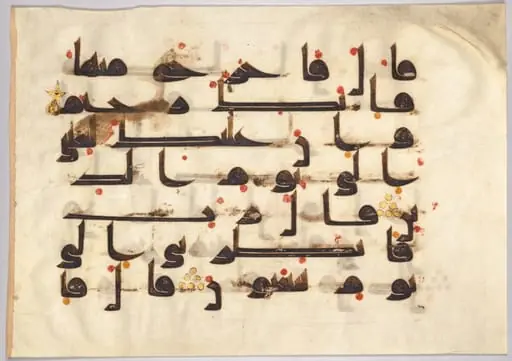
The recto contains verses depicting the confrontation between God and Iblis (Lucifer), who refuses to bow to Adam, claiming superiority due to his fiery origin versus humanity’s clay. This narrative underscores a central theological theme: the sin of pride and the absolute authority of divine will. The verses on the verso describe Iblis’s expulsion, reinforcing the consequence of disobedience. The text’s clarity and precision emphasize its role as unaltered revelation.
Technique & Style
Kufic script, characterized by rigid verticals and horizontal extensions, was employed here with meticulous control. Letters are spaced generously, enhancing legibility and visual rhythm. Red dots indicate short vowels, while gold triangles mark verse endings, functional elements that aid recitation without ornamental excess.
The ink, applied with steady hand on prepared parchment, reveals the scribe’s discipline and the manuscript’s liturgical purpose.
History & Provenance
Produced between the 8th and 10th centuries, likely in a major Abbasid center such as Baghdad or Samarra, this folio belongs to a tradition of early Qur'anic production that prioritized textual accuracy over decoration. Its survival suggests it was carefully preserved, possibly in a religious institution or private collection. The use of gold and high-quality parchment indicates it was commissioned by a patron of means, though no specific provenance beyond its Abbasid origin is documented.
Context
During the Abbasid era, the Qur'an became a focal point of cultural and religious identity. The standardization of Kufic script coincided with efforts to preserve the text uniformly across the expanding Islamic world. Calligraphy was not merely artistic but theological: the written word embodied divine presence.
This folio reflects a period when scribal practice was tightly regulated to ensure fidelity to the revealed text.
Legacy
This folio exemplifies the foundational phase of Islamic book culture, where calligraphy established itself as the primary medium for conveying sacred text. Later styles evolved toward greater fluidity, but Kufic remained a symbol of authenticity and antiquity. Surviving fragments like this one continue to inform scholarly understanding of early Qur'anic transmission and the material culture of Islamic devotion.
Artist & collection









- Folio from a Qur'an
 Folio from a Qur'an (verso)
 Qur'an Manuscript Folio
 Leaf from a Qur'an (verso)
![Qur'an Manuscript Folio (recto) [Right side of Bifolio], by Unknown](https://artifactworldgallery.com/img/unknown--qur-an-manuscript-folio-recto-right-side-of-bifolio--c1fa5781f1fa5bcd-w320.webp) Qur'an Manuscript Folio (recto) [Right side of Bifolio]
Qur'an Manuscript Folio (recto) [Right side of Bifolio]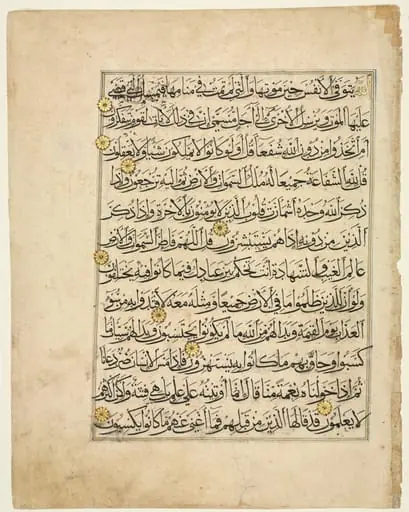 Qur'an Manuscript Folio (recto)
![Qur'an Manuscript Folio (recto; verso) [Left side of Bifolio], by Unknown](https://artifactworldgallery.com/img/unknown--qur-an-manuscript-folio-recto-verso-left-side-of-bifolio--7b560e06b8af0905-w320.webp) Qur'an Manuscript Folio (recto; verso) [Left side of Bifolio]
Qur'an Manuscript Folio (recto; verso) [Left side of Bifolio]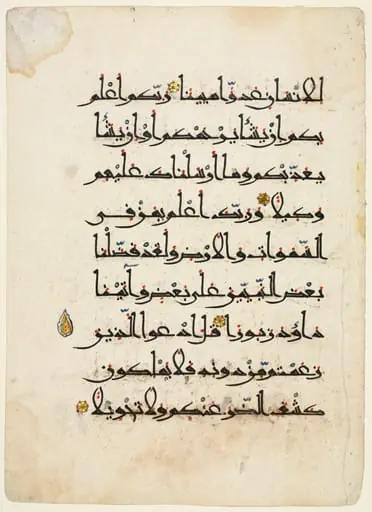 Leaf from a Qur'an (recto)
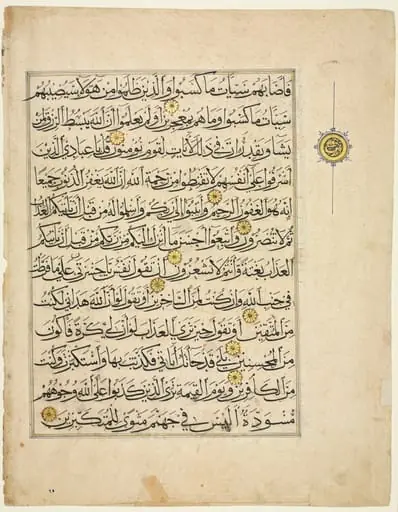 Qur'an Manuscript Folio (verso)
![Qur'an Manuscript Folio (recto; verso) [Right side of Bifolio], by Unknown](https://artifactworldgallery.com/img/unknown--qur-an-manuscript-folio-recto-verso-right-side-of-bifolio--0873974e1864806f-w320.webp) Qur'an Manuscript Folio (recto; verso) [Right side of Bifolio]
Qur'an Manuscript Folio (recto; verso) [Right side of Bifolio]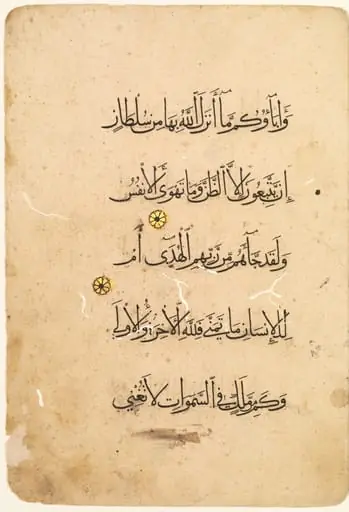 Qur'an Manuscript Folio (recto) (left side of bifolio)
 Leaf from a Qur'an