Artwork
Saint Erasmus
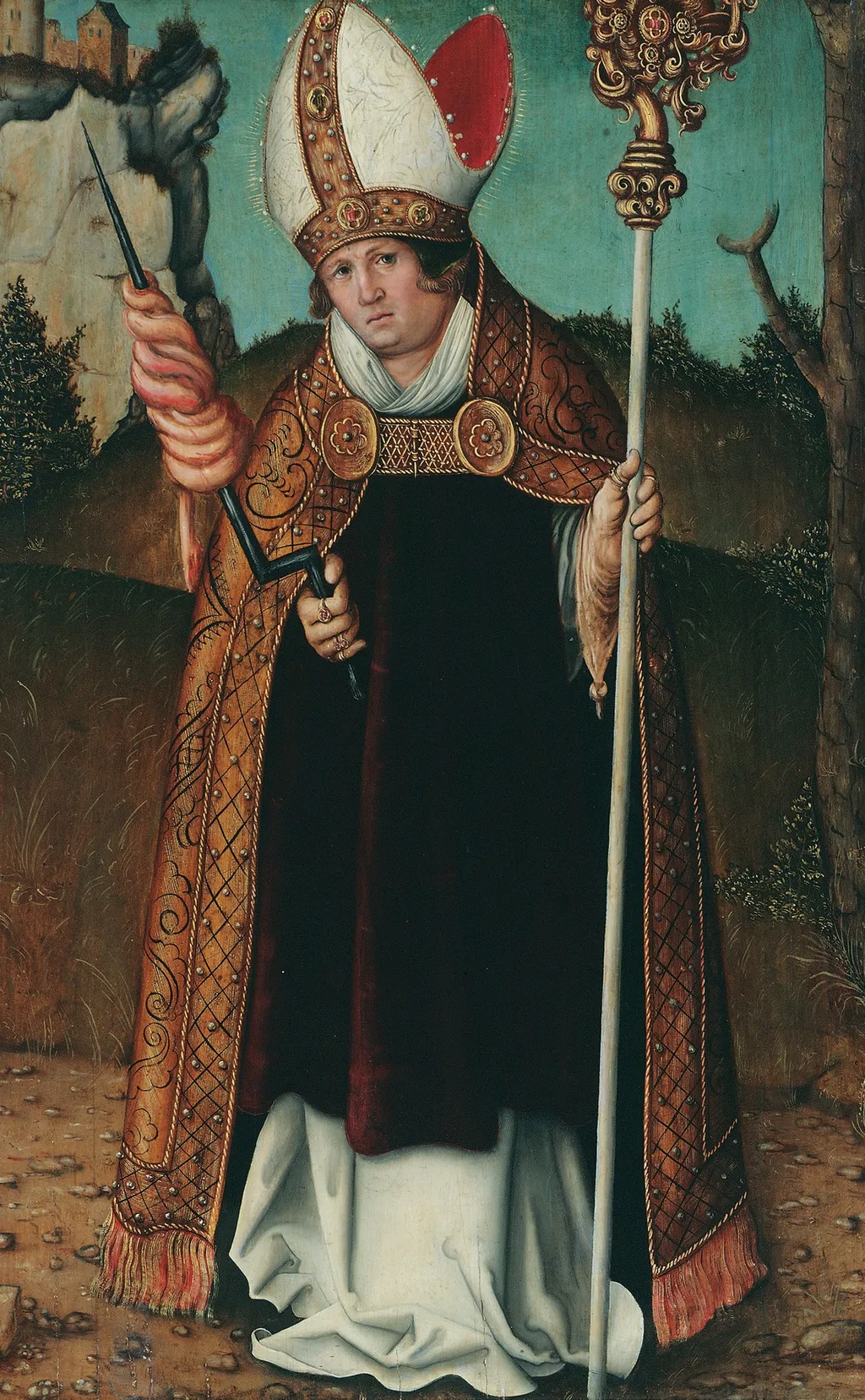
Saint Erasmus is an unspecified painting by the High Renaissance artist Unknown. It dates from 1510 and is held in the collection of the Kunsthistorisches Museum.
About this work
Overview
5 by 46 centimeters, depicting the early Christian bishop and martyr Erasmus of Formiae.
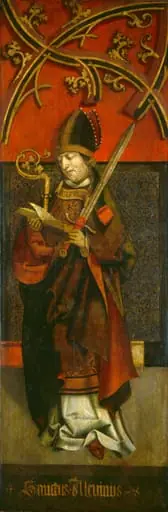
Saint Erasmus is an oil painting on panel dated to 1510, measuring 68.5 by 46 centimeters, depicting the early Christian bishop and martyr Erasmus of Formiae. The work is attributed to the Donauländischer Maler, a follower of Lucas Cranach the Elder, and is held in the collection of the Belvedere, Kunsthistorisches Museum in Vienna. As a devotional image from the early sixteenth century, it exemplifies the Northern European tradition of saint portraiture at a moment when the cult of the Fourteen Holy Helpers remained strong and the visual culture of the Reformation was beginning to take shape.
Subject & Meaning
The painting depicts Erasmus of Formiae, also known as Saint Elmo, an early Christian martyr who died circa 303 and was venerated as one of the Fourteen Holy Helpers. In the image, the saint appears as a vested bishop rather than in the throes of martyrdom. He wears a tall white mitre with gold ornament and a red panel at the back, and an elaborate gold cope with black lattice pattern and swirling motifs over a dark robe and white undergarment. His right hand holds a black T-shaped object, while his left hand grips a tall, ornate crozier with gold curving top and silver shaft. This presentation emphasizes his episcopal authority rather than his legendary disembowelment. The background shows a teal sky above a dark green treeline, with a rocky outcrop and small castle to the left and a tree trunk with cut branches to the right. The iconography draws on Erasmus's widespread cult as patron saint of sailors and those suffering from abdominal ailments, though the painting notably avoids the more gruesome attributes, the windlass and entrails, that became common in later depictions of his martyrdom.
Technique & Style
The panel is executed in oil with smooth, precise brushwork in the face and fabrics, and more textured handling in the landscape areas. Light falls from the upper left, modeling the face and hands with soft shadows. The palette is dominated by gold, black, white, teal, and brown. Fine detail appears in the gold threads and jewels of the cope, while the finish is generally polished with visible craquelure throughout. The figure fills most of the vertical panel, creating a commanding, hieratic presence typical of early sixteenth-century Northern European devotional panels. The combination of meticulous textile rendering with a relatively simplified landscape background accords with the stylistic orbit of Lucas Cranach the Elder and his workshop, though the specific handling suggests the work of a follower rather than the master himself.
History & Provenance
The painting is dated to 1510, a period when Lucas Cranach the Elder was establishing his workshop in Wittenberg and his influence was spreading throughout the Danube region. The attribution to the Donauländischer Maler, or Danubian Painter, places the work within a circle of artists working in the wake of Cranach's early style. The panel entered the collection of the Belvedere, Kunsthistorisches Museum in Vienna, where it remains today. No specific commission records or early ownership history have been documented in the available sources.
Legacy
While the specific later influence of this particular panel has not been extensively documented, the image of Saint Erasmus maintained remarkable currency in European art. The saint's martyrdom, particularly the scene of disembowelment with the windlass, became an increasingly common subject as artists gained greater anatomical knowledge and as the Counter-Reformation promoted more emotionally compelling religious imagery. Nicolas Poussin's Martyrdom of Saint Erasmus, painted for Saint Peter's Basilica in the Vatican in the 1620s, represents the most famous artistic treatment of the subject, with a copy serving as the altarpiece of the altar dedicated to Erasmus in the north transept. The present painting's more restrained, portrait-like presentation of the saint as bishop rather than martyr preserves an earlier devotional mode, one that would gradually be supplanted by more dramatic narrative treatments. The work remains significant as a document of the Cranach circle's engagement with traditional saint cults on the eve of the Reformation, when the veneration of such intercessory figures would become contested.
Artist & collection