Artwork
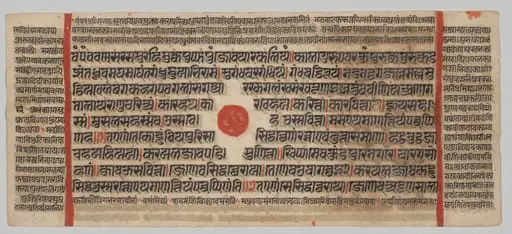
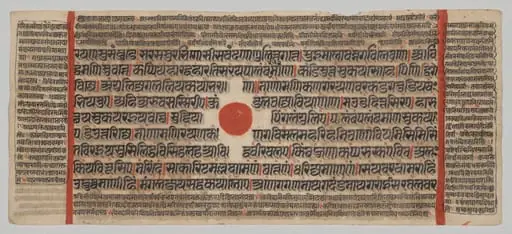
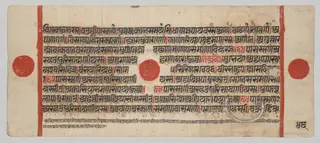
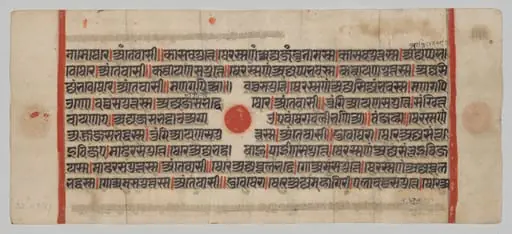
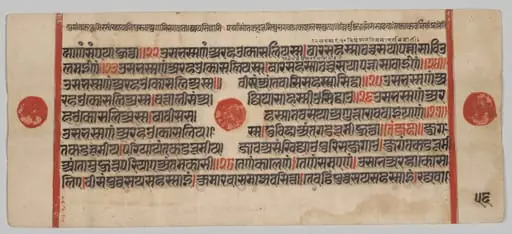
Text, Folio 37 (recto), from a Kalpa-sutra
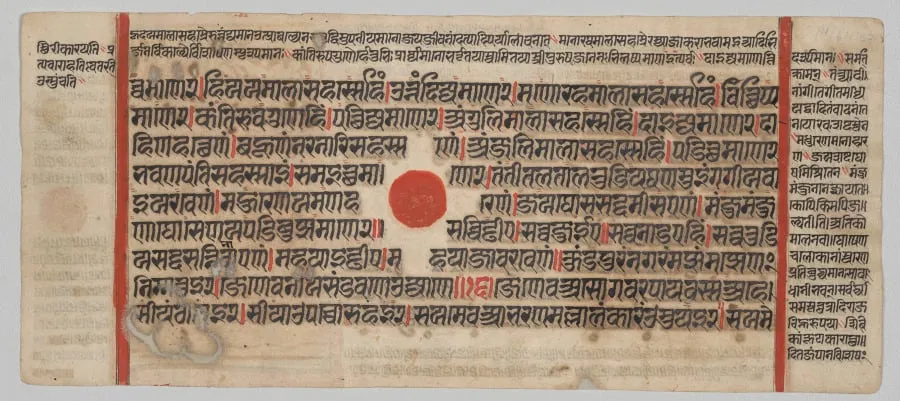
Text, Folio 37 (recto), from a Kalpa-sutra is an unspecified painting by the Mughal Painting artist Unknown. It dates from 1488 and is held in the collection of the Cleveland Museum of Art. This folio comes from a manuscript of the Kalpa-sutra, a sacred Jain text detailing the lives of the Tirthankaras.
- Accession no.
- 1932.119.37.a
- Credit line
- Edward L. Whittemore Fund
About this work
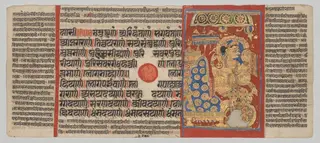
The artist shows the moment of pain and determination, his chest muscles tight, his face calm.
You see a man pulling out his own hair in big handfuls under a red tree. Gods watch from above, their blue skin glowing against a gold sky.
This is a scene from a Jain holy book, painted in Gujarat around 1490. The man is Mahavira, a spiritual leader who gave up his royal life. The artist shows the moment of pain and determination, his chest muscles tight, his face calm.
To see more work like this, look up western india, gujarat, last quarter of the 15th century.
Overview
This folio comes from a manuscript of the Kalpa-sutra, a sacred Jain text detailing the lives of the Tirthankaras. Created in Gujarat during the late 15th century, the painting illustrates a pivotal moment in Mahavira’s spiritual journey: his renunciation of worldly life. Executed in tempera and gold on paper, it reflects the regional style of western Indian manuscript illumination, characterized by vivid pigments and intricate linear detail.
Subject & Meaning
The scene depicts Mahavira, the 24th Tirthankara, severing his last ties to royalty by plucking out his hair in five handfuls, an act of ascetic commitment. His calm expression contrasts with the physical strain evident in his tensed muscles, underscoring inner resolve. Above him, Indra, the divine king, observes from beneath a canopy, acknowledging the spiritual significance of the act. The moment symbolizes the rejection of material identity in pursuit of enlightenment.
Technique & Style
The artist employs fine, energetic lines to define form and movement, emphasizing the tension in Mahavira’s body and the texture of his hair. Pigments derived from lapis lazuli, vermilion, and gold leaf create a luminous, almost otherworldly atmosphere. The flat, decorative background and hierarchical scaling, Indra smaller yet elevated, follow conventions of western Indian painting, prioritizing symbolic clarity over naturalistic space.
History & Provenance
This folio was produced in Gujarat during the final quarter of the 15th century, likely for a Jain lay patron or monastic community. Manuscripts of the Kalpa-sutra were commissioned for ritual recitation and veneration. The use of expensive materials like gold and lapis suggests the patron’s wealth and devotion.
The work survives as part of a larger codex, now dispersed across collections, with this leaf held in a major institutional archive.
Context
Jain communities in medieval Gujarat actively supported manuscript production as an act of religious merit. The Kalpa-sutra, recited during the Paryushana festival, was often richly illustrated to aid contemplation. This image aligns with broader Jain artistic traditions that emphasize nonviolence, self-discipline, and the transcendence of the physical body, rendering spiritual acts with intense visual focus.
Legacy
The folio exemplifies the enduring influence of Jain manuscript painting in western India, where stylistic conventions persisted for centuries. Its precise line work and symbolic use of color informed later regional styles. Though no longer used in liturgical practice, such works remain vital to understanding Jain visual theology and the material culture of medieval Indian religious communities.
Artist & collection