Artwork
The daughter-in-law of the king of Banaras, charmed by the music of a vagabond, comes down to meet him, from a Tuti-nama (Tales of a Parrot): Sixteenth Night
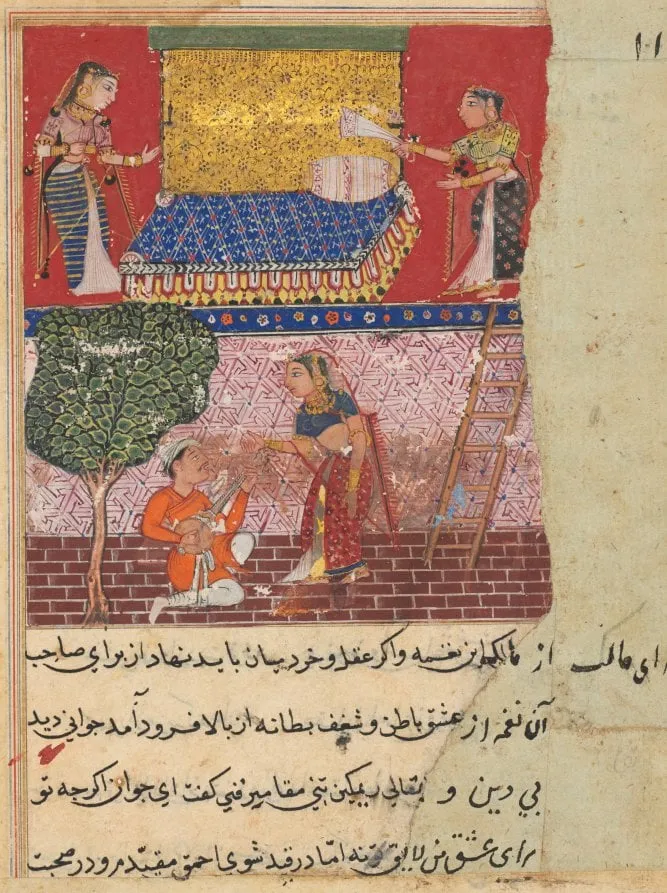
The daughter-in-law of the king of Banaras, charmed by the music of a vagabond, comes down to meet him, from a Tuti-nama (Tales of a Parrot): Sixteenth Night is an unspecified painting by the Mughal Painting artist Unknown. It dates from 1560 and is held in the collection of the Cleveland Museum of Art. This painting illustrates a scene from the Tuti-nama, a collection of tales.
- Accession no.
- 1962.279.119.b
- Credit line
- Gift of Mrs. A. Dean Perry
About this work
The stories were meant to entertain, but they also showed how people lived and loved in Mughal India.
A woman in a gold-trimmed robe climbs down a ladder from her palace window. Below, a musician with a rebab sings under a tree. The right side of the painting is patched, someone fixed it long ago.
This is one page from a Tuti-nama, a book of parrot tales told to Emperor Akbar. The stories were meant to entertain, but they also showed how people lived and loved in Mughal India. The ladder is a quiet detail, it lets the woman sneak out without being seen.
To see more paintings like this, look up Mughal India, court of Akbar (reigned 1556–1605).
Overview
This painting illustrates a scene from the Tuti-nama, a collection of tales. It depicts a princess descending a ladder to meet a musician in the courtyard below.
Subject & Meaning
The scene shows a princess, dissatisfied with her husband, enticed by a vagabond musician playing a rebab. The narrative is part of a larger story told across multiple pages of the Tuti-nama.
Technique & Style
The artwork features intricate details, such as the gold trim on the princess's robe. The composition includes a ladder connecting the palace window to the courtyard, where the musician performs under a tree.
History & Provenance
The painting is one page from a Tuti-nama created for Emperor Akbar. Damage to the right side was repaired, likely in the early 19th century.
Context
The Tuti-nama was intended to entertain, while also offering insights into life and relationships in Mughal India during Akbar's reign.
Artist & collection









 The daughter-in-law of the king of Banaras, charmed by the music of a vagabond, comes down to meet him, from a Tuti-nama (Tales of a Parrot): Sixteenth Night
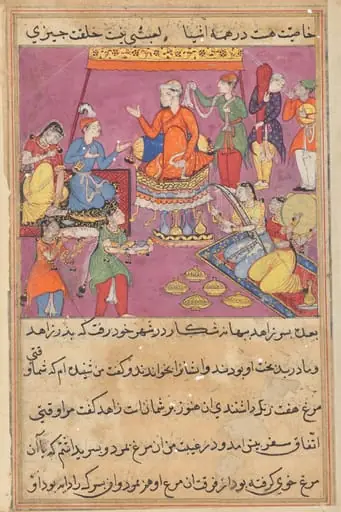 The king gives his daughter in marriage to the pious man’s son, from a Tuti-nama (Tales of a Parrot): Fifty-second Night
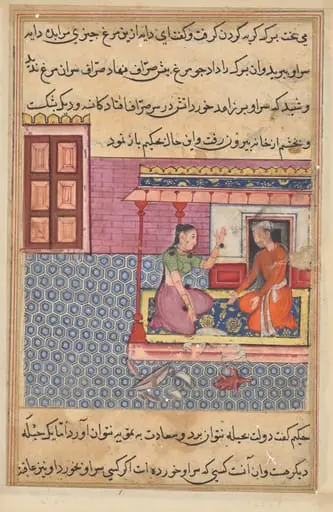 The pious man’s wife offers the seven-colored bird as food to her lover, but not finding its head, he breaks the pot and bowl in anger, from a Tuti-nama (Tales of a Parrot): Fifty-second Night
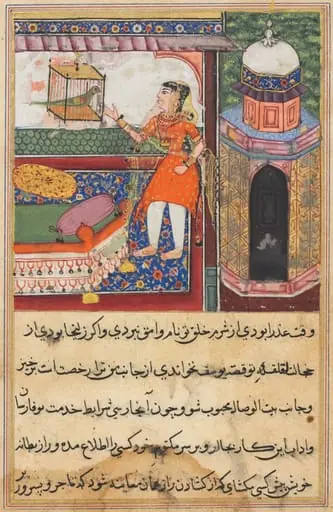 The Parrot Addresses Khujasta at the Beginning of the Tenth Night, from a Tuti-nama (Tales of a Parrot)
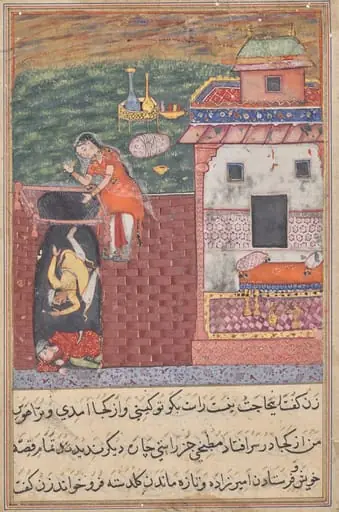 The two cooks, who attempt to seduce the warrior’s loyal wife, are trapped by her in a cellar, from a Tuti-nama (Tales of a Parrot): Fourth Night
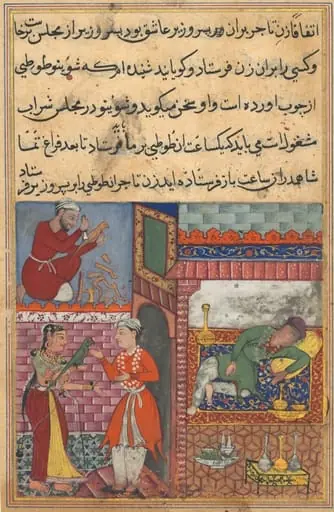 The vizier’s son receives the magic wooden parrot from the wife of the merchant, who is drunk, and has a replica made by a carpenter, from a Tuti-nama (Tales of a Parrot): Tenth Night
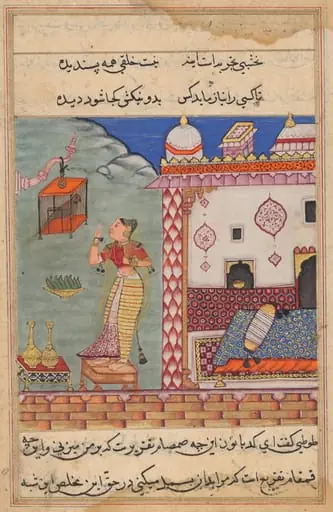 The Parrot Addresses Khujasta at the Beginning of the Twenty-seventh Night, form a Tuti-nama (Tales of a Parrot)
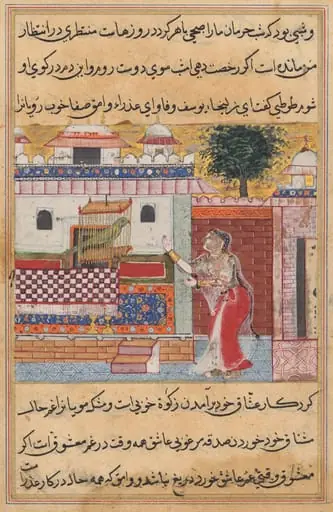 The Parrot Addresses Khujasta at the Beginning of the Twelfth Night, from a Tuti-nama (Tales of a Parrot)
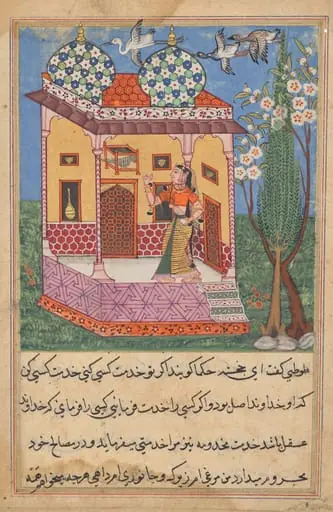 The Parrot Addresses Khujasta at the Beginning of the Twenty-sixth Night, from a Tuti-nama (Tales of a Parrot)
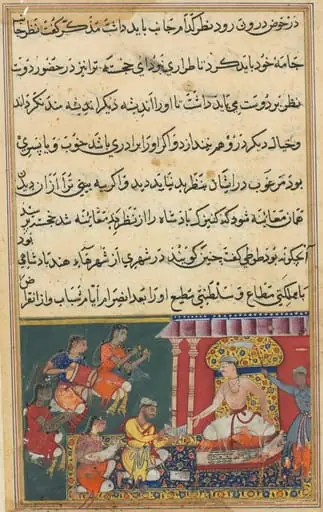 The astrologer predicts a calamity for the newly born prince in his thirteenth year, but one which he would be able to overcome, from a Tuti-nama (Tales of a Parrot): Eighth Night